
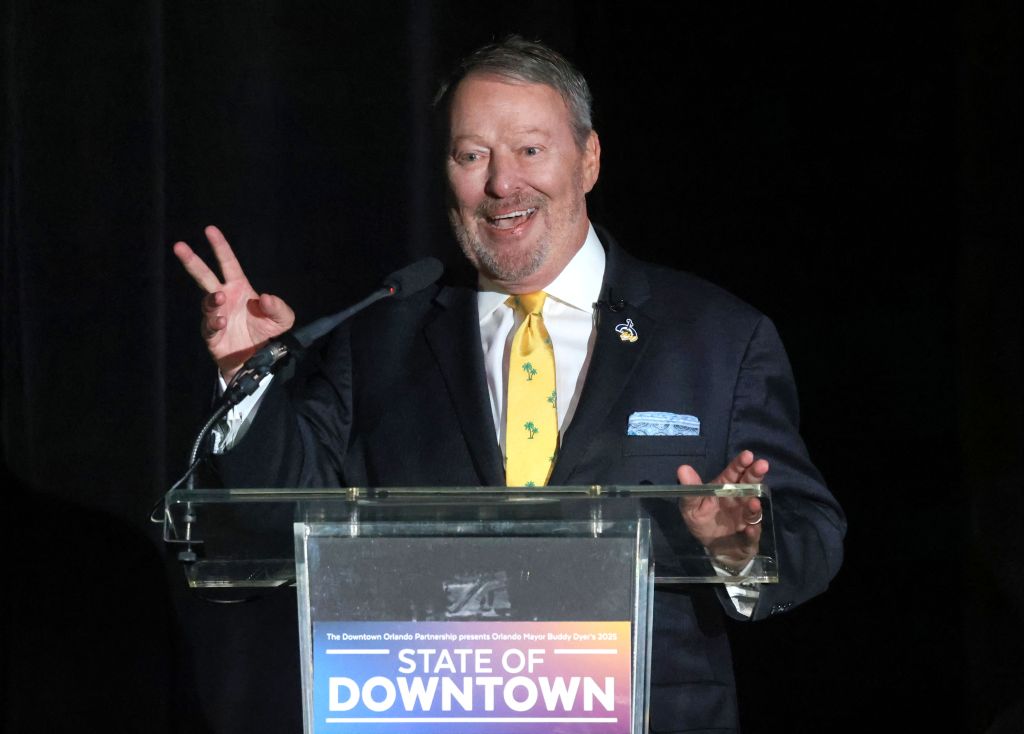
A potential multi-billion-dollar development is in the early stages of planning on the prominent site of the Orlando Sentinel’s former headquarters, which Mayor Buddy Dyer said would be a catalyst for the downtown economy.
The 20-acre property on Orange Avenue at Colonial Drive has sat dormant since the newspaper left it in 2020. The site’s owner, Richard Perez, announced at Dyer’s annual State of Downtown on Tuesday that his Midtown Development is working with a renowned architect to move the site forward.
“That’s been the missing hole in the middle of downtown,” Dyer said. “When you fill that hole, it’s going to spread all around to the north and south.”
Details are scarce for the two-city-block site, Perez said. Nothing has been formally proposed, though a video shown during the presentation promised room for residences, businesses and “nature.”
Perez said the development could take 20 years to be fully built, and that his company secured a commitment from Heatherwick Studios in London – designers of Little Island in New York City, Google’s headquarters in California and numerous other venues across Europe, Asia and Africa – to design it.
“Why not Orlando?” Perez said, ticking off billions of dollars of investment in cities like Miami, West Palm Beach and Tampa in the works. “We’re just absolutely bullish about this project, and about the future of Orlando.”
The annual gathering of corporate executives on the floor of the Kia Center doubles as a fundraiser for the Downtown Orlando Partnership, which counts about 300 corporate members.
Dyer was joined on stage by developer Craig Ustler, restaurateur Jason Chin, United Arts CEO Jennifer Evans and Perez. While discussion ventured into the role the arts and food have on downtown’s future, talk of future uses for the 633 North Orange Avenue property dominated the conversation.
It was home to the Orlando Sentinel for 69 years. The entire campus was sold by the Sentinel’s then-parent company Tribune Publishing in 2016 for $35.1 million to Midtown Opportunities.
The newspaper vacated the campus in October 2020 amid the pandemic, after shuttering its printing operation in a building on the site in 2017. Midtown Development sued the newspaper in 2020 over unpaid rent — though ultimately the legal action was dropped a year later.
Dyer said next year could see the remaining building’s demolition, “which quite honestly I know you worked in that building for a long time but I think that would be momentum for all of downtown if we just took down that building.”
Because of the property’s size and prime location as a northern gateway into the Central Business District fronting Colonial Drive near Interstate 4, it’s long been eyed by city officials as a signature redevelopment opportunity.
Dyer contended that the new plan for the Sentinel site, along with the giant sport-and-entertainment Westcourt planned west of the Kia Center and the remaining construction slated for Creative Village, display the strength of downtown’s future – even amid criticism in recent years related to gun violence, and too few restaurants and family-friendly amenities.
In a video played during the panel discussion, Thomas Heatherwick, founder of the London-based design studio, said the future development would include nature, thousands of residences, space for families and dozens of new businesses to bring something unique.
“The Orlando Sentinel site is an opportunity to create an amazing new district,” he said. “We’re so used to places feeling like their versions of somewhere else, rather than being their own unique place.”