
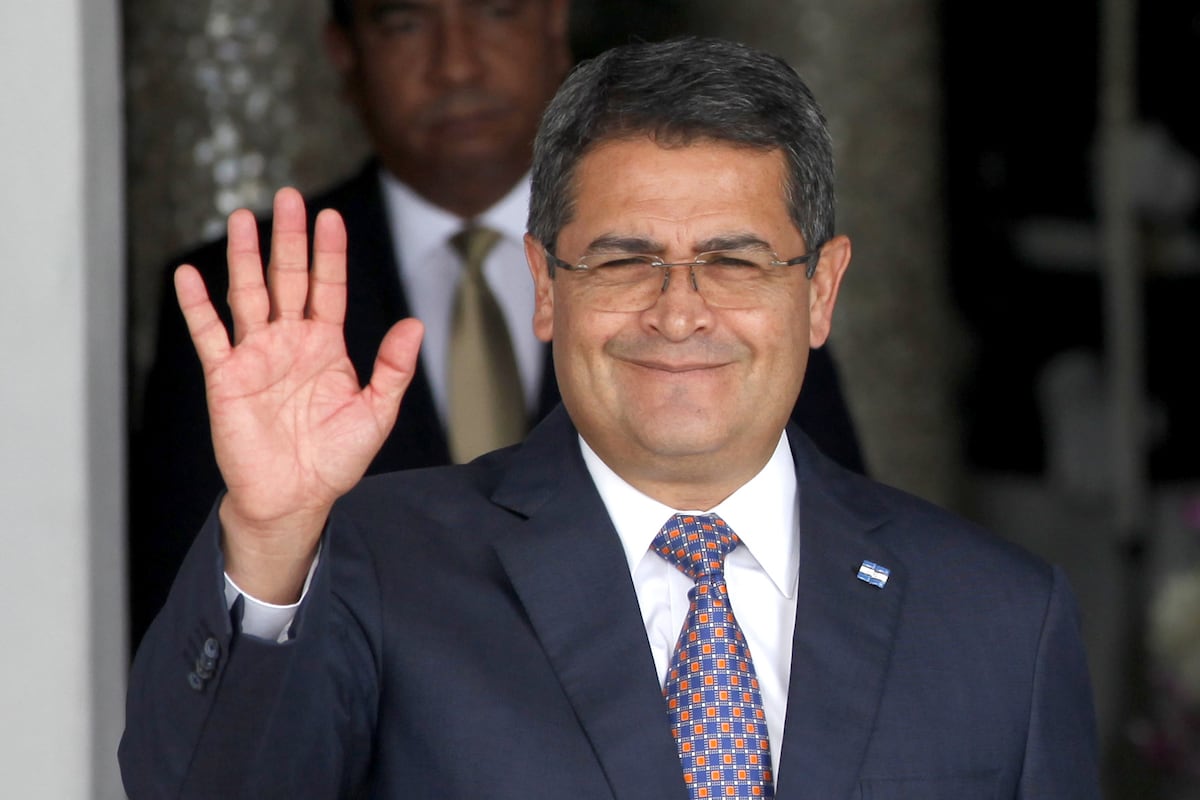
Juan Orlando Hernández, 58, left the Hazelton maximum-security prison in West Virginia on Monday, where he had been serving a 45-year sentence for his ties to drug trafficking. Hernández, who was president of Honduras between 2014 and 2022, was released thanks to a pardon from U.S. President Donald Trump, who also tried to influence last Sunday’s presidential election in the Central American country by endorsing the conservative candidate Nasry “Tito” Asfura, who belongs to the same political party as Hernández.
Hernández, a lawyer and notary by trade, was convicted in June 2024 by Judge Kevin Castel of the Federal District Court in New York for conspiring for over a decade with drug traffickers who paid him bribes to ensure that more than 400 tons of cocaine reached the United States. JOH, as the former Honduran politician is popularly known, had been found guilty of conspiring to import cocaine into the United States and possessing an arsenal of machine guns and other firearms, including AK-47 and AR-15 rifles and grenade launchers, that would be the envy of any army. The evidence was so overwhelming, according to the judges, that the trial lasted only two weeks.
The trial against JOH was highly controversial in Honduras, but also in Washington. During his years in power, Hernández had been a staunch ally of the White House. He ostensibly collaborated in the fight against drug trafficking, but in reality, he was exploiting his influence in the Central American country to ensure that the police, the military, and the judges turned a blind eye while he conducted business with drug traffickers. During his presidency, Honduras received more than $50 million from the U.S. administration to combat drug trafficking. The White House also authorized tens of millions of dollars for military aid and security in Honduras. Following the indictment, the Department of Justice began to consider the Caribbean nation a narco-state.
Trump’s pardon comes despite numerous signs linking JOH to drug trafficking. His brother, Juan Antonio, with whom he maintained a close relationship, was convicted four years ago by the same New York court for his ties to Honduran drug cartels. While JOH was still in power, the Manhattan District Attorney’s office accused him of receiving one million dollars from Mexican drug lord Joaquín “El Chapo” Guzmán.
Beyond the money trail, prosecutors gathered testimony from other drug traffickers in the local cartel Los Cachiros, revealing JOH’s activities as a key piece of the drug trafficking machine. The court documents on which the conviction was based state that Hernández was “at the center of one of the largest and most violent drug-trafficking conspiracies in the world.” In that trial, in which JOH always maintained his innocence, the prosecution argued that he abused his powerful positions and authority in Honduras to facilitate the importation of more than 400 tons of cocaine into the United States. Prosecutors also said that “Hernández’s co-conspirators were armed with machine guns and destructive devices, including AK-47s, AR-15s, and grenade launchers, which they used to protect their massive cocaine loads as they transited across Honduras on their way to the U.S., protect the money they made from the eventual sale of this cocaine, and guard their drug-trafficking territory from rivals.”
The arrest of Juan Orlando Hernández was like something right out of a movie. He only enjoyed 18 days of freedom as the former president of Honduras. After handing over the presidency to Xiomara Castro at the end of January 2022, the politician was arrested at his home, and the extradition process began. U.S. prosecutors summarized the case as “state-sponsored drug trafficking” because Hernández was part of “a violent drug trafficking conspiracy” that smuggled some 500,000 kilos of cocaine through Honduras into the United States. It was a major blow for a man who defined himself as an unconditional ally of the United States.
Hernández assumed the presidency of Honduras in 2014. His government claimed to maintain a close relationship with Washington in the fight against drug trafficking, for which Honduras received cooperation and support in combating drugs and migration. The president boasted of implementing a hardline policy against crime, which was soon tarnished by increasingly persistent accusations. In the letter he wrote to Trump requesting a pardon, he claimed that “Classified and unclassified documents held by multiple U.S. agencies, including the State Department, Southern Command, DEA, CIA, the Treasury Department, and Homeland Security, attest to the unprecedented cooperation I maintained with your Administration in dismantling cartels, extraditing drug traffickers to the United States, and combating organized crime.”
In the letter, Hernández blames the prosecutors who accused him for disregarding this evidence despite my having been praised for “unprecedented measures, historic results, and constant cooperation with U.S. agencies in the fight against drug trafficking and organized crime,” he wrote. Prosecutors, however, maintained that the then-president and his inner circle had used state structures—police, military, and public institutions—to facilitate drug trafficking networks. The Justice Department charged him with conspiracy to import cocaine into the United States and firearms-related offenses. “As President of Honduras, Juan Orlando Hernandez abused his power to support one of the largest and most violent drug trafficking conspiracies in the world, and the people of Honduras and the United States bore the consequences,” stated Attorney General Merrick B. Garland.
Critics of Hernández denounced electoral manipulation during his tenure, as well as bribes of public officials and systemic corruption during his presidency, asserting that part of his government’s power rested on pacts with drug traffickers. Despite the Honduran Constitution’s absolute prohibition against a second term, Hernández managed to circumvent the law to win the 2017 elections. A similar attempt by Manuel Zelaya to violate this constitutional prohibition led to a coup, after which he was ousted in 2009.
In April 2015 Hernández managed to have the Constitutional Chamber of a Supreme Court aligned with the government declare the article prohibiting reelection inapplicable, arguing that it violated the human rights of the president and other officials. This favorable interpretation enabled him to compete in the elections without the need for constitutional reforms.
The elections held in November 2017 took place in a climate of polarization and much uncertainty during the preliminary vote count, which initially gave an advantage to the opposition candidate Salvador Nasralla, himself now a frontrunner in the most recent presidential election held last Sunday.
The most striking thing about those elections is that the results transmission system crashed for more than 24 hours, and when it came back online, Hernández started climbing in the polls until he emerged as the winner.
The OAS observation mission stated that the process was so riddled with irregularities that they could not guarantee a reliable result and recommended new elections. Electoral authorities, however, ratified Hernández’s victory.
His second term was plagued by allegations of links between his government, and even his brother, Tony Hernández, and organized crime. Tony was sentenced to life imprisonment in March 2021 by a New York judge after being found guilty by jury. He faced four charges brought by the U.S. Department of Justice related to drug trafficking, including the shipment of tons of cocaine to the United States. In Honduras, meanwhile, public discontent grew due to the corruption scandals that plagued his presidency.
One of the most notorious cases was that of the Honduran Social Security Institute (IHSS), which suffered an embezzlement of more than $200 million. Journalism investigations revealed that part of that money was used to finance the electoral campaign of the National Party, of which Hernández is a member.
Furthermore, the so-called Mission to Support the Fight against Corruption and Impunity in Honduras (MACCIH), created in conjunction with the OAS, discovered that public funds earmarked for social projects were being diverted to a shell non-profit controlled by members of Congress, several of whom belonged to the National Party. More than $10 million from the Ministry of Agriculture were also diverted to National Party political campaigns. But what weighs most heavily on Hondurans is the misuse of funds during the COVID-19 pandemic, including the overpriced purchase of mobile hospitals, which cost the state more than $48 million, and the acquisition of defective or never-delivered medical supplies.
The Hernández administration then began to portray itself as a champion in the fight against crime, in order to weather a series of demonstrations demanding his resignation due to corruption. His conviction in the United States was celebrated as an act of justice, but the pardon raises a huge question mark over how he will be received in a Honduras that is weary of a deeply corrupt political class.
Sign up for our weekly newsletter to get more English-language news coverage from EL PAÍS USA Edition