
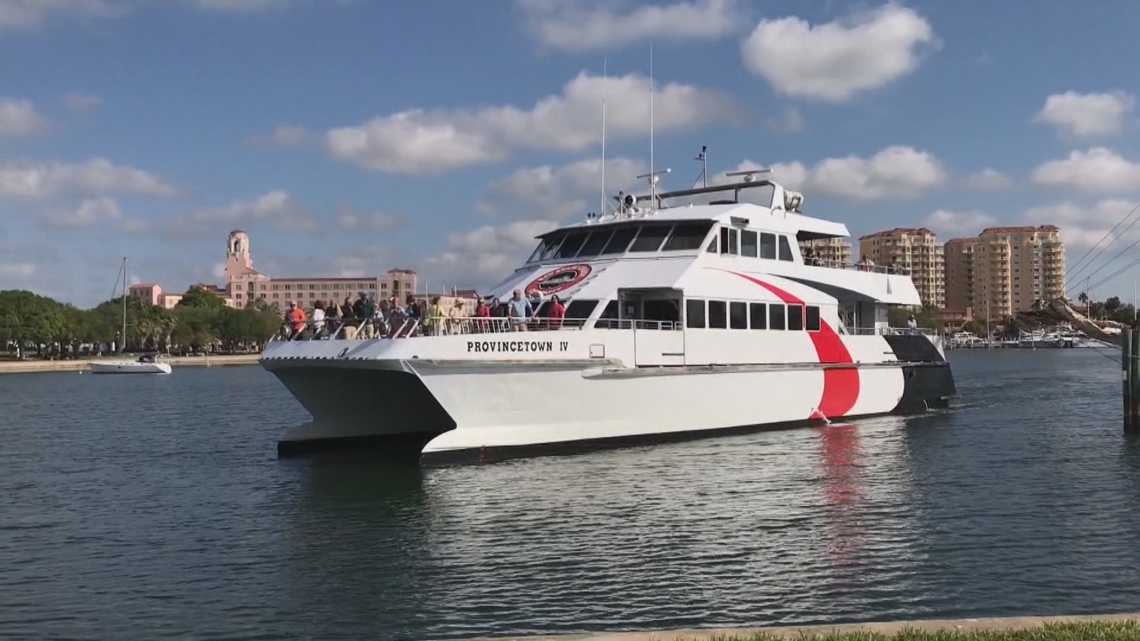
Pinellas County transit leaders unanimously selected Hubbard’s Marina as the new operator for the Tampa Bay Ferry — the final vote needed to greenlight the service.
TAMPA, Fla. — Seven months after the Cross Bay Ferry took its final ride across Tampa Bay, a new ferry service connecting Tampa and St. Petersburg has officially been approved.
On Wednesday, the Pinellas Suncoast Transit Authority (PSTA) Board of Directors unanimously selected Hubbard’s Marina as the new operator for the Tampa Bay Ferry — the final vote needed to greenlight the service.
Included in the vote was an approval to purchase a vessel that’s been identified in the San Francisco area. The boat still needs to pass a series of tests and get approval from the Federal Transit Administration (FTA) before the purchase goes through. But once it’s operational, this ferry will be able to take 250 passengers across Tampa Bay, as opposed to the previous boat’s capacity of 149 passengers.
“If this new vessel gets all the appropriate approvals, this will give us the opportunity to deliver a sustainable, convenient, and reliable transportation option on a quicker timeline,” Brad Miller, CEO of the PSTA, said in a statement.
Hubbard’s Marina, the new Tampa Bay Ferry operator
Hubbard’s Marina is a family-owned local business that was established in 1928.
It created a separate company called Tampa Bay Sea Taxi, Inc. that will oversee the new Tampa Bay Ferry’s vessel management, staffing, safety and daily operations. The PSTA’s agreement with the company is a five-year operating contract with an option to extend for an additional five years.
Tara Hubbard with Hubbard’s Marina previously said the goal is to have to ferry running by next summer, but there are still several factors that could affect this timeline.
What’s next for the Tampa Bay Ferry?
The PSTA said this version of the ferry is designed to last — offering consistent, year-round service rather than the short seasonal runs seen in past years.
That means it could take some extra time to get all the approvals for the new vessel and build the right dock for the ferry’s increased capacity and year-round use.
“We’re excited about the next steps: right boat, right docks, right process. For the right boat, the best option for long-term success could be the slowest: ordering one or more new boats,” PSTA Chair Figgs-Sanders said. “For the right docks, long-term success hinges on the right locations, which may require permitting and construction. And, for the right process, we’ll create long-term repeat customers by hiring an exceptional crew and making trips seamless.”
“To do this right, each step will take time. We’re designing a new service that’s sustainable, not restarting an old one that struggled to pay its bills,” Figgs-Sanders added.
The PSTA is working on a plan to secure a dock in St. Pete’s North Yacht Basin, where the old Cross Bay Ferry docked before it was forced to move further south to Port St. Pete. The plan for Tampa is to use the same spot where the old ferry docked, behind the Tampa Convention Center.