
The holiday shopping season is a time when retailers typically cash in as Americans rush to find the perfect gifts for their loved ones.
But this year, Santa’s sleigh may be running a bit light as shoppers pull back on spending and South Florida retailers settle into a softening market.

Bisnow/Chloe Gallivan
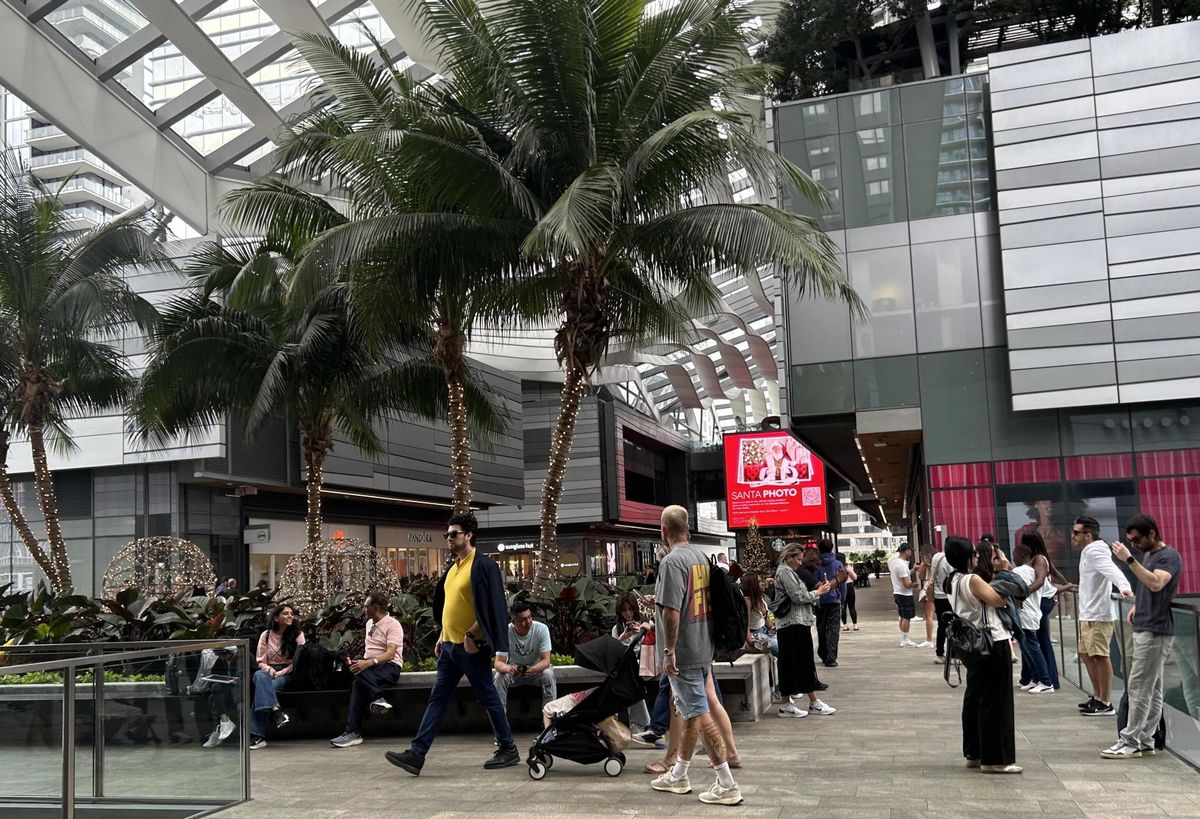
Shoppers roam Brickell City Centre on the weekend of Black Friday.
Amid broader economic uncertainty and declining consumer confidence, retail rents have been falling in South Florida, absorption has turned negative and the vacancy rate has inched up over the last three quarters.
“I don’t think people have gotten into the holiday spirit quite yet, where in seasons past it was starting after Halloween,” said Current Capital Real Estate Group President Todd Nepola, who owns and manages dozens of Florida shopping centers. “I don’t see people in Christmas mode and buying presents yet as rapidly as the years before.”
The holiday season is the strongest part of the year for retailers, Colliers Research Manager Haley Boatright said. While it remains true, this year may be a bit softer than years past.
Average holiday budgets for Americans have dropped just more than 10% from $1,261 to $1,133 per person, according to a JLL holiday retail report.
Households making less than $50K a year are making a steeper cut, dropping spending by 24% this year, while those in households earning more than $150K a year increased their spending by 26%, according to the report.
And while national Black Friday retail sales rose 4.1%, all of the gains came via online shopping, which rose 10.4%, Fashion Network reported, analyzing Mastercard SpendingPulse numbers.
In-person spending dropped 3.6% on Friday and 8.6% on Saturday, according to RetailNext data reported by FN.
“We’re not necessarily bothered by it,” Jonathan Rosen, JLL‘s executive vice president of retail in its Miami office, said about online shopping outpacing in-person. “These brands still like and prefer to have an actual presence on the street, which is with a storefront.”
In-person retail isn’t going anywhere, especially among stronger national brands like Lululemon, Rosen said, “but it might shrink footprint on the retail side slightly.”
Before a projected softer holiday season, the South Florida retail sector has been slowing for months, Nepola said.
“I think it’s just the slowdown and everybody is banking on the so-called season, and I don’t know if Florida is quite as seasonal,” Nepola said.
Asking rents in Miami-Dade County’s retail sector have fallen 6.1% year-over-year to $42.56 per SF, according to a third-quarter Colliers report. Vacancy has inched up over the last three quarters, reaching 3.8%, compared to 2.9% at the beginning of the year.
After retailers absorbed 146K SF in the first quarter in Miami-Dade, absorption has turned negative in the two quarters since then, including 169K SF more vacated than occupied in Q2, according to Colliers.
“Things have definitely gotten cooler across all sectors of retail, whether it be discretionary, like restaurants, to even used car lots,” Nepola said. “Everybody’s definitely feeling a slowdown down here in South Florida.”
The Colliers report says the rise in vacancy suggests landlords may need to “sharpen” concessions and pricing strategies, especially with vacancy expected to continue inching up, with 1.7M SF under construction, an increase from less than 1.5M SF a year ago.
“Slower leasing momentum and negative absorption across the tri-county area reflect softening demand, compounded by economic headwinds like rising housing and insurance costs that strain consumer spending,” the report says.
Bisnow/Matt Wasielewski
A view of Brickell buildings from Brickell City Centre
Tenants are attributing some of the slowdown to changes in immigration policies, which have led to the deportation or self-deportation of many residents in immigrant-heavy areas like Doral, where multifamily vacancy rates have begun to climb, The Wall Street Journal reported.
In Florida, where about 22% of the population is foreign-born, and Miami, where about 35% of the population is foreign-born, not as many people are out and about as of late, Nepola said.
“That hurts a lot of my tenants, because a lot of my shopping centers are on … those kinds of streets that have a lot of traffic from the guys that [are at] Home Depot in the daytime, and there’s not as many guys there anymore,” Nepola said.
Another contributing factor is declining consumer confidence, which fell nearly 7 points in November to 88.7, the lowest reading since April, according to The Conference Board.
Written responses by consumers reference prices and inflation, tariffs and trade, and politics, with an increase in mentions of the longest government shutdown in history, as factors affecting the economy, The Conference Board Chief Economist Dana Peterson said in a statement.
“Even though the government shutdown technically hurt a small group of the population and those people will still get paid, I think the news is just in everybody’s ear all day long, and it gives people fear,” Nepola said. “And when people are scared, the first thing they do is stop spending.”
South Florida has fared better than most of the nation, with one of the highest consumer confidence indexes.
Still, sentiment dipped about 2.3% to 100.3 in the third quarter, the South Florida Business Journal reported, analyzing the Metropolitan Consumer Sentiment Index. That is a 7.6% decline from 108.6 in the first quarter.
“Some of the high-level narrative about the economy and shopping, we’re not fully immune to that,” Rosen said.
But the influx of wealthy consumers to the area since the pandemic — who have only increased their spending — has provided a nice cushion.
“It almost feels like for every customer that might be priced out or they’re shopping spending power is reduced, it’s being replaced with someone who’s extremely affluent,” Rosen said.