
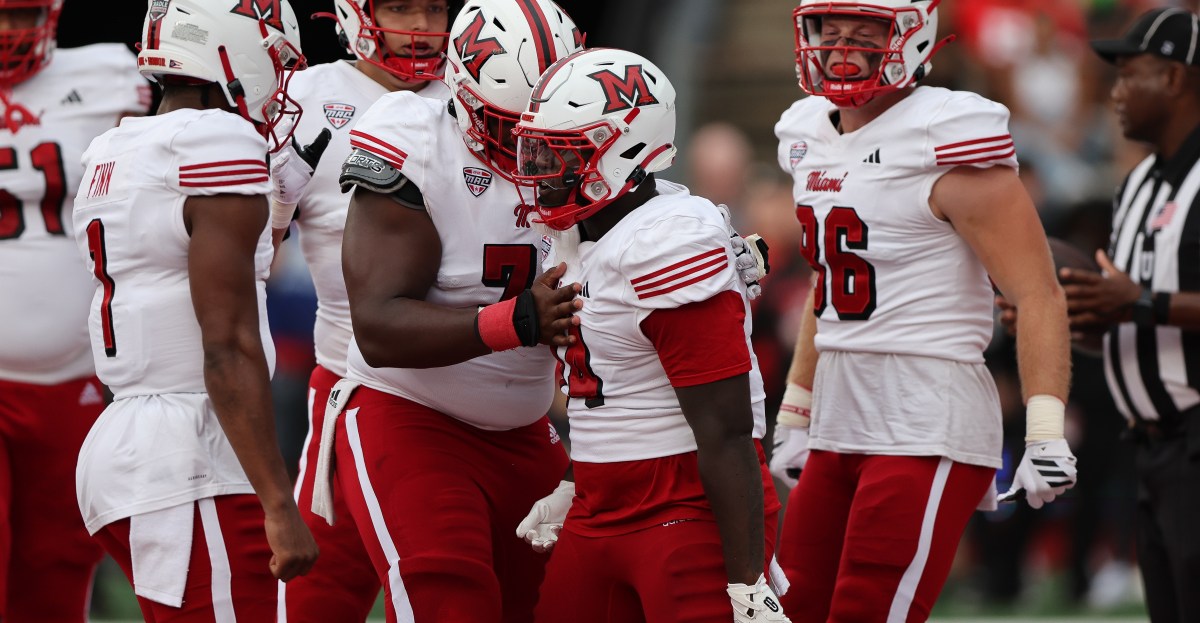
The Miami (OH) RedHawks (7-5, 6-2 MAC) are accustomed to preparing travel to Ford Field in the first week of December.
The MAC is a conference of immense parity, yet head coach Chuck Martin built a juggernaut that’s suited to compete for championships on an annual basis. The RedHawks are the first team to qualify for three-straight MAC titles since 2013-15 when Bowling Green and Northern Illinois fought for the conference crown in three-straight seasons.
Miami won the league title in 2019 and 2023 under Martin but got run out of the building by rival Ohio last December, so the RedHawks are ready to write a different script after 2024’s title game disappointment. Martin, in his 12th year with the program, seeks to become the second frontman in the conference’s history to win three title games, joining former Marshall head coach Bob Pruett, who won in 1997, 1998, 1999, 2000, and 2002.
Martin is back, and so are offensive coordinator Pat Welsh and defensive coordinator Bill Brechin, who are also in their 12th seasons with the program. But even with all the continuity, this was a vastly different ballclub from the 2023 and 2024 teams that competed in the MAC Championship Game.
Here’s how Miami got here.
When it comes to the Miami RedHawks, it’s never about the start and always about the finish. Miami is no stranger to rough starts. In 2016, it became the first team to qualify for bowl eligibility after an 0-6 start and that theme has carried through for a decade. For the second-consecutive year, the RedHawks stumbled out of the gate with an 0-3 record yet qualified for the MAC Championship Game.
Miami faced two Big Ten opponents on the road to launch its 2025 campaign. In the opener at Wisconsin, the defense showed signs of promise, holding the Badgers out of the end zone until roughly four minutes remained in the third quarter. But the offense struggled to function, causing the team to leave the Jump Around in a 17-0 shutout. The following week at Rutgers it was more of a defensive struggle, as the Scarlet Knights scored 21 unanswered in the final 22 minutes to cruise to a 45-17 domination. Miami’s home opener vs. UNLV was its first true heartbreak. The RedHawks led 38-24 entering the fourth quarter thanks to a pair of non-offensive touchdowns, but the Rebels stormed back and won their first-ever game in the Eastern Time Zone on a last-second field goal.
At 0-3, Miami received the best medicine to boost its confidence — an FCS opponent. The RedHawks walked all over Lindenwood in a 38-0 shutout, properly preparing them for the MAC road ahead. In the MAC opener, the team overcame an immediate 14-0 deficit at Northern Illinois, unleashing 25-straight point to claim the Mallory Cup. The following week saw another low-scoring bout, as the defense stood seven minutes away from a shutout in a 20-7 punishing of Akron.
The win streak then climbed to four after more fortunate offensive performances against Eastern Michigan and Western Michigan. Miami produced 44 points in a shootout win over the Eagles to climb above .500 for the first time all season, and then the win streak extended to five against Western Michigan. The RedHawks trailed 17-9 to Western Michigan entering the fourth quarter, but they flipped the switch and handled their future MAC Championship opponent 17-0 in the final stanza — sealed by a late strip sack by star defensive end Adam Trick.

DEKALB, ILLINOIS – OCTOBER 04: Deion Colzie #4 celebrates with Cole Weaver #84 of the Miami (OH) RedHawks after scoring touchdown against Northern Illinois Huskies at Huskies Stadium on October 04, 2025 in DeKalb, Illinois. (Photo by Jayden Mack/Getty Images) Getty Images
After the triumphant win over the Broncos, which also started 0-3, Miami was in firm control of its MAC title destiny. However, the midweek games commenced and the RedHawks finally caught themselves on the wrong side of results. Miami dropped a back-and-forth to arch rival Ohio, 24-20, in a rematch of the 2024 MAC Championship Game, surrendering a 49-yard touchdown pass with 2:15 remaining. Then the following week, in what was supposed to be quarterback Dequan Finn’s revenge game vs. his former school Toledo, Finn unexpectedly left the team — causing Miami to shuffle quarterbacks. The RedHawks’ first game without Finn did not end in ideal fashion as the offense significantly struggled in a 24-3 home defeat to Toledo.
In Miami’s final midweek game, Chuck Martin made an adjustment that would define the remainder of the team’s season. He switched quarterbacks from senior Henry Hesson to redshirt freshman Thomas Gotkowski, and the offense was finally unlocked. Miami dropped 37 points in Gotkowski’s first significant action of the season, pushing past Buffalo in a critical matchup for both teams. Then in the season finale with a win-and-in scenario for Detroit, Miami wasted no time. The RedHawks stormed out to a 31-10 halftime lead over Ball State in the Red Bird Rivalry, ultimately reaching a season-high 45 points in Gotkowski’s first career start.
Miami found itself in a three-way tie for second place at 6-2 in the MAC standings, deadlocked with Toledo and Ohio. Despite losing to both perennial contenders, Miami emerged due to the common opponents tiebreaker — owning a superior record against the group of Western Michigan, Ball State, and Northern Illinois.
Miami is the MAC’s model of continuity from a coaching staff standpoint, with Chuck Martin and the coordinators running the show for a decade-plus. But the RedHawks weren’t exactly the model of continuity from an on-field personnel standpoint this offseason, losing all 11 offensive starters from the 2024 MAC runner-up team.
Seventh-year senior quarterback Dequan Finn was expected to provide the team stability, but Finn left the team to prepare for an NFL future with three games left on the regular season docket. Henry Hesson briefly handled starting duties, but now, Thomas Gotkowski is the QB1 leading this team. The redshirt freshman only has two games of substantial sample size on his résumé, but they’ve been solid performances. He completed 25-of-47 passes for 411 yards in Miami’s big-play offense, firing four touchdowns and zero interceptions in the pocket. Gotkowski can move with his legs too. The Indianapolis native averages 5.0 yards per carry on the year, turning 18 attempts into 90 yards — after factoring the two sacks he’s taken.
Quarterback isn’t the only position Miami had to switch starters midseason. Sixth-year senior running back Kenny Tracy, while in the midst of his first season as the lead back, suffered a season-ending knee injury in October. That expanded the role of power back Jordan Brunson, who now operates as the first option. The 6’0”, 233 pound bruiser rattled off two 120+ yard games as the starter, and he usually fields around 14-20 carries per game. Miami relies on size and strength at the running back position, and the RedHawks trot out another power back in D’Shawntae Jones oftentimes near the goal line. Jones leads the team with seven rushing touchdowns, and the past two weeks featured his most utilization all season.
The most electrifying player on the Miami offense is wide receiver Kam Perry. The second-year RedHawk ranks first in the FBS among all players with more than 20 receptions in receiving average at 24.7 yards per catch. Perry is the prototypical deep threat, utilizing his speed and hesitations to break free down the field several times per game. He only needed 35 receptions to rack up 835 yards, and the 5’9” junior rattled off a 50-yard catch in six games in the regular season. Only two other receivers have more than 11 catches in this offense, and that’s Cole Weaver (40 receptions, 534 yards) and Keith Reynolds (34, receptions, 339 yards). Weaver has been a late bloomer this season, and the sophomore really arrived on the scene in the late-October showdown vs. Western Michigan — logging 71 percent of his production in the RedHawks’ final five games.

PISCATAWAY, NJ – SEPTEMBER 06: Miami (OH) Redhawks running back D’Shawntae Jones (14) scores a touchdown during a game between the Miami (OH) Redhawks and Rutgers Scarlet Knights at SHI Stadium on September 6, 2025 in Piscataway, New Jersey. (Photo by Andrew Mordzynski/Icon Sportswire via Getty Images) Icon Sportswire via Getty Images
Miami’s offensive line replaced all five starters from a formidable 2024 unit, but there remains solid talent in the front five — which ranks top 10 nationally in fewest tackles for loss allowed. The top name to watch is the 6’6” right tackle Drew Terrill, and this line has held the fort down quite well, Toledo game aside.
Defense is still the strength of this team, just like all previous Miami squads that qualified for the MAC title game. The unmistakable name up front is defensive end Adam Trick, who developed from a 2024 reserve to a 2025 star. Trick presents plenty of speed as a pass rusher, and that speed has allowed him to register 8.5 sacks and 12.5 tackles for loss on one of America’s top pass rushes.
Miami’s front is loaded with plenty of backfield invaders, as suggested by the team’s 3.2 sacks per game (third in the FBS). Ten different players have at least two sacks, and checking in at second on the roster is outside linebacker Jackson Kuwatch — another 2024 reserve turned 2025 starter that instantly thrived in an expanded role. Kuwatch has 87 tackles along with five sacks as one of many defenders in the midst of a breakout campaign. Another player that enjoyed a breakout year was inside linebacker Corban Hondru, but he has missed the past two games and is not expected to suit up in Detroit. Miami will greatly miss the talents of the versatile linebacker who collected 83 tackles, six tackles for loss, and three interceptions this fall.
The secondary showcases a slew of all-conference caliber talent, especially at the safety position. Eli Blakey and Silas Walters are two of the most talented players in the MAC, operating as two of the five Miami players that saw substantial action in the 2024 title game (Trick, Oscar McWood, and Nasir Washington are the others). Blakey leads the team in tackles (90) and pass breakups (8), operating as one of four RedHawks with multiple interceptions. Walters is also in that boat with three picks, and he contributes seven pass breakups as one of Miami’s top coverage men. Rounding out the talented safety room is Eli Coppess, who stepped in and caused plenty of havoc when Walters missed two contests midseason.
It wouldn’t be a true Miami team without a star kicker. The same program that produced the likes of Sam Sloman and Graham Nicholson is continuing its special teams factory through Dom Dzioban. The longtime RedHawk — who formerly starred as their punter — is thriving in his second season as the primary placekicker. Dzioban sunk 19-of-21 field goals in the regular season, faring 10-of-10 from the sweet spot of 40-49 yards.
Scoring offense: 26.1 points per game (81st in FBS)Passing offense: 163-of-311 (52.9%), 2,351 yards, 16 touchdowns, 10 interceptions, 7.6 yards per attempt, 14.4 yards per completion, 195.9 yards per game (101st in FBS)Rushing offense: 421 carries for 1,911 yards, 16 touchdowns, 4.6 yards per carry, 159.3 yards per game (69th in FBS)Sacks/tackles-for-loss allowed: 19 sacks for 103 yards, allowing 1.58 sacks per game (t-44th in FBS); 45 tackles for loss for 148 yards, allowing 3.8 TFLs per game (t-10th in FBS)Red zone offense: 34-of-40 (85.0%); 32 touchdowns (16 rush, 7 pass), 11 field goals (64th in FBS)First downs: 217 first downs (103 rush, 98 pass, 16 penalties) (109th in FBS)Conversion rates: 51-of-149 (34.2%) on 3rd down (116th in FBS), 11-of-21 (52.4%) on 4th down (t-88th in FBS)Scoring defense: 21.9 points per game (t-41st in FBS)Opponent passing offense: 224-of-402 (55.7%), 2,475 yards, 21 touchdowns, 14 interceptions (t-13th in FBS), 206.3 yards per game (47th in FBS)Opponent rushing offense: 397 carries, 1,413 yards, 10 rushing touchdowns, 3.6 yards per attempt, 117.8 yards per game (28th in FBS)Sacks/tackles-for-loss: 38 sacks for 243 yards, averaging 3.17 sacks per game (t-3rd in FBS); 73 tackles for loss for 324 yards, averaging 6.1 TFLs per game (t-37th in FBS)Red zone defense: 30-of-34 (88.2%), 23 touchdowns (8 rush, 15 pass), 7 field goals (t-110th in FBS)Opponent first downs: 225 first downs (85 rush, 121 pass, 19 penalties) (t-45th in FBS)Opponent conversion rates: 76-of-172 (44.2%) on 3rd down (117th in FBS), 9-of-18 (50.0%) on 4th down (t-47th in FBS)Kicking: 19-of-21 (90.5%) (t-12th in FBS), long of 51 (t-52nd in FBS)Punting: 53 punts, 2,195 yards, 41.4 average (102nd in FBS)Returning: 18 kickoff returns, 501 yards, 1 touchdown, 27.8 average (4th in FBS), 19 punt returns, 160 yards, 1 touchdown, 8.4 average (70th in FBS)