
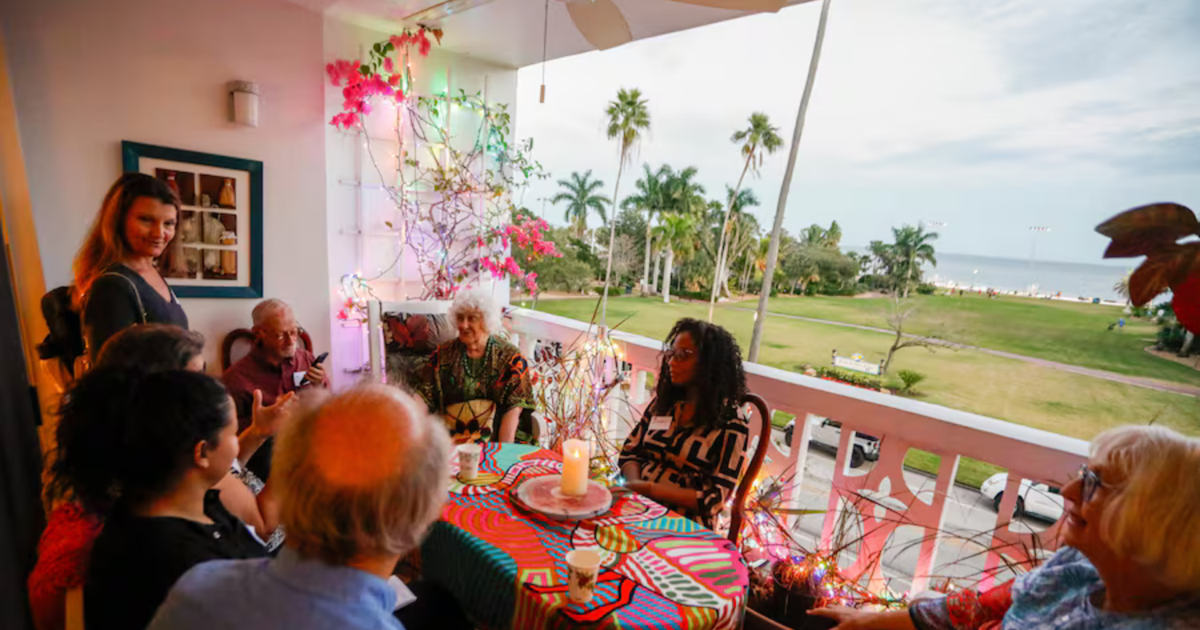
After four hurricanes threatened Tampa Bay but never made landfall in 2004, Sharon Joy Kleitsch threw a party.
“This calls for gratitude,” she thought. Since then, she’s played host every year on Dec. 1, the day after the official end of hurricane season.
Hurricane parties usually happen during the storm. Friends and loved ones gather at whoever’s home is the sturdiest with Publix hurricane cakes, flashlights and booze. Life stops for the storm, then hits hard once it’s gone.
At Kleitsch’s un-hurricane party, she never knows who will show up. She invites those who contributed to the community in some way as a thank you. It’s an annual meeting of the minds for St. Petersburg’s new-age scene. In the corner, a mind lamp that changes color based on the energy in the room morphed to yellow, the color of “will and emotion,” according to performance artist Michèle Young.
Josette Green, who leads St. Petersburg Black history bike tours, counted 98 people on the invitation for a party in a 1,020 square-foot condo.
The evening began on the balcony with a perfect view of the bay through Elva Rouse Park. Holiday lights on bougainvillea framed the front-row seat to a scene of pickup soccer and beach volleyball as people walked their golden retrievers. That view, those activities and a 75-degree temperature with a slight breeze in December are why millions gamble their livelihoods to live in a state at perpetual risk of devastation.
Out of view, Tropicana Field has a new roof. Homes are being rebuilt. A gash remains in the former Tampa Bay Times building where a crane fell. Inside, the flourless chocolate cake brought by Emmanuel Roux, the owner of the 15th Street Farm, was a hit. Shireen Chada, a member of the Brahma Kumaris spiritual movement, clad in a white saree, showed off her new book, “Experiencing God: 40 Meditations to Connect with God in Daily Life.”
Kleitsch almost didn’t throw last year’s party after hurricanes Helene and Milton tore up the state 13 days apart. The pain and trauma felt too fresh. She did it anyway.
“We’re still here,” Kleitsch said. “The people transcend.”
Sanat Hazra missed it last year. Helene sent three feet of water through his old Florida bungalow on Lido Key. Nine mattresses floated down the street. He had to hire an attorney to take his insurance company to court in order to get his due.
He fixed up his house but can’t sell it. He’ll try again next year, thinking someone will forget about the storms, though he won’t.
“Everyone’s saying, ‘Once in 100 years,’ but I don’t believe that,” Hazra said.
Steven Bingler saw entire homes float away as Hurricane Katrina forever changed New Orleans 20 years ago. An urban planner, he helped with recovery efforts there and is working on a plan for 25 counties in North Carolina hit by Helene that in some places, he says, still can only be reached via mule.
He flew down just for the party, “finding people whose hearts are on fire.”
“Today is the day we need to prepare for next hurricane season,” Bingler said.
One woman couldn’t stomach talking about it. Helene ruined her Bahama Shores home. It’s still on the market a year later. She couldn’t stand that her guests kept bringing up the storms at Thanksgiving.
Approaching old age, she already was staring down a decision to downsize. Sometimes hurricanes can speed up a natural process.
At a party celebrating a collective exhale, “There’s no sigh of relief,” she said. “It’s not here yet.”