
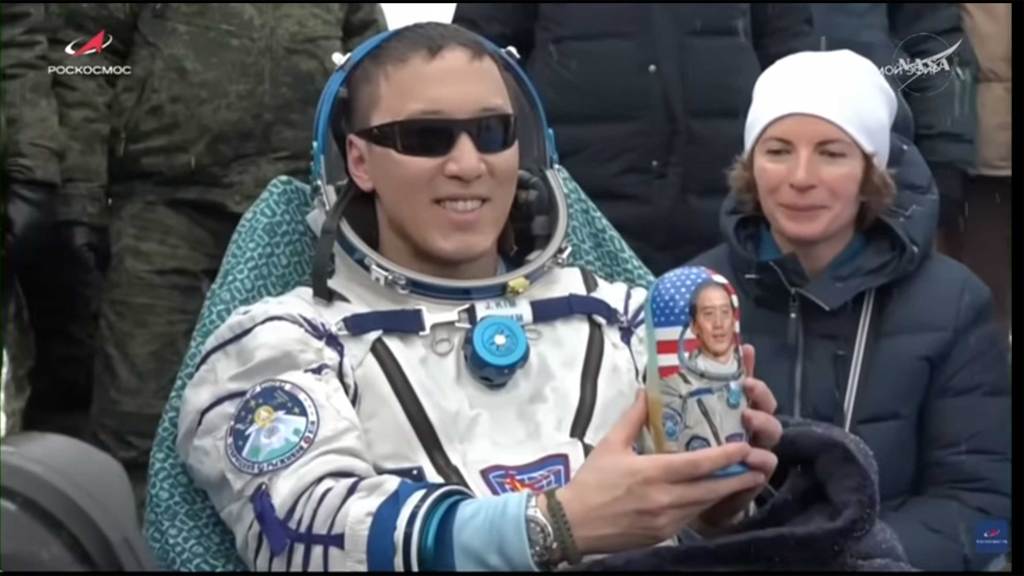
NASA astronaut Jonny Kim flew home from the International Space Station packed tight with two Roscosmos cosmonauts, their Soyuz spacecraft landing Tuesday in the frozen steppes of Kazakhstan to complete an eight-month stay in space.
Kim launched to to the station back on April 8 with cosmonauts Sergey Ryzhikov and Alexey Zubritsky aboard the Soyuz MS-27 spacecraft and spent nearly 245 days in space, as part of Expeditions 72 and 73 on board the station.
It was Kim’s first spaceflight, and he was the penultimate member of his 11-member NASA astronaut class, known as The Turtles, to make it to space. The final member, Zena Cardman, remains on board the station having flown up as a member of Crew-11, which isn’t slated to return until early 2026.
Kim and his Soyuz crewmates landed at 12:03 a.m. EST (10:03 a.m. local time) in near Dzhezkazgan, Kazakhstan having departed the station a little more than three hours earlier.
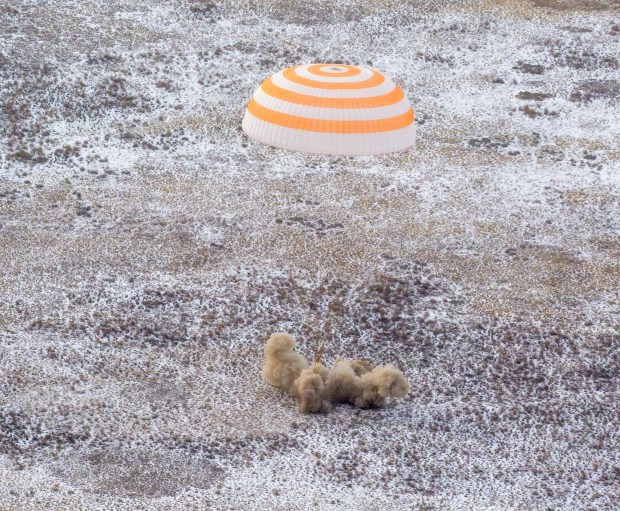 The Soyuz MS-27 spacecraft is seen as it lands in a remote area near the town of Zhezkazgan, Kazakhstan with Expedition 73 NASA astronaut Jonny Kim, and Roscosmos cosmonauts Sergey Ryzhikov, and Alexey Zubritsky aboard, Tuesday, Dec. 9, 2025. The trio are returning to Earth after logging 245 days in space as members of Expeditions 72 and 73 aboard the International Space Station. (Bill Ingalls/NASA)
Their tiny capsule, with a snug fit for the three humans, came in for a parachute-assisted touchdown but tipped to one side before recovery crews were able to converge on the spacecraft and help the three space travelers out.
All three were fine, and Kim was presented with a traditional Matroyshka (stacking) doll to mark his return.
Kim will be headed back to Johnson Space Center in Houston after post-landing medical checks.
His crew’s return came after their relief crew arrived two weeks earlier, made up of the trio of NASA astronaut Chris Williams and Roscosmos cosmonauts Sergey Kud-Sverchkov and Sergei Mikaev.
The launch of that Soyuz spacecraft, though, damaged some of the launch support infrastructure in Kazakhstan, so it’s unclear when the next Soyuz launch would be possible.
Russia had already dialed back its frequency of flights to the station to at least eight-month intervals.
NASA’s flights under the Commercial Crew Program had been flying up about every six months since SpaceX began regular missions in 2020, but the latest mission could also end up being around eight months long.
President Trump’s proposed NASA budget had called for less flights to the space station, and possibly with less crew, as it nears the end of its service after 2030.
But Trump’s nominee to be the next NASA administrator, Jared Isaacman, said during confirmation hearings this month that he would like to continue to see NASA use the space station as much as possible during its end run while pushing commercial companies to progress on their proposed replacement stations.
For now, SpaceX remains NASA’s only operational commercial crew provider while Boeing continues to pursue certification of its Starliner spacecraft. A Starliner flew up with two crew in 2024, but suffered propulsion problems that ultimately led NASA to send it home without crew.
With safety in mind, and to ensure fixes made since that mission are adequate, the next Starliner mission to the station will be uncrewed. Only after it successfully launches, docks and lands could it be in line to join SpaceX for its contracted crew rotation duties.
NASA and Boeing had already adjusted the original contract to dial back the number of potential crew rotation missions from the six it was originally awarded down to four.
SpaceX, meanwhile, is slated to fly its 12th operational mission, Crew-12, to relieve Crew-11 next year, although NASA has yet to announce the astronauts assigned to fly on that mission.