
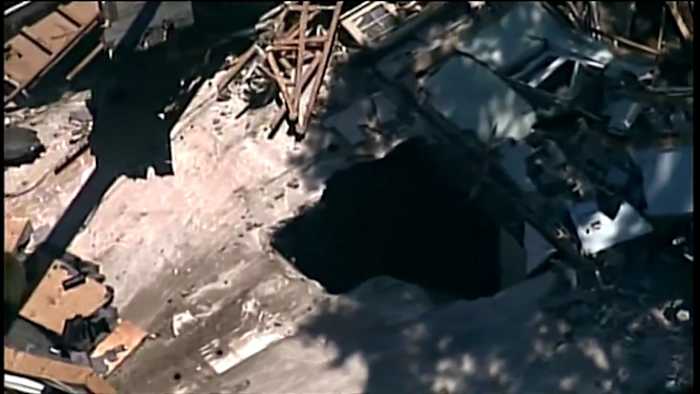
ORLANDO, Fla. – Any long-time residents of the Sunshine State are likely all too familiar with sinkholes.
They’re a relatively common staple of Florida, thanks to the fact that the state sits on a bedrock made up mainly of limestone.
And because of how porous limestone is, water can seep in and eat away at this layer, forming cracks that eventually cause the ground itself to collapse.
While nowhere in the state is immune to sinkholes, Central Florida tends to see them form much more often, leading to the region being dubbed “Sinkhole Alley.”
“It goes all the way from Hillsborough County, and close to Tampa, all the way up to Daytona, and it goes through our areas of Maitland and Winter Park,” UCF’s Dr. Manoj Chopra told News 6 last year.
[BELOW: Deadly Central Florida sinkhole is also the deepest]
However, experts at the University of Florida say that more sinkholes have been forming in recent years due to factors like climate change and land development.
In fact, a 300-foot-deep sinkhole opened up beneath a Central Florida fertilizer plant back in 2016, which reportedly sent millions of gallons of contaminated sludge into the state’s main drinking water aquifer.
When it comes to sinkholes, the Florida Geological Society breaks down the state into four main types of areas:
AreaDescriptionSinkholes?CitiesIBare or thinly covered limestoneFew, generally being shallow, wide and happening over timeMiami, Hollywood, HialeahIIConsists mainly of permeable sandFew, generally being shallow, small and happening over timeFt. Lauderdale, Orlando, Port St. LucieIIIMainly heavy soil with low permeabilityMost numerous, with varying sizes and happening abruptlyTampa, Tallahassee, St. PetersburgIVCohesive sediments interlayed with discontinuous carbonate bedsVery few, but some large, deep sinkholes may occurJacksonville, St. AugustineA “Sinkhole Risk Map” using data from the Florida Geological Survey. (Red = Area 1; Blue = Area 2; Green = Area 3; and Purple = Area 4) (Arcgis)
The map also shows which counties these different areas span. As it turns out, the worst stretch of sinkholes in the state is in west-Central Florida, where large amounts of karst limestone can be found below ground.
[You can find the full map here]
Within Central Florida, places like Orlando’s Lake Eola and Winter Park’s Lake Rose actually got their starts as sinkholes.
Chopra told News 6 that there’s an easy way to tell whether a lake in Florida began as a sinkhole.
“If you fly over Central Florida, if you see those really round lakes, they’re probably sinkholes, because a sinkhole is typically a funnel that fails the surface and falls in,” he explained.
A massive sinkhole opens up in Winter Park in 1981, eventually forming into Lake Rose.
There are also two primary types of sinkholes to watch out for, state officials warn:
Cover-Subsidence Sinkholes: These form slowly and occur when surface sediments settle or wash into a void. Common in Area II.
An example and illustration of a cover-subsidence sinkhole provided by the Florida Department of Environmental Protection. (Florida Department of Environmental Protection)
Cover-Collapse Sinkholes: These form by the sudden collapse of cover sediments into a large void in the limestone bedrock beneath the surface. Common in Areas III and IV.
An example and illustration of a cover-collapse sinkhole, provided by the Florida Department of Environmental Protection. (Florida Department of Environmental Protection)
On the flip side, state officials also caution that not everything is a sinkhole, as there are some “imposters” that may fool residents.
These can include utility main breaks, storm-drain line leaks, septic tank collapse, underground rotting tree stumps, erosion, and buried debris.
Examples of “Sinkhole Imposters” provided by the Florida Department of Environmental Protection (Florida Department of Environmental Protection)
But for homeowners aiming to keep their houses from falling prey to a sudden sinkhole, the FDEP discusses the following warning signs that could indicate a sinkhole is forming:
Inside or Outside?Warning SignInside your homeCracks in walls or floorsInside your homeFloors become uneven or slopedInside your homeWindows and doors become difficult to open/closeInside your homeCreaking/popping noisesInside your homeNails in walls and sub-floors begin to extrudeInside your homeCabinets and drawers become uneven and difficult to open/closeInside your homeDisplaced moldings and wall trimInside your homeWater leaksOutside your homeWater pooling under the house or along the foundationOutside your homeChanges in surface drainageOutside your homeCracks in exterior walls or foundationOutside your homeExposed rock that is not normally visibleOutside your homeCracks or depressions in the yardOutside your homeBroken water, utility or sewer linesOutside your homeCracks or separation of paved surfacesOutside your homeLeaning trees, vegetation or structuresOutside your homeDying foliage and grassBreaking News Alerts
Get breaking news alerts delivered to your inbox.
Copyright 2025 by WKMG ClickOrlando – All rights reserved.