
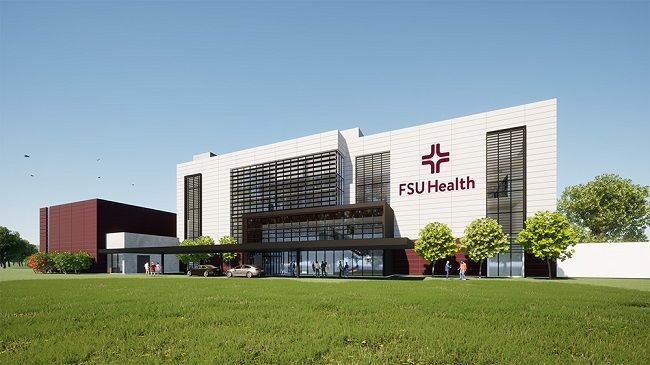


Florida State University and Tallahassee City Manager Reese Goad have agreed to a proposed Memorandum of Understanding (MOU) that will serve as the basis for the transfer of all city-owned hospital assets currently leased to Tallahassee Memorial Healthcare, Inc. (TMH)
The City Commission is scheduled to take action on the MOU at the next regularly scheduled January 14, 2026, meeting at 3 p.m. at City Hall.
The MOU proposes approximately $3.6 million in annual payments to the city for the next 30 years. In addition, the agreement requires the continuation of charity/indigent care, a $250 million investment by 2034 and a longer-term investment.
The Agreement
The agreement will begin the transformation of the hospital into a full academic health center, operating under FSU Health, a healthcare ecosystem that combines research, clinical care, and teaching to bring healthcare innovation and cutting-edge medical advances directly to patients across North Florida.
“Florida State University is committed to investing in the future of healthcare while expanding our mission of education and research,” FSU President Richard McCullough said. “We appreciate that support from the City of Tallahassee and look forward to establishing an academic health center in North Florida.”
The agreement outlined in the MOU provides that FSU will ensure that charity/indigent care remains in full effect and continue to be at least as generous as what is currently in place, In addition, the MOU lays out an approach whereby FSU will invest $1.7 billion locally of the next 30 years. This commitment consists of a 30-year contribution to citizens as payment for the city-owned assets; a short-term investment to improve local facilities and provide research grants; and a 30-year long-term investment plan aligned with academic health center practices.
Specifically, the contribution to citizens totals $109 million over 30 years, recognizing the citizens’ investment in the original facilities. An additional investment of $250 million by the end of 2034 will upgrade existing facilities and support clinical faculty, research and other investments. The final portion of the financial commitment will support the development of new clinical and laboratory spaces and facilities. Together these commitments are expected to exceed $1.7 billion.
“The agreement charts a bold, transformative path forward. Thanks to the dedication of professionals who refuse to accept the status quo, the future of healthcare in Tallahassee will be better,” Tallahassee Mayor John Dailey said. “By aligning our hospital with one of the state’s premier universities to create an academic health center, we are redefining healthcare in a way that positively impacts the lives of residents locally and across the region.
Financial Impact
Academic health centers are integrated healthcare institutions that combine patient care, medical education, and research within a university-affiliated hospital system. These institutions play a central role in advancing medical innovation, training future healthcare professionals, and providing specialized medical services that may not be available at community hospitals. Typically affiliated with medical schools, research universities, or teaching hospitals, academic health ceneters serve as regional hubs for complex and specialized care. The creation of an academic health center in Tallahassee will bring world-class medical training, cutting edge clinical research, and expended healthcare services to North Florida, lessening the need for Tallahassee citizens to travel for health care and providing opportunities for others outside the region to travel to Tallahassee for health care.
The Office of Economic Vitality has completed an initial economic impact assessment utilizing source data from the U.S. Department of Commerce, Bureau of Economic Analysis and its Regional Input-Output Modeling System. When with the investment commitments outlined in the MOU, the analysis projects a conservative economic impact exceeding $3.64 billion and the creation of more than 900 jobs over the next 30 years.