
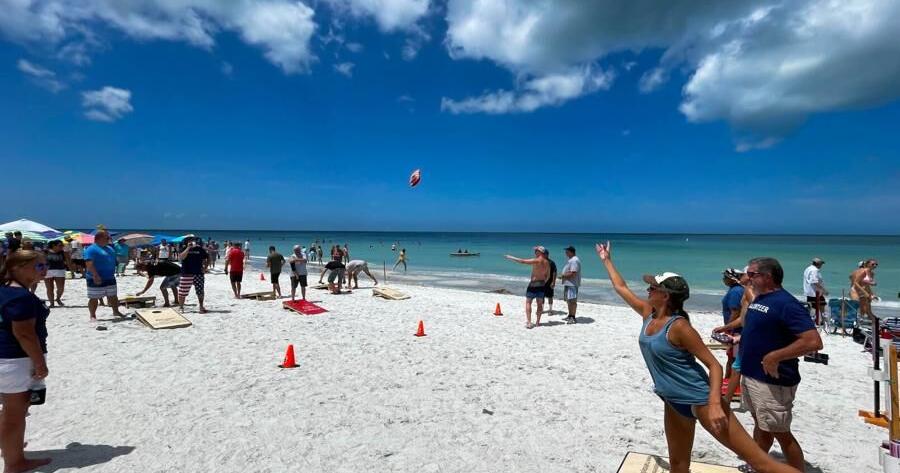
INDIAN ROCKS BEACH — For years, Indian Rocks Beach has held the distinction of being the only Pinellas County beach community that didn’t charge for visitor parking, making it a magnet for frugal beachgoers.
But with officials agreeing to implement a paid parking pilot program in 2026, the free ride is set to end soon.
After reigniting discussions of what’s long been a hot button topic on the tiny barrier island last summer, the talks stalled over the last year while the community recovered from the 2024 hurricane season as well as the loss of several key City Hall employees this year, including longtime City Manager Gregg Mims.
But during the Dec.9 City Commission meeting, the board agreed with new City Manager Ryan Henderson’s idea to implement a pilot paid parking program at the city’s beach access sites to help kickstart the process.
“After reviewing everything, my impression is this is something the community wants to move forward with,” said Henderson, who was sworn into office on Nov. 12.
“The question is how to implement it.”
After another lengthy discussion that featured quite a bit of resident commentary, the five commissioners directed Henderson to move forward with the pilot program as soon as possible.
“That makes sense to me, because implementing it in the entire city is a much bigger undertaking,” Mayor Denise Houseberg said of the idea to start small and then spread out. “The beach access is the most abused. People park and stay there for 11 hours.”
Henderson, the former city manager of Anna, Texas, who was selected to replace Mims, said he was recommending they pilot the program starting with the 182 beach access spots for six months and then make necessary adjustments.
“The piloting allows us to implement it, get it going, and then make any applicable changes,” he said, adding the move to charge for parking is “a big decision to consider,” and the program would serve as a trial balloon.
In running through a presentation, Henderson proposed they charge $4.50 an hour to align with the county’s maximum rate, utilize the ParkMobile online app as the only means of payment, and he recommended 6 a.m. to 10 p.m. as the hours of enforcement.
Henderson also noted the pilot program would allow officials to collect data, assess the revenue collected, and monitor the effects on surrounding neighborhoods as well as efficacy of enforcement, which would be handled by a combination of city code enforcement officers and Pinellas County Sheriff’s deputies.
As for the funds collected, estimated to be as much as $100,000 annually, of which the city would receive a 60% split, Henderson said the money would be used to improve resiliency and infrastructure.
“Indian Rocks Beach is the best beach in Pinellas County, and we want to preserve it and the infrastructure,” he said. “The political will is there to implement (paid parking), and we’re ready to do it.”
After Henderson said they would bring an ordinance before the board to change the fee schedule to $4.50 an hour and to enter an agreement with ParkMobile in January, the newcomer succinctly summed up the current tenor of the situation.
“We’re one of the last cities, if not the last city, to charge for parking,” he said. “So, we’re due. The time is right. Let’s get this thing going … because no one is not in favor of this.”
City approves ordinance establishing procedures for certified recovery residences
A state-mandated piece of legislation that has been treated as a formality in most Pinellas County communities received a lot of attention in Indian Rocks Beach when it came to vote on the ordinance.
After City Attorney Matt Maggard explained how Florida Senate Bill 954 “requires all cities and counties to establish a procedure” for certified recovery residences, which he said are voluntary and private sobriety establishments and not state-supported halfway houses, a lenghty discussion ensued as several residents questioned it.
“These can be anywhere in the city?” one resident asked, while another said the situation left her “really confused.”
Maggard attempted to quell their fears and concerns by stating approval of the ordinance is required “to comply with state statutes,” while noting that the legislation only “creates an application and review process” should someone want to open a certified recovery residence in the barrier island community.
“This establishes a procedure, but they still must come before the City Commission for approval or denial,” he said.
Former commissioner Lan Vaughan, who qualified to run again in March, agreed.
“The state is telling us to put a process together, and that’s what we’re doing,” he said.
When Mayor Denise Houseberg asked if “someone would have to request” opening such a facility in the city, Maggard replied, “that’s correct.”
The ordinance is scheduled for a second and final reading in January.