
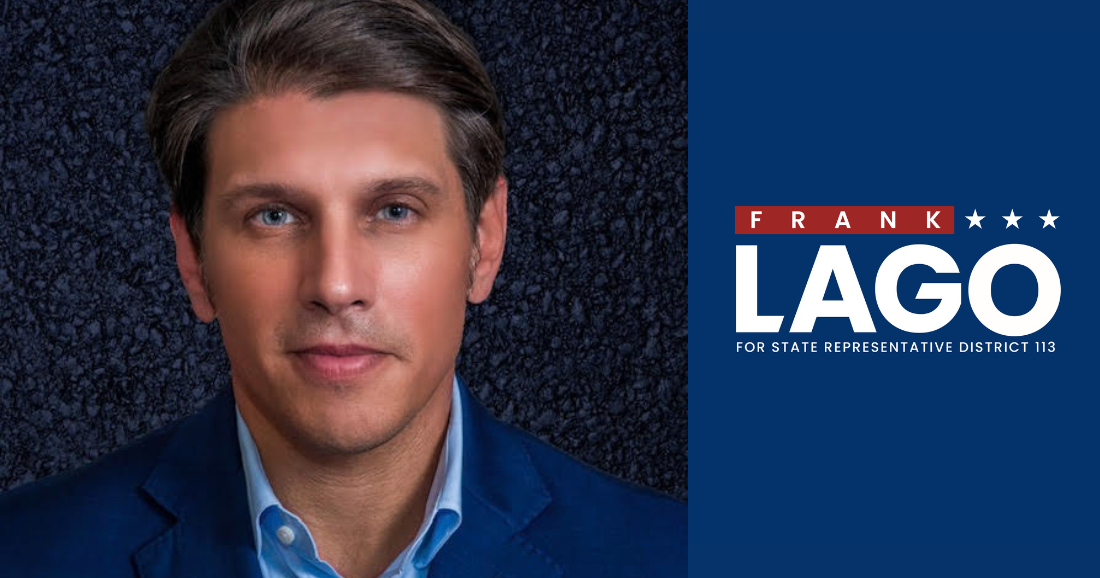
Stuck behind miles of vehicles trying to depart Key Biscayne during that infamous Sunday evening traffic nightmare last year during the I-95 ramp construction, Frank Lago said he simply abandoned the thought of leaving.
“I spent the night on Key Biscayne, at my girlfriend’s parents’ house,” he said.
Lago, 45, is a Miami businessman with deep ties to Key Biscayne, and knows there are critical transportation and infrastructure issues facing the Village, just like the one he witnessed that mid-April night.
It’s also one of the many infrastructure issues in Florida’s District 113, a House seat which is now up for grabs between Lago and, currently, four other challengers when the next election is called.
Lago’s even received an endorsement from former State Rep. Vicki Lopez, which he calls “a great honor” and hopes to fill her vacated seat now that she has been appointed to Miami-Dade’s Board of County Commissioners.
“At the end of the day, our focus still is going door-to-door, and the most important support will be the one by the voters,” Lago said. “Vicki Lopez’s endorsement, alone, is not going to win this election.”
His platform is based on “bringing substantial money back to (my) district.”
Running as a Republican, there might be a slight advantage, too, since the demographics of registered voters have recently swung a little in favor of his party in District 113.
“There are a lot of non-partisan issues, like modernizing our infrastructure,” he said.
Representing District 113, which includes such areas as Key Biscayne, Brickell, Little Havana, Shenandoah and The Roads, comes with a powerful responsibility.
“I’d say all districts are important, they all represent a piece of Florida,” Lago said. “But, in 113, this is the heart and soul of Miami. For example, Little Havana, where it seems everyone is connected in some way, either by living there or those who came here from Cuba, like my parents did and (his girlfriend’s) parents did back in the ’60s, or even those who tour the city to learn about the history. This is the epicenter of Miami and, to me, it is very important.”
Was a key to Sweetwater’s FIU link
Born in Mercy Hospital in 1980, Lago graduated from Christopher Columbus High School and earned both his undergraduate and master’s degrees from Florida International University, where he began his career as an urban planner.
Lago has worked in municipal government since 2005, but while getting his master’s degree, he began specializing in economic development for FIU’S Metropolitan Center where they helped municipalities like West Miami and Sweetwater.
FIU, at the time, was looking to shed its commuter status for students, and instead make the university into a true “international” campus, one which has grown to the 58,000 students today.
“But they were landlocked,” Lago explained.

Celebrating a birthday earlier this year, District 113 candidate Frank Lago is joined by his parents, his sister and his girlfriend.
So, the focus went to the nearest neighboring community, Sweetwater, which hired Lago to help change the city’s Comprehensive Master Plan to allow for off-campus student housing for FIU students.
The annexation of the Dolphin Mall was also one of Lago’s important accomplishments in 2010 before heading to the private sector to get that Master Plan changed by trying to “sell the vision” to expand the city’s tax base and creating the University City District, although things proceeded slowly at first, he admitted.
There are now seven buildings in Sweetwater for FIU students.
“It’s become a nice community of students and a vibrant community of homesteaded owners,” Lago said. “The city is even bigger than it was.”
In 2011, Lago resigned from his job as Chief of Staff to then-Sweetwater Mayor Manny Marono to focus on a run for Esteban Bovo’s vacated House District 110 House seat, a campaign that fell short but was a valuable learning experience.
Today, Lago works in real estate advising and consulting on land and development issues for workforce and affordable housing, and office and industrial real estate. He also serves as Chair of the Miami-Dade County Planning Advisory Board.
Worked with Lopez on condo bills
As a board member of the Brickell Homeowners Association, Lago worked with Lopez on the condo legislation she brought to Tallahassee, allowing her to gauge the temperature as to how her own condo association would assess potential laws.
“She did a great job for the district, not only carrying some great bills (to the Legislature), but she was always present in the community, even after coming back from Tallahassee earlier in the day,” he said. “She cares about the community, the issues and the people, and I plan on following in her footsteps. I think she’ll do an even greater job as County Commissioner.”
Lago will be running against, at least, two other Republicans, Miami businessman Tony J. Diaz and former Miami-Dade County Commissioner Bruno Barreiro. Two Democrats, real estate professional and community activist Gloria Romero Roses, and finance and politics pro Justin Mendoza Routt, are also in the mix.
Lago said knows Key Biscayne well.
District 113 candidate Frank Lago and his girlfriend, Natasha Tejera, at Cuba Nostalgia this past spring.
His girlfriend’s parents arrived in the U.S. from Cuba in 1964 and lived in New Jersey for a while before purchasing a home in Key Biscayne in 1979, only to see Hurricane Andrew destroy the property in 1992. It has since been rebuilt.
Lago’s parents own a condo at the Commodore Club.
He said Key Biscayne’s challenges, obviously, include the traffic, with “one way in and one way out,” as well as flooding, that “if it rains for 20 minutes, certain parts of the Village begin flooding, but that’s being worked out.”
Also, overhead power lines have “led to power outages like once a week” when it gets windy. We need to underline the overhead lines, and I plan on working with the Village to accomplish their plan,” he said.
His best message to residents?
“Don’t develop any more vertical buildings within the Village of Key Biscayne … “I completely understand when Village residents say, ‘Don’t build anything on the Causeway.’ It’s a safety concern if something happens.”