
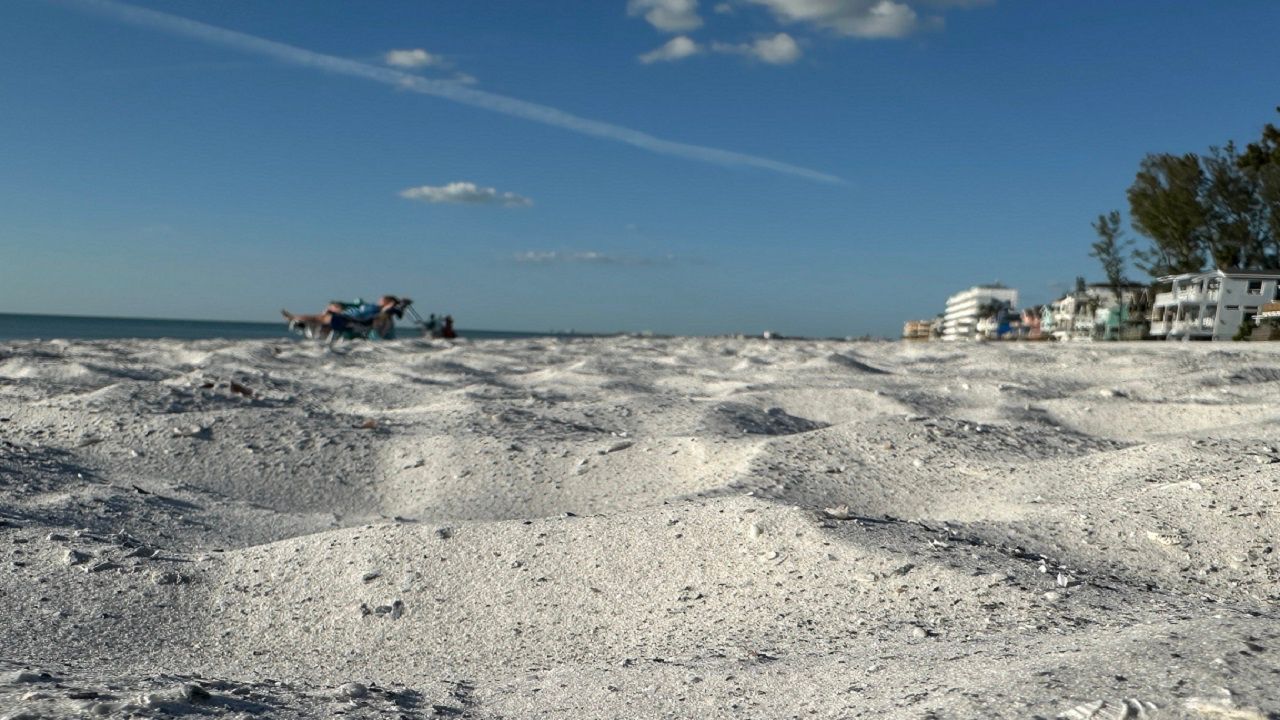
TREASURE ISLAND, Fla. — Pinellas County announced it’s wrapping up its beach nourishment project.
The $125 million effort started in September to add sand back to the county’s shoreline. It followed serious erosion caused by last year’s hurricanes. The county originally said the work was expected to take six months.
What You Need To Know
Pinellas County said Sunset Beach in Treasure Island is the last of nine beaches that will get sand through next week as part of its nourishment project
Vegetation will also be planted on dunes to make the beaches more resilient against future storms
The assistant manager of Caddy’s of Treasure Island said foot traffic does seem to be picking up as people hear the project is nearing completion
Read previous coverage here
“The team really strapped up their boots, and they got it done in record time,” said Visit St. Pete-Clearwater President and CEO Brian Lowack.
Lowack credited the county’s public works and environmental staff working with barrier island municipalities and the commitment from county commissioners for the swift progress.
From a tourism perspective, Lowack said the timing is perfect. Visitors are expected to increase every week until peak spring break season, which is good news for communities still recovering from Hurricanes Helene and Milton.
Among those enjoying Sunset Beach on Monday afternoon were Gulfport residents Louann and Sean Collins.
“We love the beach here. I don’t think we can beat it,” said Louann.
In a county with miles of beautiful beaches, the Collinses said that beach just has a certain something.
The $125 million project started in September and covered nine of the county’s beaches. @VisitSPC’s Brian Lowack says it’s the boost businesses that rely on tourism can use going into the new year. Visitors were down a bit this year – fewer than 15 million vs. 2024’s 15.4 mil. pic.twitter.com/51qZCF6Ctl
— Sarah Blazonis (@SarahBlazonis) December 23, 2025
“It’s just a different vibe and a different feel,” said Sean.
Both said the nourishment not only widened the beach, but also improved the quality of the sand.
“The sand is just so nice. It was a little rougher before,” said Sean.
“It’s so soft,” said Louann. “It’s powdery and a little cool, actually.”
That part might not be so unique. According to Pinellas County, Sunset Beach is the last of nine along its coast to get new sand as part of its nourishment project.
“Throughout the beaches, over 2.5 million cubic yards of sand, which is – fun fact – enough to fill The Dali Museum over 40 times with sand,” said Lowack.
Lowack said it’s the boost businesses that rely on tourism can use going into the new year. He said the region did see a slight dip in tourism in 2025, with just fewer than 15 million visitors compared to last year’s 15.4 million. While Lowack said spots like Clearwater, St. Petersburg, and Dunedin had great years for tourism, beach nourishment can help extend that.
“Where our work’s really going to focus on are the southern portions of the beaches in the county where they were hit a little bit harder,” Lowack said.
“People aren’t seeing it as accessible. They just see it as being closed,” said Evan Bradish, assistant manager of Caddy’s of Treasure Island on Sunset Beach.
Bradish said the restaurant and bar had a front row seat to the nourishment project. Staff have been serving customers from a semi-permanent space as their building undergoes hurricane repairs.
“We had to completely vacate the beach, actually take down part of our operation and close down for a few days. Luckily, they’ve opened up our area,” Bradish said.
He told Spectrum News there’s now significantly more beach and more foot traffic as people realize work is wrapping up. Bradish said he’s looking forward to what’s to come in the new year.
“Being excited about everything coming together. We’ll be back in our building, so many other places are opening back up. It’s time to be on the beach. It’s the perfect time,” he said.
Lowack said some areas of the beaches have new dunes and after the first of the year, crews will plant vegetation in those spots to try to strengthen the beach and make it more resilient against future storms.
According to the county, a $13 million state grant helped pay for the work, but most of the money is coming from tourist development tax dollars. Lowack said the region is one of just a few in Florida to collect more than $90 million in TDT funds four years in a row, even after the hurricanes, highlighting the role tourism plays in local communities.