
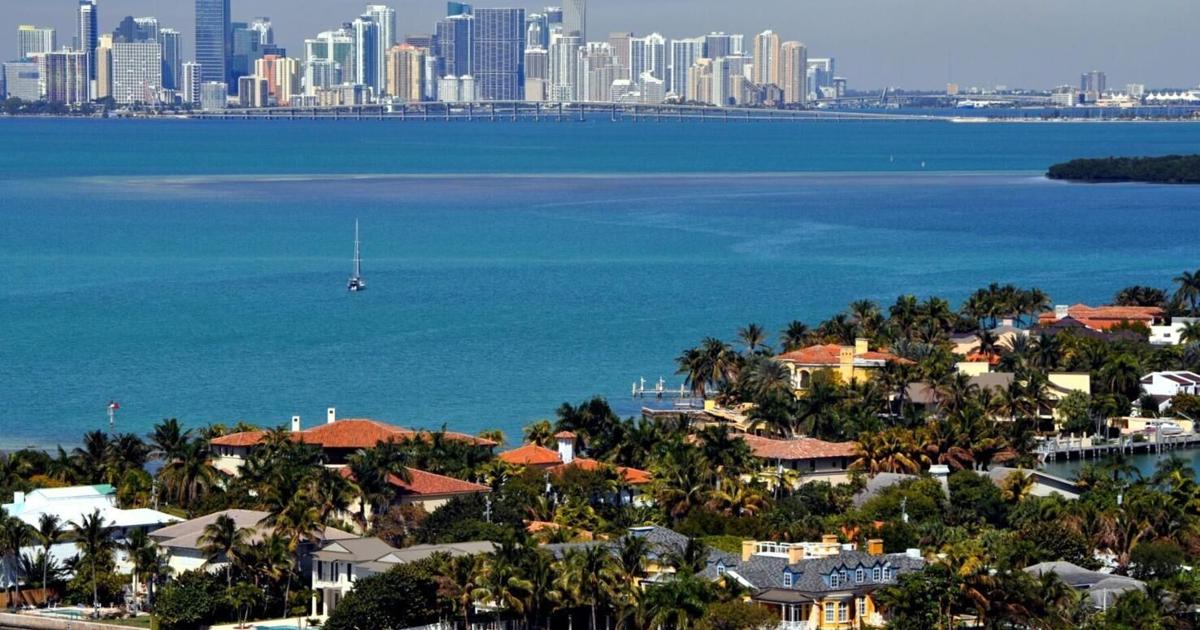
Eight resolutions to reduce the burden of property taxes for Florida homeowners are being mulled in Tallahassee, but what will the financial impact be on municipalities such as Key Biscayne?
Village Chief Financial Officer Benjamin Nussbaum addressed Council members last week with his analysis, saying an impact will be felt if any of the current eight proposals, or more, receive a “yes” vote by the public in the November 2026 election, which would then affect the 2027-28 Village budget.

Village CFO Benjamin Nussbaum at his desk.
“This will destroy small local governments like us,” Village Mayor Joe Rasco said. “We will stop having the ability to do the things we do here, with the public’s input.”
Instead, he said, the Village would be at the mercy of legislators in Tallahassee to receive funding “or they would want to consolidate us and take away our fire department or some of the unique things we do here. That’s really it. Forget the numbers, control is the big problem.”
Key Biscayne officials, such as Rasco, Nussbaum and Village Manager Steve Williamson have been proactive on the subject, meeting with local and state officials, and providing their level of expertise from the Village’s standpoint.
In September, Nussbaum explained to former State Rep.Vicki Lopez, one of the 37 House members of that special task force, the nuances of how reducing or eliminating ad valorem taxes would impact Key Biscayne.
It all stems from Gov. Ron DeSantis’ opinion on possibly reducing all homesteaded property taxes, although without putting on a strain on schools, police and fire, as later conversations developed.
What does it all mean?
A look at the eight House Joint Resolution bills and their potential impact to Key Biscayne:
HJR 201: Eliminates non-school ad valorem taxes for homesteaded properties.
“This might be the most significant,” Nussbaum said, reflecting on the Village’s 7,200 parcels. “This would have an immediate impact on Key Biscayne in Year 1 of $10.6 million. So when we look at the percentage of our general fund budget, it’s about a quarter of our budget and about a third of our ad valorem taxes (which make up about 72% of the Village’s revenue).”
HJR 203: Creates a new $100,000 homestead exemption every year for 10 years with $1 million maximum.
“This one grows over time, $100,000 each year to a million, so in Year 1, the impact is $1.7 million, but there could be a $17 million impact by the time it’s fully phased in, in Year 10,” Nussbaum said. “It’s interesting to look at Key Biscayne’s demographics versus the rest of the state. They said that after 10 years, it would eliminate property taxes. Looking back at our homesteaded properties, over a quarter of them have a homestead exemption/Save Our Homes assessment reduction over a million dollars today. So, even after a million dollars, it still would not eliminate the full tax base here.”
HJR 205: Exempts homesteads owned by residents aged 65+ from non-school property taxes.
“This is a little harder to price out because the Property Appraiser doesn’t have the data on which parcels have owners over 65 years old,” Nussbaum said. “Based on current demographics, (an estimated) 30% would be eligible and that has about a $3 million impact in Year 1 and grows over time.”
HJR 207: Establishes a new 25% non-school homestead exemption.
“This also will grow over time as values grow as well because it’s percentage based,” said Nussbaum, who calculated an impact of $2.75 million in Year 1 to $5.4 million when fully phased in.
HJR 209: Adds a $200,000 exemption for homesteads with active property insurance (double from the previous session).
Although the resolution doesn’t pinpoint what type of insurance is required (windstorm, flood, etc.), Nussbaum made the assumption that all properties in the Village would have some type of insurance. But, this one is also too difficult to pinpoint, because the Property Appraiser does not have data on homes that do not carry property insurance.
HJR 211: Eliminates the $500,000 Save our Homes portability cap.
“The current rules allow for a maximum of $500,000 of portability, which means if your market value is $1 million, your taxable value is $300,000, so there’s a $700,000 difference,” Nussbaum said. “If you were to leave and pour it over, you can only bring $500,000, not the full $700,000 difference. This would eliminate that cap and allow you to take the full amount to the new property.”
HJR 213: Reduces annual assessed value growth to 1% (homesteaded) and 5% (non-homesteaded).
“So, right now if you’re homesteaded, it increases to the lesser of 3% or CPI, or for non-homesteaded the limit is 10%,” said Nussbaum, who added that business owners across the state are saying it is a challenge.
He also said what basically is a three-year spread (to get to 3%), or 5-5-5 plan, is a “softer glide path,” but noted that in Key Biscayne, “Our market values have increased much faster than the 3% limitation.”
HJR 215: Requires a two-thirds vote to increase millage; merges SOH benefits for newly married couples.
“This would require a super-majority of Council if we were to increase millage rates,” Nussbaum said. “And two-thirds for any increase over the rollback rates, so there’s even more safeguards than what’s currently in place.”
Looking ahead to what’s next
Councilman Fernando Vazquez called it a “cone of uncertainty” and feared panic by local residents if it wasn’t explained properly.
“It’s not just us,” Williamson said, who pointed out that these eight resolutions are only “high-level conceptual” in nature. “Everyone who has that taxing ability, whether it’s the County, the South Water Management District or the Children’s Trust, is looking at their budgets and will be impacted similarly. The only one it doesn’t account for is the school district.”
Nussbaum said in previous conversations in Tallahassee, he heard small business owners in northern Florida saying they’d be ruined because business could be conducted right across the border in Georgia, for example.
“I sense the difficulty because when you affect one group, there’s obviously unintended winners and losers across the board,” Nussbaum said.
Of the Village’s total parcels, 37.5% are homesteaded, slightly below Miami-Dade County’s average of mid-40’s to 50%, and about a third of the way down the list from all Florida cities as a whole.
“If you look at how much ad valorem taxes come from (just) homestead properties, it’s 32.9%,” Nussbaum said.
Solutions could include going to a fee-based form of tax or raising sales tax.
“If we feel there is a (certain) way it’s going, do we start to reduce our budget or raise money and put it in reserves? These are strategies we need to think about,” Williamson said.
Nussbaum, in his report handed to Village Council and to those in attendance last Tuesday night, showed how three levels of the budget could be impacted by any decision regarding reduced ad valorem taxes.
There are those that are legally mandated (such as police and fire); those that are at-risk or discretionary (parks and recreation, landscaping, school resource officers, some community center activities); and those that are under review (maritime, school crossing guards, strategy development sessions).
“People are concerned about this,” Rasco said, “and they’re starting to think which way they have to go.”