
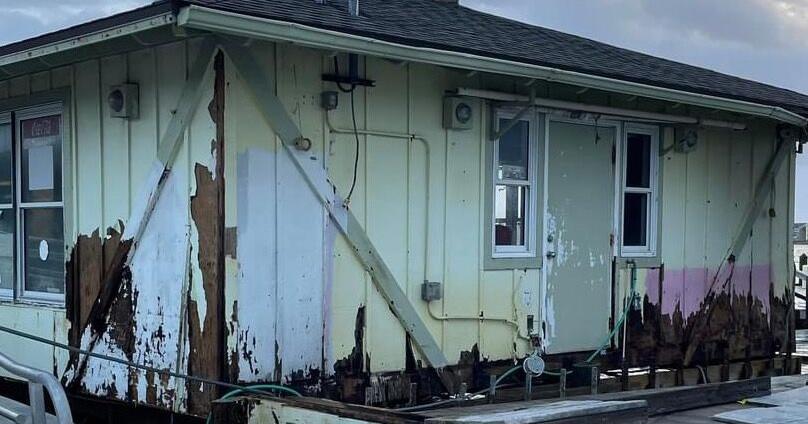
ST. PETE BEACH — The city will rebuild the popular Merry Pier Bait Shack at 801 Pass-a-Grille Way after hurricanes Helene and Milton left it substantially damaged, but commissioners opted for a scaled-down version to reduce costs.
City commissioners unanimously voted to restore the 123-year-old Pass-a-Grille landmark despite it not being designated historic or eligible for historic classification.
“I think this is an important building,” Commissioner Karen Marriott said. “It’s important to the community and a little bit iconic for Pass-a-Grille to have the Merry Pier Bait Shack.”
In 1902, Joseph Merry built a dock and the first store on the Gulf beaches that became the bait shop. He sold bait, tools and eventually groceries, all brought in by boat. His son, Capt. Kenneth Merry, who lived in Pass-a-Grille for 83 years, eventually took over operations.
During World War I, Capt. Merry served in the Merchant Marine. According to an article in the Tampa Bay Times archives, his wife, Blanche, a St. Pete Beach postmaster, wrote: “When Kenneth came back from the Merchant Marine, we were married in Tampa (1920) and lived there three months. Then we came back, took over the store and ran it for eight years. Then came the Depression. It ruined us. We fed a lot of families.”
The Eighth Avenue Pier was named the Kenneth B. Merry Pier in 1979. “It’s quite an honor,” the captain said at the time. “My father rented poles and sold bait from this pier he built.”
St. Pete Beach acquired the property and in 2022 completed significant renovations to restore it as a fully operational fishing and boating destination, including a bait shop, fish market and rentals.
Public Services Director Camden Mills said in April the commission directed staff to provide appraisals and solicit competitive bids to determine if rebuilding the bait shack to current code-compliant standards is feasible.
An investigation by city staff revealed the appraised value of the structure is $210,000, while the cost to rebuild to current building and FEMA standards is estimated at $210,682, not including design and permitting. Insurance will cover $82,121. The cost to demolish the building is $65,688.
“As we are considering rebuilding this structure, there are a few important points to consider,” Mills told commissioners.
First is the FEMA 50% rule. “Based on the numbers, the structure is substantially damaged and would have to be brought up to current code elevations,” he said. “This structure is in the high-risk coastal flood area and because of that would have to adhere to the 50% rule in that coastal area.”
In addition, flood-proofing would be required. “We don’t necessarily have to elevate the structure to the base flood elevation,” Mills said. “An alternative, because this is a commercial structure, is we could either wet or dry proof it.”
Dry flood-proofing involves sealing a building to be watertight with membranes, shields or sealants, while wet flood-proofing allows controlled flooding in lower areas through vents and flood-resistant materials. Recommendations include elevating equipment, sealing openings such as doors and vents, and using resistant materials below flood levels.
Mills said if the city continues with a rebuild, it would have to obtain multiple permits: a city building permit and coordination with the state Department of Environmental Protection and Pinellas County because of the structure’s location over the waterway.
“One option is to demo the building and not rebuild it. Another option would be selective demolition and rebuild the structure to current building codes and standards,” he said.
The city has budgeted $144,650 — including $65,529 in the capital improvement program. “If we did want to move forward with a rebuild, we predict there would be a funding gap that we would have to address,” Mills said.
He added that a decision is needed for the city to renew its submerged land lease for the pier.
Commissioner Lisa Robinson asked if it could be done for less than the $210,000 rebuild estimate.
Mills said that’s possible, noting the design for that structure included flood-proofing that would allow water to flow through. “Essentially, your walls and all your flooring would be waterproof and would have some sort of vent system in it to allow it to be compliant,” he said.
Commissioner Jon Maldonado asked if the city demolished the structure, could it build anything there.
“That’s correct” that it couldn’t, Mills answered.
“So the only option is to rebuild,” Maldonado said. “Maybe, as Commissioner Robinson said, scale back to a bare basic minimum structure. It’s a bait shack and possibly maybe one bathroom.”
The commissioner noted a $106,000 funding gap exists. “We can work with that and move things around in terms of wants versus needs, but I would also like to see that shaved down as much as possible,” he said. “We’re not asking for a state-of-the-art structure or building. We’re just asking for a bait shack that can service both our residents and tourists, who rely on that heavily in our community.”
Mayor Adrian Petrila said he has heard from many residents who would prefer “the city save this landmark in Pass-a-Grille, and so I think if we have a way to pay for it and have it financially viable within a very short amount of time, I think we should do what we can to save this property.”
Maldonado said at several meetings and through discussions beyond his district, he has had no opposition to saving what the city can within reason.
“This is an investment for our community,” he said. “This is something that’s not only going to return pennies and dollars to us annually — this is something that brings our community together. It is a focal point. Families gather there. Although it’s not designated a historic building, it certainly contributes, and it will eventually become, in my hopes, a contributing structure for Pass-a-Grille and for our community.”
Marriott added: “As you pointed out, mayor, I think it’s an investment that will recoup in a relatively short amount of time. I think this one is a pretty easy decision to find the money now to rebuild it.”
Commissioners asked staff to report back with a revised, scaled-down plan.