
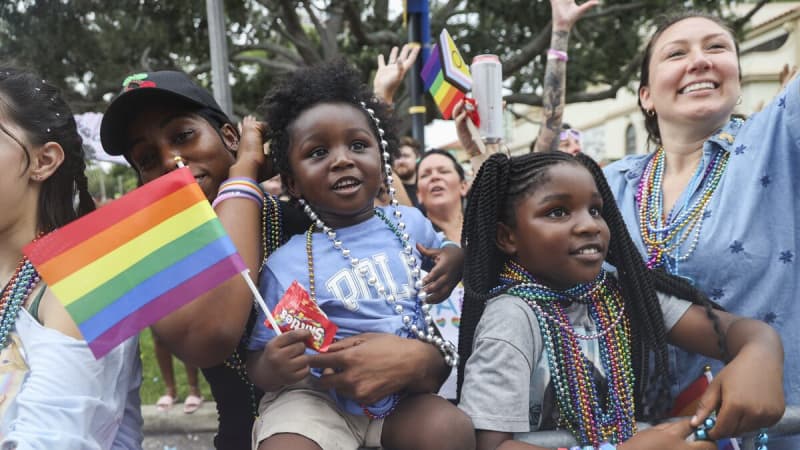
Citing “the current political and economic climate,” Tampa Pride announced in September that it would not host its annual Pride parade next year.
Now, a new organization has formed to put on Pride events in its place.
“Pride was not going to go away because an organization could not do it, so we stepped up,” said Aaron Horcha, vice president of Pride of Tampa. “We started because this is not the year for the LGBT community to not be supported, to not be embraced.”
Pride of Tampa is planning a festival on March 28 at the Cuban Club in Ybor City, Horcha said. The event will feature music, live entertainment and local vendors.The group also is organizing Taste of Pride, a food-focused event,in early March.
Horcha said Pride of Tampa is working with the nonprofit PFLAG Riverview to raise money and organize the festival. The organization filed paperwork to register as a nonprofit in October.
“Our goal is to make sure every demographic of the LGBT community is supported,” said Horcha, who previously worked for St. Pete Pride, the largest LGBTQ+ festival in the Southeast.
Stephanie Foglia, a Pride of Tampa board member, said Pride celebrations are “more important now than ever.”
“We need to be visible,” Foglia said of the LGBTQ+ community. “To remind our political leaders that we exist. That we have voting power. That we have financial power. That we’re not going away.”
Tampa Pride, which for years hosted the city’s annual Pride Festival and Diversity Parade, said in a September Facebook post that it has faced “challenges with corporate sponsorships, reductions in county, state and federal grant funding, and the discontinuation of DEI programs under Florida Gov. Ron DeSantis.”
The organization said it was taking a yearlong hiatus to “regroup, reassess our long-term strategy, and identify additional avenues of funding.” Former president Carrie West told WFLA-TV “there is no guarantee” that Tampa Pride events will resume in 2027.
The move came as federal and state leaders cracked down on efforts to promote diversity, equity and inclusion.
Some Tampa Bay governments responded by quietly scaling back diversity-related programs. In September, St. Petersburg removed the words “diversity” and “equity” from the titles of two city offices. The following month, fearing federal retribution, Tampa suspended the work of its Racial Reconciliation Committee.
Other changes were more visible. Across Tampa Bay, Florida’s transportation department painted over street murals to keep roads “free and clear of political ideologies” — including St. Petersburg’s rainbow Progressive Pride mural.
It was not the first time Tampa Pride has cited a hostile political climate when canceling events.
In 2023, the nonprofit called off its Pride on the River festival — which included drag performances — after DeSantis signed a bill restricting children from attending “adult live (performances).”
“We are afraid if we did go through with this (DeSantis) would come in with his gestapo,” West told the Tampa Bay Times that year.
After the September announcement from Tampa Pride, the leaders of St. Pete Pride said their 2026 events would continue as planned.
St. Pete Pride President Byron Green-Calisch told the Times that the organization has changed its funding model to rely more on donations as sponsorship money has dwindled. The organization lost between $150,000 and $175,000 in sponsorships over the summer, Green-Calisch said.
“It is hard to raise money specifically in a political context when there’s rhetoric vilifying the queer community,” he said. “Businesses do weigh that risk: Am I going to be retaliated in this moment if I choose to support or engage?”
Horcha said Pride of Tampa is relying on corporate and “grassroots” money.
“Pride doesn’t take a hiatus, especially in this political environment,” Horcha said. “We are here to stay.”