
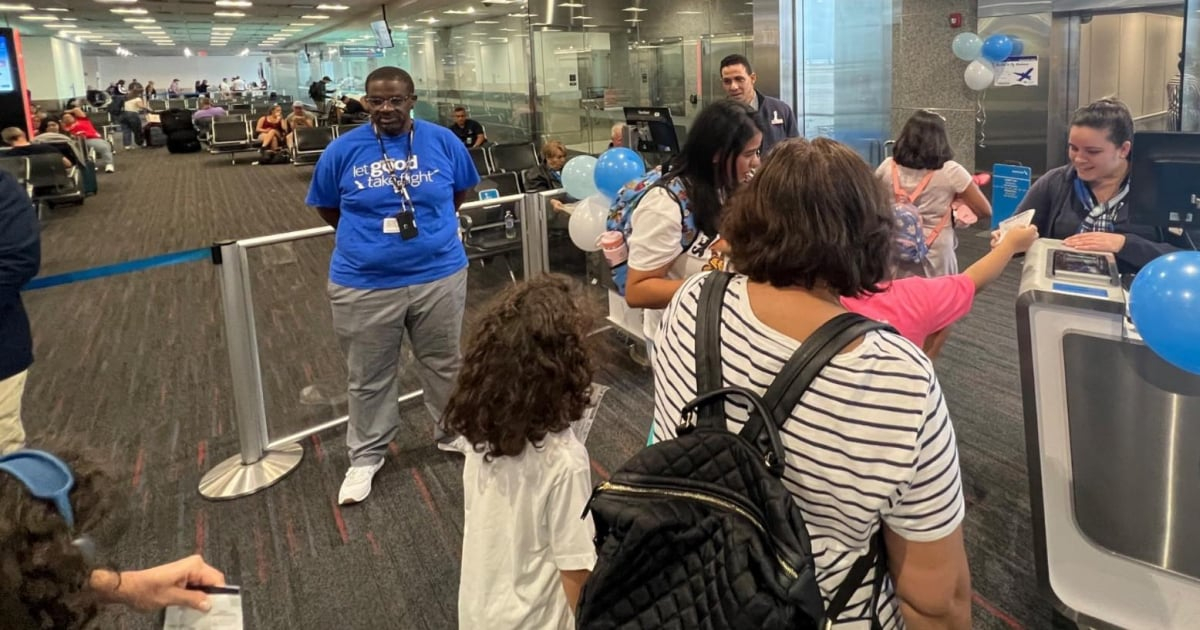
The airports in South Florida are facing an unprecedented holiday season, with millions of passengers projected to pass through their terminals between late December and early January.
According to a report from Telemundo 51, Miami International Airport (MIA) expects the arrival of 3.3 million travelers between December 19, 2025, and January 5, 2026, representing a 3% increase compared to the same period last year.
The busiest days are expected to be December 26 and 27, as well as January 2 and 3, with more than 190,000 passengers daily.
To accommodate this influx, MIA inaugurated the new Ibis Garage on December 19, adding 2,240 spaces to the Dolphin and Flamingo garages, reaching a total of 10,500 spots, the highest number in the airport’s history.
Authorities advise travelers to arrive at least three hours in advance to complete check-in, go through security checks, and park without issues. They also recommend completing online check-in and checking the mobile app or the airport’s website for updated flight information.
Additionally, passengers have options such as the Economy Park and Ride, which offers lower rates, and valet parking services in front of gates 2 and 20 of the Dolphin and Flamingo garages. Those who are only picking up passengers can use the Cell Phone Waiting Lot, which has 60 free spaces near LeJeune Road and NW 31st Street.
The TSA reminds travelers that, since July, they can keep their shoes on during security checks, but suggests carrying medications, documents, chargers, and a change of clothes in their carry-on luggage due to potential delays in accessing checked baggage.
Fort Lauderdale-Hollywood International Airport (FLL) is projected to handle 2.1 million passengers during the same season, with peaks of over 124,000 people per day.
Critical dates include the weekend before Christmas and New Year’s, as well as the first weekend of January.
Authorities recommend arriving two hours early for domestic flights and three hours for international flights, checking the REAL ID regulations, and taking advantage of the airport’s free app to check flight and parking status.
The terminal has more than 11,000 parking spaces, but warns that they could fill up quickly, so it suggests considering ridesharing or valet services.
Airports have also enhanced security and accessibility measures: special lanes for individuals with limited mobility and the use of Mobile Passport Control to expedite entry.
These actions aim to minimize delays and ensure that the peak season runs smoothly, although it is expected that congestion and the massive flow of passengers will continue to create logistical challenges.
Problematic start to the holiday season
The high season began with significant difficulties for passengers.
Both FLL and MIA reported dozens of delays and cancellations, particularly on Saturday, December 20, the day before Christmas.
In the first one, there were 265 delayed flights and 11 cancellations, affecting airlines such as United Airlines, Spirit, Frontier, Air Canada, American Airlines, and JetBlue.
The destinations with the most delays included Newark, Toronto, Atlanta, Charlotte, and Chicago O’Hare.
Miami International also reported 275 delays and three cancellations, primarily impacting flights to London Heathrow, Toronto Pearson, Atlanta, Charlotte, and Chicago O’Hare, with the greatest effect on American Airlines, Delta, United, and JetBlue.
These disruptions reflected not only the usual increase in passengers during the holidays but also the pressure on airport infrastructure to manage a massive flow of domestic and international flights.
Authorities emphasize that advance planning is key: checking the flight status, arriving with enough time, and activating alerts in the official airline apps to receive real-time information.
Patience and advance preparation become essential to avoid setbacks in a season where every minute counts.