
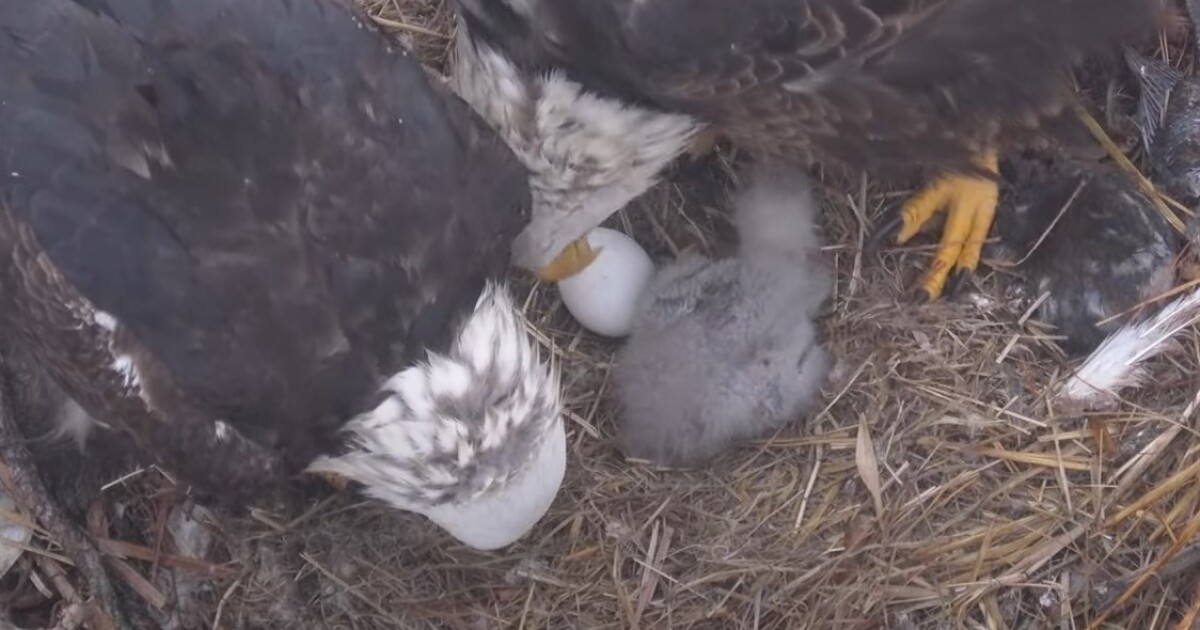
It’s nearly a certainty that E26 will be an only eaglet.

Southwest Florida Eagle Cam
E26 is fed by F23 Sunday (Dec. 28) morning while sitting next to the unhatched second egg. There are a litany of reasons why the second egg may not have hatched. It is well beyond the outer time span (40-41 days) for hatching.
The second egg — laid November 15 — is past the 40-day benchmark for a successful hatch and the hope for a “Christmas Miracle” has come and gone like so much holiday gift wrapping.
Breeding pair F23 and M15 can be seen on the Southwest Florida Eagle Cam as they continue to dutifully roll the egg. But it’s probable that their ministrations will be for naught. They are also dutiful in their care and feeding of E26 with the fuzzy little chick continuing to thrive and grow.
One viewer on that cam, who goes by the name Elfruler, is a retired university professor and an avid birdwatcher, especially for eagles.
Elfruler has a web site devoted to eagles, a YouTube channel capturing videos of eagles in nests at several locations, a listing of links to nest cameras around the U.S. and Canada and a blog.
Elfruler said they couldn’t provide an exact cause for why the egg at the North Fort Myers nest didn’t hatch, only suggest some possibilities.
“If the ovum was never fertilized, there would be no embryo, so nothing to hatch. If it was fertilized and an embryo began to develop, many things could interrupt that process so that the embryo eventually was nonviable. This could include biological or chemical contaminants. Note that both eggs would be likely to have been exposed to such contaminants,” Elfruler said. “Another possibility is that something happened to the second egg that might have damaged it before the embryo inside could successfully pierce the shell membranes and the shell. Even examining a retrieved egg would be unlikely to reveal what that damage was and how it was caused.”
The possibilities for the failure are endless. So-much-so that Elfruler’s web site has a sizeable section called “When Bald Eagle Eggs Don’t Hatch.”
The site also lists data collected from 2006-2020 from bald eagle video cameras that yielded a body of statistics about eggs, hatches, and fledges.
“Over the 15-year period, 20.8% of the eggs laid at these nests were lost or never hatched,” Elfruler said. “This falls within the range of 10%-25% of unhatched eggs that is suggested in published research.”
Furthermore, Elfruler writes, “if an egg remains unhatched, it is either unfertilized (sometimes referred to as infertile) or nonviable (or inviable). Infertility is an issue concerning the reproductive processes of one or both parents. Nonviability (not able to live or survive) is an issue with the development of the embryo. In only about 5% of the losses in the Table were eggs determined with certainty to be infertile or nonviable. This page explores what might cause infertility and nonviability.”
The failure list is rather exhaustive. If you’d like to delve deeper on Elfruler’s site, here’s a link to the information.
For the North Fort Myers nest, the likely scenario is that the unhatched egg will eventually deteriorate and fall apart. Meanwhile, F23 and M15 will continue to care for E26 and the chick will grow until it’s ready to fledge in several months.
WGCU will keep track of E26’s progress and report further on the chick’s life.
1 of 35
— sat eagle.JPG
The female side of the North Fort Myers breeding pair of Harriet and M15 has not been seen around the Bayshore Road nest for 24 hours, raising a slew of concern, worry and comments from the thousands of online viewers of the Southwest Florida Eagle Cam. Shown above is M15 during a Saturday afternoon moment with the nest’s two eaglets, E21 and E22.
SWFL Eagle Cam / Special to WGCU
2 of 35
— mom and dad eagle.jpg
A second egg was confirmed at the North Fort Myers nest of bald eagles F23 and M15 Saturday night shortly after 7 p.m.
Southwest Florida Eagle Cam
3 of 35
— 2 eggs eagle.JPG
Southwest Florida Eagle Cam / Special to WGCU
4 of 35
— eagle egg and eaglet b.jpg
Mom F23 keeps a watchful eye Tuesday on eaglet E26 and the as yet unpipped send egg in the Bayshore Road nest in North Fort Myers.
Southwest Florida Eagle Cam
5 of 35
— Eagle eggs.jpg
The first pip seen in one of two eggs in the North Fort Myers nest of Harriett and M15 was seen when M15 got up to reposition himself on the eggs Tuesday morning.
Southwest Florida Eagle Cam / Special to WGCU
6 of 35
— eagle 2.JPG
Southwest Florida Eagle Cam / Special to WGCU
7 of 35
— EAGLE 1.jpg
Southwest Florida Eagle Cam
Special to WGCU
8 of 35
— Eagle and shell.JPG
Southwest Florida Eagle Cam / Special to WGCU
9 of 35
— eagle and eggs.JPG
There are now two eggs being incubated in the nest of bald eagles M15 and F23 in North Fort Myers. A second egg was laid shiortly before 2 p.m Monday.
Southwest Florida Eagle Cam / WGCU
10 of 35
— Eagle and shell.JPG
Braun, Michael
11 of 35
— eagle and eggs.jpg
Two eggs, laid November 8 and November 11, were closing in on the average 36-day incubation period when the first egg showed a pip and the hatch began. The eggs are the second clutch of eggs from F23 and M15. E24 was hatched at 4:01 p.m. Saturday.
Southwest Florida Eagle Cam/Dick Pritchett Real Estate / WGCU
12 of 35
— EAGLE EGGS 2024.jpg
The Southwest Florida Eagle Cam keeping eye on the North Fort Myers eagle nest is in hatch watch mode with the likelihood of an earlier than normal hatch.
The Southwest Florida Eagle Cam / WGCU
13 of 35
— Eagle and shell.JPG
Braun, Michael
14 of 35
— Eagle1.JPG
Braun, Michael
15 of 35
— Eagle2.JPG
Braun, Michael
16 of 35
— Eagle and shell 2.JPG
A screengrab from the Southwest Florida Eagle Cam shows the fluffy form of E21, the hatched eaglet from Harriett and M15’s first egg from 2022, which emerged from its egg shortly before 8:30 Wednesday night.
Southwest Florida Eagle Cam / Special to WGCU
17 of 35
— Eagle egg 2025.jpg
M23, the male half of the breeding eagle pair at a North Fort Myers nest, tends to the egg his partner, F15, laid earlier ion the week. A second egg could be coming if past efforts are an indication.
Southwest Florida Eagle Cam
18 of 35
— Eagle and shell 2.JPG
Southwest Florida Eagle Cam / Special to WGCU
19 of 35
— Bald Eagle secondary.JPG
The bald eagle was found tangled in vines along the ground
von Arx Wildlife Hospital / WGCU
20 of 35
— Eagle and shell 2.JPG
Braun, Michael
21 of 35
— Eagle at night 9p.m..JPG
Harriett taking a break from incubating on Tuesday night around 9 p.m.
Southwest Florida Eagle Cam / Special to WGCU
22 of 35
— mom and dad eagle and eggsb.jpg
The breeding eagle pair at a North Fort Myers nest produced their first egg for this breeding season earlier this week. A second egg was confirmed Saturday afternoon. Above, F23, the female in the North Fort Myers breeding pair, tens to the eggs Sunday morning.
Southwest Florida Eagle Cam.
23 of 35
— feeding eagles B.JPG
SWFEC / Special to WGCU
24 of 35
— swfl eagle cam Harriet screen grab.png
The eagle pair inhabiting a North Fort Myers site along Bayshore Road welcomed their first egg of the 2022 nesting season Tuesday night.
Southwest Florida Eagle Cam / Special to WGCU
25 of 35
— Eaglet face.PNG
The newest eagle from the breeding eagle pair of Harriett and M15 in North Fort Myers, named E21, was hatched at 8:22 p.m. Wednesday, the time confirmed by Southwest Florida Eagle Cam on the 24-hour web cam site.
Southwest Florida Eagle Cam/Special To WGCU
26 of 35
— Eaglet hatched E21
The newest eagle from the breeding eagle pair of Harriett and M15 in North Fort Myers, named E21, was hatched at 8:22 p.m. Wednesday, the time confirmed by Southwest Florida Eagle Cam on the 24-hour web cam site.
Southwest Florida Eagle Cam/Special To WGCU
27 of 35
— Eaglet.jpg
Scenes from an eagle nest
Southwest Florida Eagle Cam / Special to WGCU
28 of 35
— Chickyb.JPG
Scenes from an eagle nest
Southwest Florida Eagle Cam / Special to WGCU
29 of 35
— e23.JPG
Scenes from an eagle nest
Southwest Florida Eagle Cam / Special to WGCU
30 of 35
— IMG-7003.JPG
M15 and a female “friend” perch on the nest tree in North Fort Myers. The Southwest Florida Eagle Cam cameras were reactivated Friday, heralding the start of Season 12 of the breeding eagle “show” in North Fort Myers. After much drama last year, including the disappearance of Herriet, the breeding female, this year will have just as much with the possibility of the male, M15, matching up with a new female.
Southwest Florida Eagle Cam / Special to WGCU
31 of 35
— second pip.JPG
A second pip was seen, but not yet confirmed, on the Southwest Florida Eagle Cam web site.
Southwest Florida Eagle Cam / Special to WGCU
32 of 35
— 2 eggs.JPG
A second egg for North Fort Myers eagles Harriet and M15 was produced Dec. 2 at 8:09 p.m.
SWFL Eagle Cam / Special to WGCU
33 of 35
— WGCUSWFLEagles020224AM
One year after the disappearance of Harriet, the beloved eagle cam eagle, M15 and F23 have taken to raising their first eaglet as a new pair. The eaglet is about a month old and could be seen above the sides of the nest Tuesday morning, February 2, 2024. F23 took over the nest this summer.
Andrea Melendez / WGCU
34 of 35
— M15 calling.JPG
The female side of the North Fort Myers breeding pair of Harriett and M15 has not been seen around the Bayshore Road nest for 24 hours, raising a slew of concern, worry and comments from the thousands of online viewers of the Southwest Florida Eagle Cam. Shown above M15 calls out a warning as the nest’s two eaglets, E21 and E22, nap.
SWFL Eagle Cam / Special to WGCU
35 of 35
— New pip pic.JPG
Pips have been seen in both eggs in the North Fort Myers nest of bald eagle mated pair M15 and F23.
Southwest Florida Eagle Cam / Special to WGCU
More on the North Fort Myers eagles
WGCU is your trusted source for news and information in Southwest Florida. We are a nonprofit public service, and your support is more critical than ever. Keep public media strong and donate now. Thank you.