
Local Leaders Say Proposed Ferry Hub will Divorce Community from Water
Members of Community Board 1 (CB1) have reservations about designs for a new ferry terminal at the southern tip of Manhattan that is being developed as part of the FiDi and Seaport Climate Resilience Master Plan, which will rebuild the nine-tenths of a mile between the Brooklyn Bridge and the Battery with flood defense infrastructure. This initiative recently passed its 30-percent design milestone.
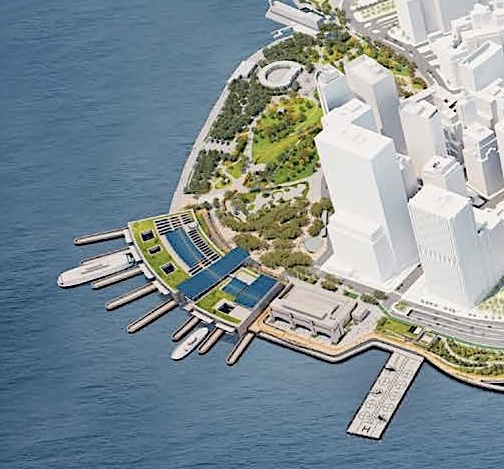
Plans for the new ferry hub envision demolishing the existing Staten Island Ferry Terminal, and erecting a new building slightly to the west of the current structure’s location, on the site of the existing U.S. Coast Guard headquarters (which will be torn down). Once the first half of the new building – to be constructed at a higher elevation and incorporate various flood-protection measures – is complete, Staten Island Ferry operations will be moved there and the existing ferry terminal will be demolished. This will make room for the new building to double in size, so that the adjacent Governors Island Ferry can move into the additional space. The new combined ferry terminal serving both Staten Island and Governors Island is budgeted at $1.6 billion, a price that has inflated by $100 million since last spring. (For comparison, the existing Staten Island Ferry building – which is relatively new, having been completed in 2005 – was delivered at a cost of $200 million.)
The Battery Maritime Building, which currently houses the Governors Island Ferry, is a legally protected landmark and will not be demolished under this plan. It will, however, cease to function as a ferry dock, and instead be completely enclosed by flood walls. On the land side of the new ferry terminal and the Battery Maritime Building, the plan calls for refurbishment of Peter Minuit Plaza and the creation of new pedestrian plaza on a deck over the FDR Drive approach to the Battery Park underpass.
The net effect of these plans will be to cut off the public’s physical and visual access to the waterfront for a quarter of a mile, with that stretch of waterfront being occluded by large structures of steel and concrete. The exception to this will be a green roof” atop the new ferry hub, which planners tout as an opportunity to manage stormwater runoff, cool the building, and “foster biodiversity.” But this amenity will not be open to the public, in part because it is likely to house specialized gear such as irrigation equipment and solar power cells.
At a January 12 CB1 meeting, members reviewed these plans. Laura Starr, who is also landscape architect, said, “it’s critical to be able to have continuous greenery from the Battery, over the roof of the Staten Island Ferry building and then around. What we need as residents here is continuous green space, not just a morsel of it here or there and then more pavement and more views that have been off. The public should be able to enjoy the best views in the City out to the harbor. Why should that be restricted?”
She continued, “we have to emphasize continuous green, because there’s just so little of it. In Hudson River Park, there are little strips of green. Battery Park City doesn’t have much immersive greenery. The Battery has immersive green, but this plan takes a lot of it away by blocking views with the new ferry building.”
Ms. Starr added, “cutting off the circulation through green space is a travesty. We have this opportunity now to give Lower Manhattan its own Brooklyn Bridge Park and we’re not doing it.”
Chair Tammy Meltzer said, “it is just a giant cement wall for the Battery Maritime Building. They’re just walling it in. With so many smart engineers, why can’t we find a different way to protect the Battery Maritime Building instead of cementing in the entire thing. This very much makes the building one for the haves and have-nots. You’d never know there’s water on the other side, because the entire building is privatized.”
Rosa Chang said, “when I look at the ferry hub rendering, I have to admit it makes me really sad. When we look at the site plan for the overall perimeter, what bothers me about it is that you’re walking behind the building for so long, it really does divorce you from any experience of the waterfront.”
Former CB1 chair Catherine McVay Hughes, who headed the Board during 2012’s Hurricane Sandy and remains a local advocate for resiliency measures, told the Broadsheet, “the ferry hub is a necessary component of the FiDi-Seaport vision. I share the concerns that the hub will reduce waterfront views. The best way to compensate for that is to improve the waterfront experience nearby, by taking down the FDR Drive viaduct south of Brooklyn Bridge, while also greening the East River esplanade and related infrastructure.”