
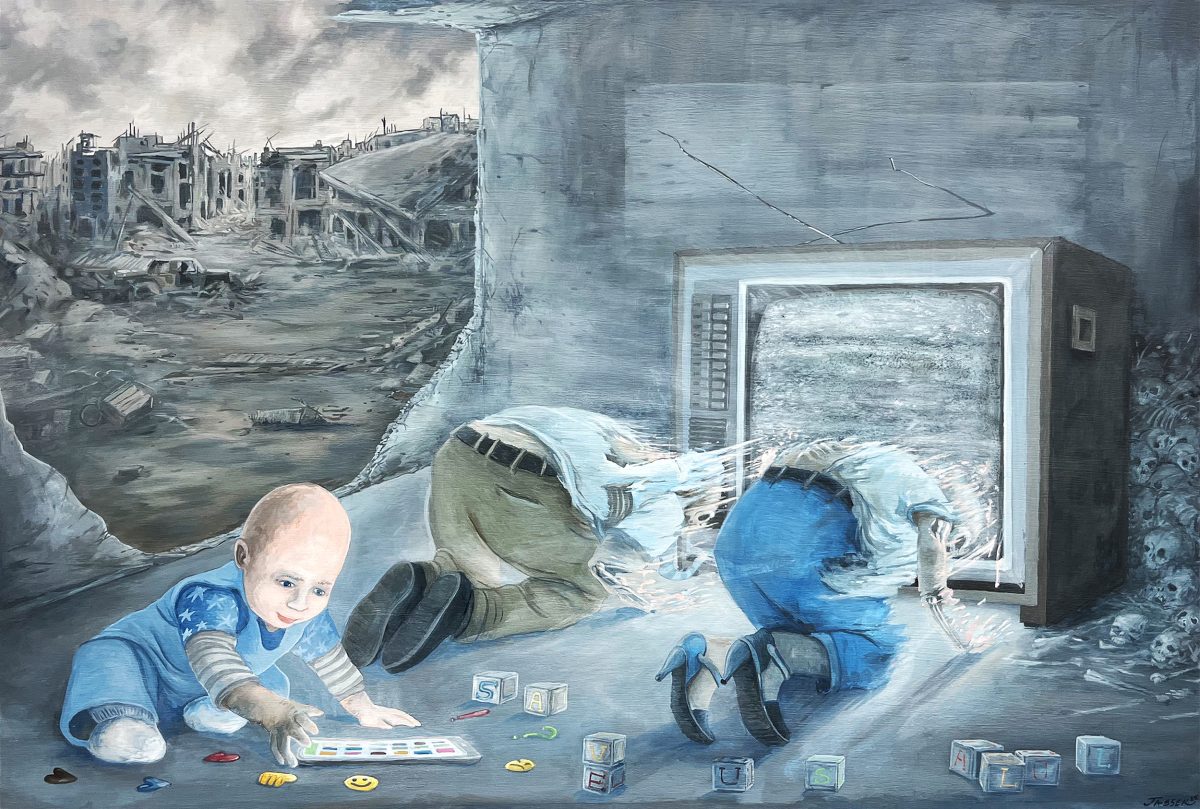
A leap of the imagination
“Are You Seeing What I’m Seeing?” opens Friday at the Manhattan Beach Art Center
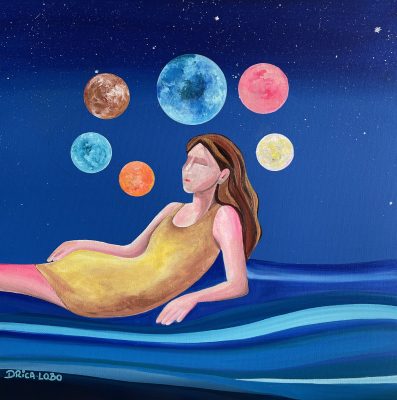 Drica Lobo, “Orbit of Being”by Bondo Wyszpolski
I have mixed views about art, and often they fight one another. Which I encourage. And while I maintain a healthy respect for the Old Masters — Vermeer, Chardin, Rembrandt, Sargent, Manet, and so on — that is to say the exquisite work of art, fine-boned, mannered and elegant, I also think that art should jump down from the wall and slap us around. A shake up so we wake up.
After all, art is not just the candle flame, it is also the forest fire, and the artist should at times be as fearless as a matador or a rattlesnake handler. The artist should be mindful, yes, but willing to be reckless, to exceed the speed limit. While art is not always about precision, I feel it should be about risk and exploring new ideas. To quote Karl Ove Knausgaard, “Art lives by transgressing boundaries, by going beyond what everyone has agreed to see and think.”
Art demands the right to be confrontational, to step in front of us and say, Hold on! Where do you think you’re going? Show me your papers!
But very few artists dare to be outrageous. They fear the PC police and so they police themselves by painting the same tired subjects in the same tired manner. In this era of not stepping on toes, we forget that art is about stepping on toes. Not all art, of course; we can always admit the defanged and the declawed, but why, if we may be rhetorical, are you still painting flowers in 2026? You’ll never duplicate the vibrancy of van Gogh or the delicacy of the many 17th Century Dutch floral painters. The world has had it up to here with wallpaper art. “I am an artist,” wrote Gottfried Benn, “I’m interested in countercurrents.” Don’t make ripples; make waves. Learn the rules — and then push your way past them. Art allows you that freedom. Take it.
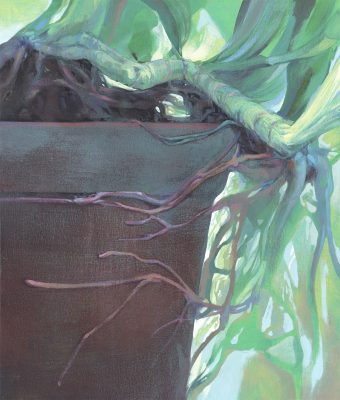 Hannah Smoot, “A Quick Response”A “prompt” response
The Italian futurist Marinetti called himself “the caffeine of Europe.” Who is the caffeine of the South Bay? Who is our Goya? Our Käthe Kollwitz? Our Lucien Freud or our sacrilegious Félicien Rops? Art should be provocative, but provocation alone is not art. It requires sensibility above all, and imagination.
I’m fully aware that you’ll find very little of this in our local galleries. If you paint a picture of our President with his limbs snipped off, believe me, no gallerist will touch it. Religion, sex, politics, you have to tread very carefully. But sometimes you can suggest or infer such things and then maybe, just maybe, you’ll sneak in under the radar.
Which brings us to “Are You Seeing What I’m Seeing?” which opens on January 16 at the Manhattan Beach Art Center and features new work by 36 artists. Schoolkids are frequent visitors, and so those youngsters (meaning their parents) needed to be factored in.
Five years ago, a few colleagues and I formulated an exhibition we called “Are You Thinking What I’m Thinking?” and it was shown at the Palos Verdes Art Center, the Malaga Cove Library Art Gallery, and the Muckenthaler Cultural Center in Fullerton. Here’s how it evolved: Several “titles” (actually drawn from my reservoir of potential chapter headings for never-written novels) were placed into fortune cookies and the fortune cookies were then taped to a wheel of fortune, and in turn each artist stepped up, spun the wheel, got their title (that is, the title of the work they were to create), and the results were often surreal and amusing.
Titles like “Who’s Whistling at My Antiquities?”, “Waking Up in My Halloween Costume”, and “From Swan Lake To Swanee River” ended up in the hands, respectively, of Steve Shriver, Bernard Fallon, and Stephen Mirich, and the results were delightful and delicious. I’d like to revive this concept someday because I have a crop of new titles such as “Three Ways to Convince Andrea to Help Mow the Lawn” and “The Faster You Dance, the Less Bullets I’ll Use.”
But today we’re trying something a little different.
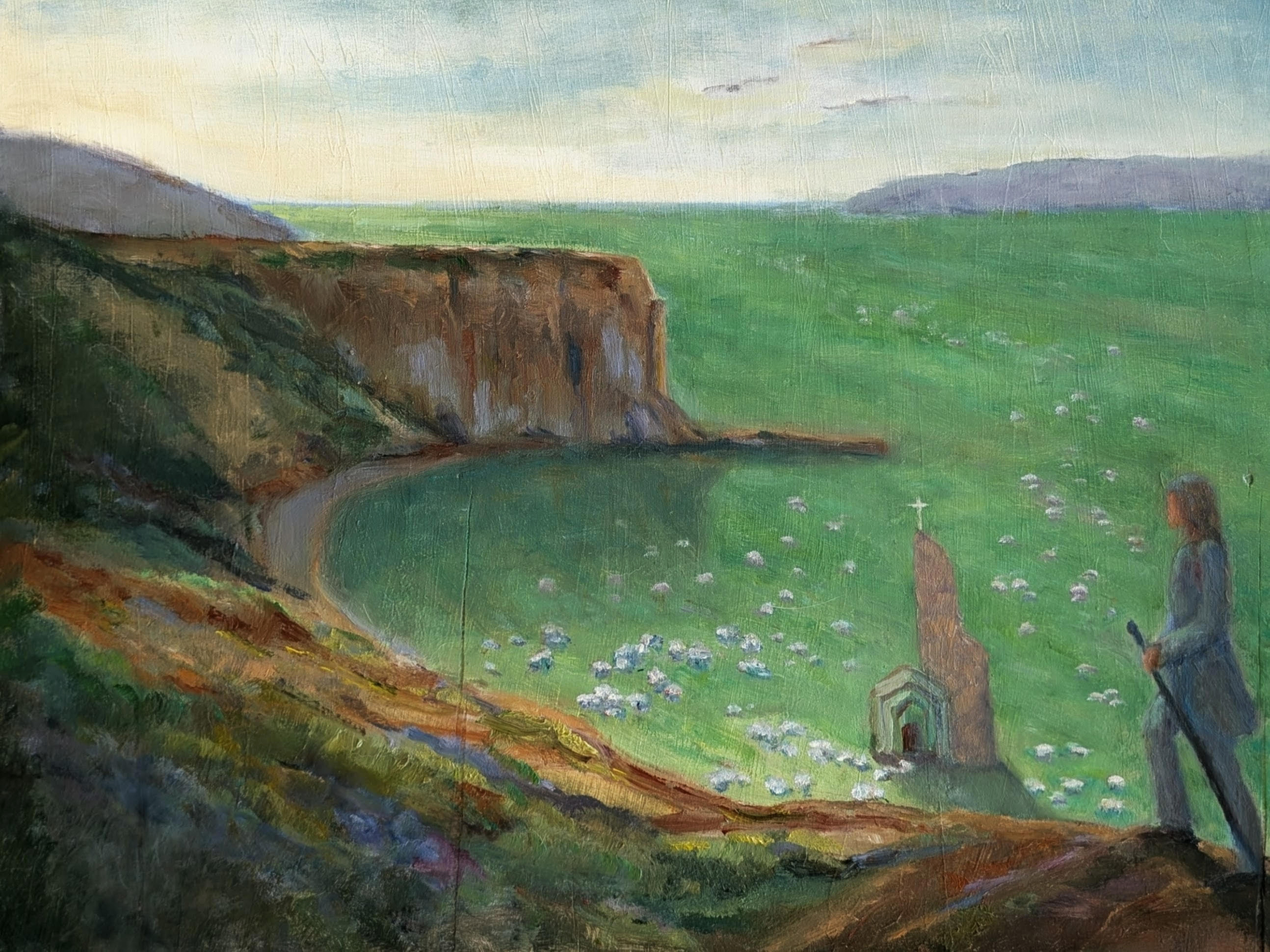 Debbie Giese, “The Wondering Wayfarer”My colleagues and I — Fei Alexander, Debbie Giese, Bernard Fallon, Eileen Oda Leaf and Karen Wharton — selected 62 short descriptions, or prompts, which were then separated into ten themes or categories. These included Marine and Coastal, Mythical/Biblical, and Death and Disorder. We then reached out to various artists, explained the unconventional scheme we had in mind, and fortunately most of them said variations of “Yes, count me in!”
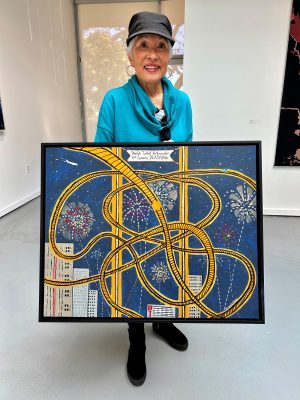 Bronnie Towle with “DEATH Wish”So where did these descriptions come from? Well, in one of my sprawling, unfinished novels I have several characters who visit numerous museums and galleries, all of them imaginary, and for dozens of pages they examine and comment upon the works that they see. These pictures, like the venues showing them, do not exist, but I’ve described them nonetheless. That’s where these descriptions originated. For our purposes, however, we excluded the ones that were too silly or provocative, these being, as one might guess, of a political, heretical, or deviantly sexual nature. Tsk, tsk. You’ll never know what you’re missing.
Each prospective artist was given the entire list of 62 descriptions to mull over, and if they happened to choose the same prompt as someone else, well, so much the better. This in fact happened in a few cases such as: “A beautiful, well-lighted seascape or woodland scene, but with a terrible, angry black sky hovering over it.” To my disappointment, no one wanted to illustrate “We spent an hour looking at their mummified dog collection,” although viewers will have a chance to see Mark Fenton’s interpretation of “A mechanical bull with the head of Marilyn Monroe, and people lining up to ride on it.”
One might ask, and I’m glad you did, why have the artists chosen the descriptions they did? What piqued their imagination? I solicited a few replies:
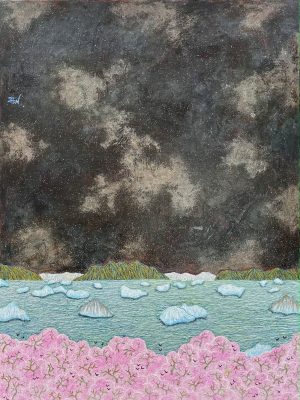 Hung Viet NguyenHow the wheels began to churn
Hung Viet Nguyen selected the description mentioned above, the one with the furious sky and the pleasant foreground, which he not only found surreal but, he says, “gave me much inspiration to challenge myself into new work. I visited Iceland not long ago; the melting icebergs are still in my mind and I’m pretty much concerned about global warning.”
Larry Manning picked a description from our “Quirky” category. The prompt suggested that the work would be placed flat on the floor or carpet and looked at from above, as if the viewer is peering into a deep hole.
“I employed AI to compile 100 divisive slogans and narrowed them down to 20 from each side of the political split. I used them to create a satirical composition that shows well-intentioned people, signs aloft, spiraling down to a literal well of hell, intolerance paving the descent. I hope the painting has enough shock value to make viewers reconsider, and start a conversation along the lines of ‘the end game being intolerant of intolerance.’” Larry then pointed out that “I never do paintings with social commentary; this is a first. I hope it is meaningful.”
Of course, and like Hung’s painting, poignant and relevant today.
Bronnie Towle selected the prompt, “A bad day at the theme park (you pick the ill-fated ride).” And why this one? “I think it was the imagery of an exciting carnival ride juxtaposed with the impending fear that something disastrous could happen. I have always been fearful of high roller coasters… What could be more terrifying than to fly off the rails! Hence the title “DEATHwish.”
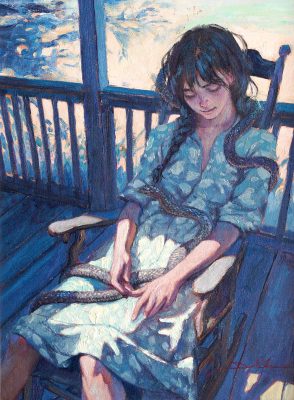 Daniel Gonzalez, “Alone with Her Snakes”Daniel Gonzalez was intrigued by “She spent the day alone on the veranda in her rocking chair, alone with her serpents.” He made several preliminary sketches that he shared with us.
“What immediately appealed to me was the quiet strangeness of the description. I wanted to make a painting that invited the viewer to look a little closer, to almost do a double-take. At first glance, she (the young woman) seems peaceful, resting in the warm afternoon light, but the longer you look, the more the scene reveals itself.
“To that effect,” Daniel says, “I played with contrast throughout the painting. The straight, rigid lines of the veranda frame her in place while the curved fluid bodies of the snakes weave around her form. I kept most of the snakes in the shadow, so the hands and lap become a focal point, allowing the viewer to discover the serpents gradually rather than all at once.”
Furthermore, he adds, “The bleached warm highlights lay against very cool deep shadows. The interplay of temperature and value helps soften the surreal moment into something intimate and calm, almost dreamlike… I wanted the painting to hold that tension between serenity and unease, beauty and strangeness — and to reward anyone who stays with it for a few extra seconds.”
Lastly, as one more example of the diverse subjects that will be on view, Fei Alexander explains why she chose to illustrate this prompt: “1950s American tract homes in the foreground, T’ang dynasty landscapes, like in old Chinese scroll paintings, in the distance and above them.”
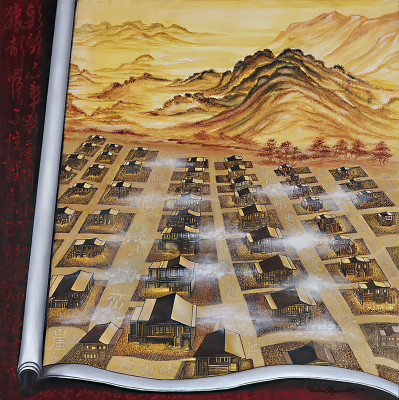 Fei Alexander, “Scroll of the Time and Culture”“This choice was influenced by my instinct as a native Chinese regarding the phrase ‘T’ang dynasty,’” Fei says. “Having practiced traditional Chinese ink paintings from an early age, the aesthetics of T’ang dynasty landscape art have become an integral part of my artistic expression.
“I researched 1950s American tract houses and employed a bird’s-eye view composition. I then started by painting a fictional traditional T’ang dynasty landscape on the upper section of the canvas to set the tone and ambiance of that era, then gradually incorporated the American tract house structures. By employing the format of a T’ang dynasty handscroll, I transformed this East-West convergence into a dynamic Chinese scroll painting — essentially a painting within a painting that intertwines diverse cultures and historical epochs.”
Another artist, Judy Herman, tackled the same description, and viewers will find parallels as well as divergencies in both works.
Open minds, open eyes
What I’ve endeavored to say is that art is more savory when spiced with awe and wonder. One doesn’t need to rely on the cattle prod to evoke a reaction, but at the same time the beauty of an artwork does not have to depend on the beauty or morality of its subject. Take a familiar subject, or object, and re-envision it so that we see in it an unfamiliar light that captures our attention.
For example, an image of an airliner gliding through a bright blue sky may look sleek and graceful, but the airplane itself is not generally a memorable sight. What’s memorable is the plane on fire and plunging down from a sky that can no longer support it. Metaphorically, that’s where the art is — in the plunge. Beauty with a slight tic or blemish is always more intriguing.
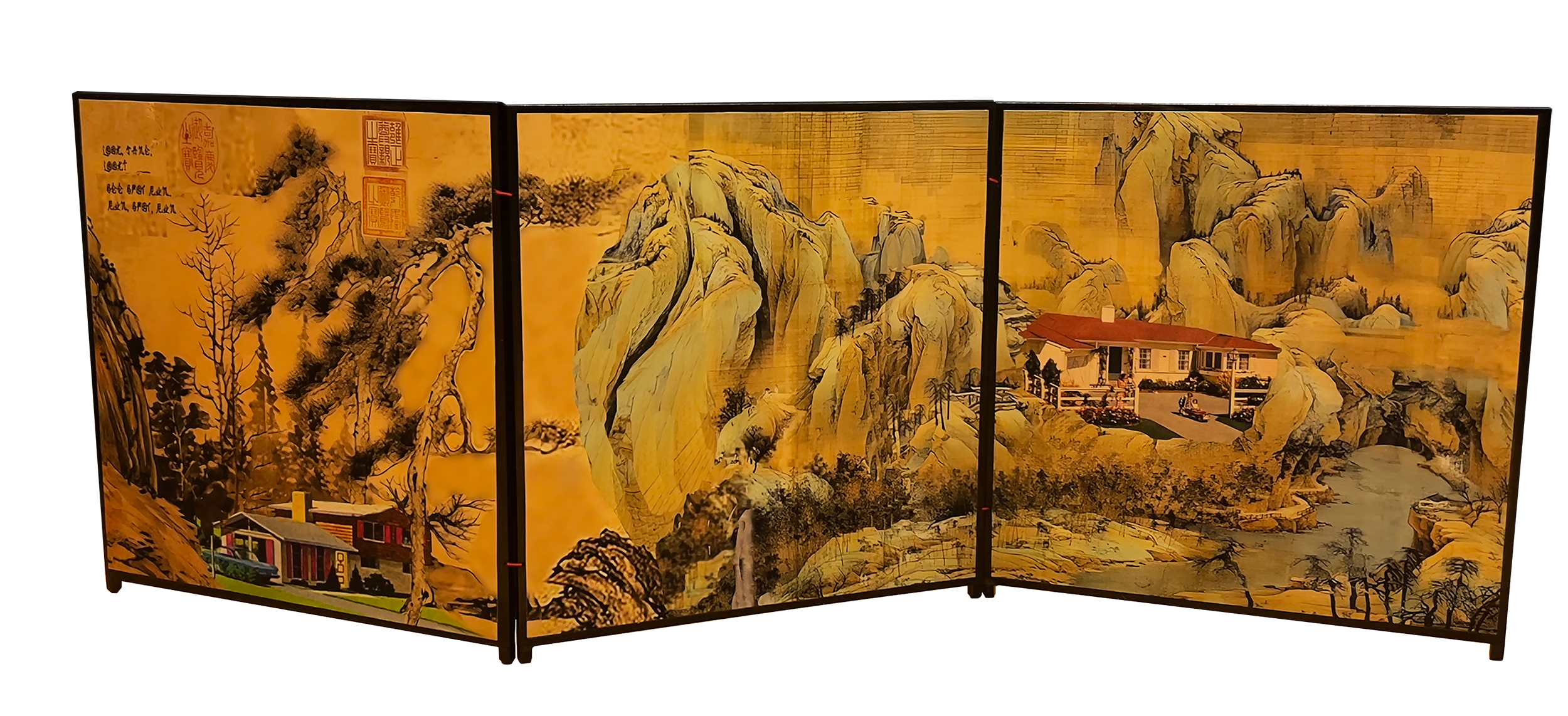 Judy Herman, “No Place Like Home”And yet, for all that, this exhibition is a fun show where diversity of subject matter, passion and imagination have yielded an abundant harvest from the seeds of fruitful thinking. You’ll come and join us, won’t you?
Our website is: www.areyouthinkingwhatimthinking.art
Are You Seeing What I’m Seeing opens on Friday, Jan. 16, with a reception from 6 to 8 p.m. in the Manhattan Beach Art Center, 1560 Manhattan Beach Blvd, MB. Hours, Wednesday and Thursday from 10 a.m. to 9 p.m.; Friday, Saturday, and Sunday from 10 a.m. to 5 p.m; closed Monday and Tuesday. Special programming to be announced. Closes March 29. Call (310) 802-5540 or visit manhattanbeach.gov. PEN