
 Ira L. Black/Getty Images
Moneywise and Yahoo Finance LLC may earn commission or revenue through links in the content below.
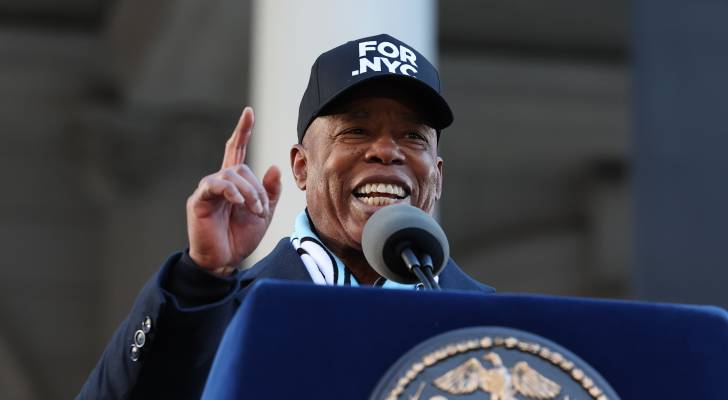
Housing affordability is one of the biggest challenges New York City’s new mayor Zohran Mamdani is trying to tackle. But old remarks from one of his top housing appointees have ignited a political firestorm — prompting former mayor Eric Adams to weigh in.
“Homeownership is how immigrants, Black, Brown and working-class New Yorkers built stability and generational wealth despite every obstacle,” Adams wrote in a fiery post on X (1). “You have to be completely out of your f—-ing mind to call that ‘white supremacy.’”
Adams included a screenshot of a 2019 tweet from Cea Weaver, whom Mamdani recently appointed as director of the NYC Mayor’s Office to Protect Tenants.
Weaver’s tweet read: “Private property including and kind of ESPECIALLY homeownership is a weapon of white supremacy masquerading as ‘wealth building’ public policy.”
The backlash extended beyond City Hall. U.S. Assistant Attorney General Harmeet Dhillon said on X that the Justice Department “will NOT tolerate discrimination based on skin color” and is “paying very close attention” to what is happening in New York City (2).
Adams added that Weaver’s remarks reflected “extreme privilege and total detachment from reality.”
Others echoed his view that homeownership has long been a crucial wealth-building tool — and not one limited to any racial or ethnic group.
“The truth is that homeownership is a central mechanism of Black wealth, the way in which Blacks in America have pulled themselves up by the bootstraps,” Marlon Rice, a candidate for the New York State Senate’s 25th District, said (3).
In a Substack post, Rice described how his stepfather, born and raised in the Farragut Projects of Brooklyn, worked extra shifts to buy a brownstone in Clinton Hill in 1979 (4).
“Purchasing his home was a tool to help uplift his family out of poverty, not a tool of white supremacy,” he wrote.
According to the NYC Commission on Racial Equity, 32.7% of Black families in the city own their homes compared to 46.6% of those who identify as white and 51% of those identifying as Asian (5).
Story Continues
Across the country, homeownership remains a major path to building wealth. But high home prices — combined with elevated mortgage rates — have become a significant barrier for households trying to get started.
Realtor.com estimates that a typical U.S. household now needs to earn about $118,530 a year to afford a median-priced home of $402,500 — more than 50% above the median household income of roughly $77,700 (6).
In places like New York City — where the average home price is roughly double the national figure — families would need substantially more (7).
The good news? These days, you don’t need to buy a home outright to start building wealth with real estate.
Crowdfunding platforms like Arrived have made it easier than ever for everyday investors to gain exposure to America’s real estate market.
Backed by world-class investors like Jeff Bezos, Arrived allows you to invest in shares of rental homes with as little as $100, all without the hassle of mowing lawns, fixing leaky faucets or handling difficult tenants.
The process is simple: Browse a curated selection of homes that have been vetted for their appreciation and income potential. Once you find a property you like, select the number of shares you’d like to purchase and then sit back as you start receiving any positive rental income distributions from your investment.
Read More: Approaching retirement with no savings? Don’t panic, you’re not alone. Here are 6 easy ways you can catch up (and fast)
Owning a rental property sounds great — until something goes wrong. One bounced check and your rental income disappears.
But institutional investors don’t face that problem. Their portfolios are diversified across hundreds — sometimes thousands — of units.
Now, accredited investors can tap into that same approach through platforms such as Lightstone DIRECT, giving you access to institutional-quality multifamily and industrial real estate — with a minimum investment of $100,000.
Founded in 1986 by David Lichtenstein, Lightstone Group is one of the largest privately held real estate investment firms in the U.S., with more than $12 billion in assets under management.
Over nearly-four decades, their team has delivered strong, risk-adjusted performance across multiple market cycles — including a 27.5% historical net IRR and a 2.49x historical net equity multiple on realized investments since 2004.
With Lightstone DIRECT, you gain access to that proprietary deal flow.
Here’s the kicker: Lightstone invests at least 20% of its own capital in every deal — roughly four times the industry average. With skin in the game, the firm ensures its interests are directly aligned with those of its investors.
Another option is mogul, a real estate investment platform offering fractional ownership in blue-chip rental properties, which gives investors monthly rental income, real-time appreciation and tax benefits — without the need for a hefty down payment or 3 a.m. tenant calls.
Founded by former Goldman Sachs real estate investors, the team hand-picks the top 1% of single-family rental homes nationwide for you. In other words, you gain access to institutional-quality offerings for a fraction of the usual cost.
Each property undergoes a rigorous vetting process, requiring a minimum 12% return even in downside scenarios. Across the board, the platform features an average annual IRR of 18.8%. Offerings often sell out in under three hours, with investments typically ranging between $15,000 and $40,000 per property.
You can sign up for an account and then browse available properties here.
We rely only on vetted sources and credible third-party reporting. For details, see our editorial ethics and guidelines.
@ericadamsfornyc (1); @AAGDhillon (2); NYT (3); marlonriceforny.substack.com (4); NYC (5); Realtor.com (6); Zillow (7)
This article provides information only and should not be construed as advice. It is provided without warranty of any kind.