

As the sustainability movement took hold in construction a quarter-century ago, concrete maker Louis P. Grasso Jr. was nudged by its leaders to gain a competitive edge by producing a pozzolan made from locally sourced recycled glass to reduce cement’s carbon content. Soda-lime glass, typically used in bottles, consistently contains at least 71% silica dioxide, “which immediately signaled its potential as a high-quality pozzolan,” he says. That generated his development of the trademarked additive Pozzotive, now in its largest application yet—in 52,000 cu yd of concrete used to build floors in the more than $3-billion JPMorgan Chase high-rise in Manhattan, which opened last year.
Grasso, co-founder and co-managing partner of the company that produces and markets it, Urban Mining Industries Inc., found that concrete made with the recycled-glass pozzolan was stronger and more durable than traditional portland cement, and that it can replace up to 50% of the material with just 6% of its carbon footprint. Waste glass also “was one of the most costly and problematic recyclables in the waste stream … with little to no viable end market and largely destined for landfill, which is still the case today,” he says.
Proof-of-concept tests in cement mixes led to new industry group approvals and specifications, enabling the manufacturer to ramp up production at its Beacon Falls, Conn., plant, with 2025 sales of more than 20,000 tons of Pozzotive, a 25% increase over the previous year, according to the company, which declines to reveal its latest revenue.
Connecticut contractor and cement producer O&G Industries partnered with Urban Mining Industries in 2021 to build the plant and uses Pozzotive to replace fly ash from coal-burning power plants that is scarcer as more facilities close.
Applications for Pozzotive have included projects for high-profile university buildings seeking sustainable building technologies, as well as state transportation agencies to keep road salts from penetrating concrete, says the company, noting also its use as an industrial filler in wall paint.
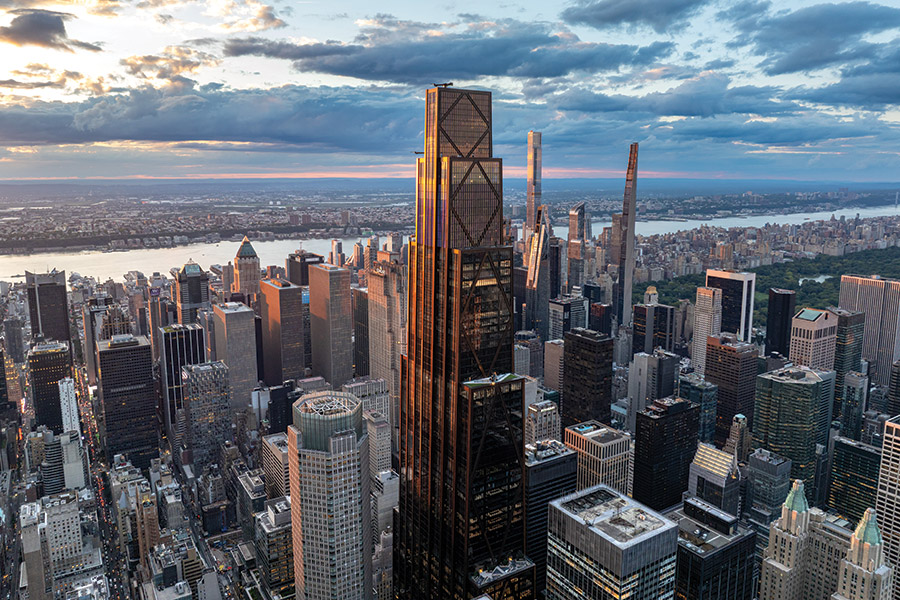
JPMorgan Chase Building in Manhattan
Photo courtesy of Urban Mining Industries Inc.
Pozzotive was put to the test when it was specified for use on the 60-story, 1,388-ft-tall Park Ave. headquarters for the investment bank, which set an ambitious goal to be the largest net-zero emissions building in New York City. “When we proposed it to [the owner] and showed results from a previous project and the impact on carbon footprint, they were ecstatic,” and allowed its use, says Fortunato Orlando, senior principal of Severud Associates, the tower’s structural engineer, which has included Pozzotive in concrete specs since 2016.
“We knew from our ongoing production levels at our plant that we could meet the demands of a project this size,” says Grasso. “We presented Pozzotive directly to the JPMorgan Chase leadership team and there was strong alignment across all stakeholders.” Substituting Pozzotive for 40% of cement in all structural concrete except the 16,000-psi foundation mix “not only saved over 5,000 tons of embodied carbon, but also enhanced the strength of the concrete,” says Orlando. It “performed well in cold and hot weather with very minimal surface cracking.”
To expand feedstock, Urban Mining Industries is developing a process to recycle decommissioned solar energy panel glass as more panels are retired, says Grasso.
The company was picked in 2024 for a $37-million U.S. Energy Dept. grant intended to accelerate domestic clean energy manufacturing, and help the firm build new East Coast plants. But the Trump administration canceled it last year, among hundreds of others. “We are working toward reengaging with the agency involved,” says Grasso. “We continue to operate our business and make plans for continued growth independent of that,” he says, noting efforts to launch new capital raising.