
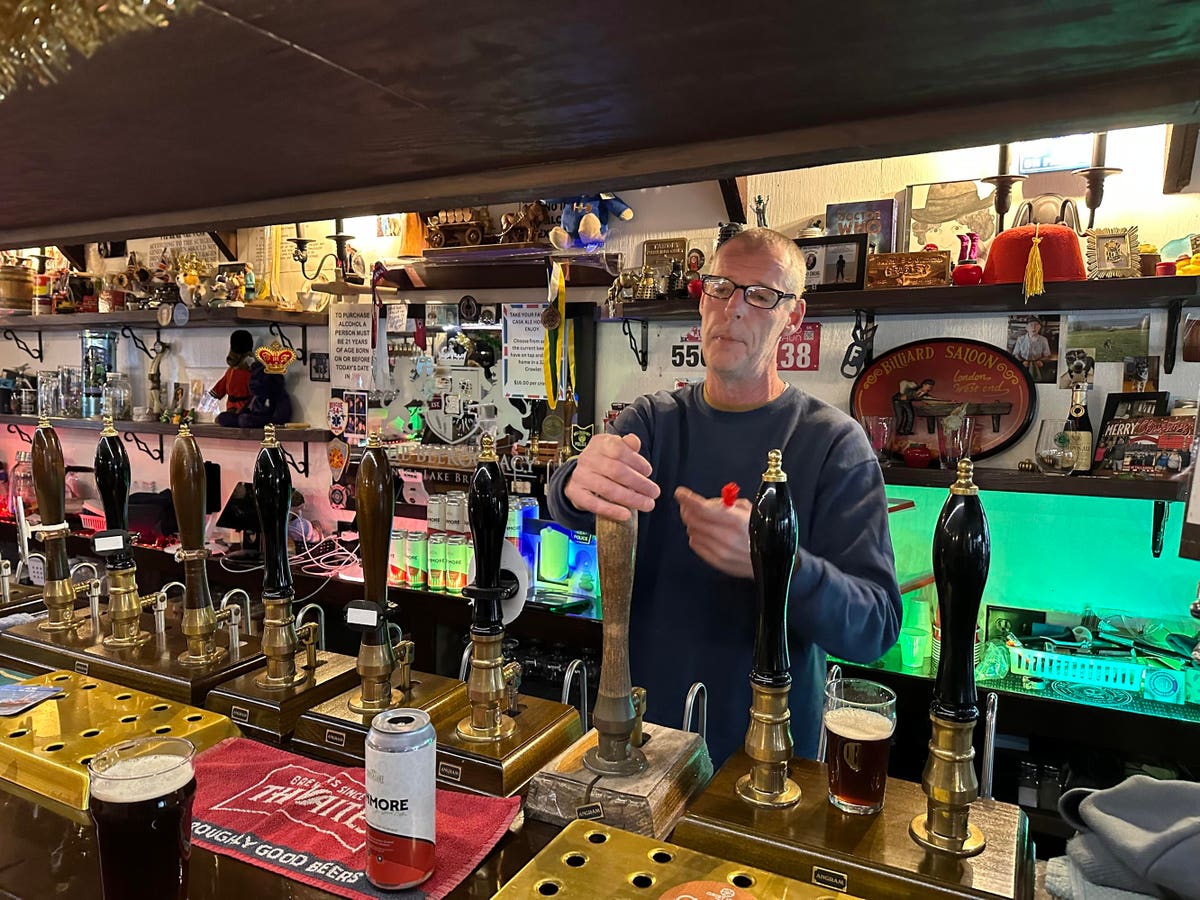
Bradley Gillett, the owner of the Seneca Lake Brewing Company in Rock Stream, New York, pours craft ales from one of his 12 beer engines.
Gary Stoller
Many and probably most American beer drinkers are unfamiliar with beer engines. Bradley Gillett, the owner of the Seneca Lake Brewing Company in Rock Stream, New York, knows all about them. His Finger Lakes pub pours his brewery’s unfiltered, unpasteurized craft beer from 12 cask beer engines—likely a greater number than at any bar, pub or taproom in America.
For the uninitiated, beer engines are hand pumps that pull beer from a cask. They are commonly used in English pubs but rarely found in American drinking establishments. In America, most bars use CO2, or nitrogen, to pressurize a keg and then push carbonated beer through the tap, according to Beverage Craft, which sells beer equipment in North America. Beer from a beer engine is warmer and flatter, and some experts say such beer is beer in its purest, most tasty, form.
“For me, there is nothing finer than a cask ale, because it is beer in its most honest and complete form!” Gillett exclaims. “Unfiltered, unpasteurized, and naturally conditioned, cask ale finishes its journey in the vessel from which it’s served. Without the forced carbonation or excessive cold, the beer reveals its true character.”
The Seneca Lake Brewing Company in Rock Stream, New York, pours its own ales from a dozen beer engines.
Bradley Gillett
Beer has been part of Gillett’s life for a long time. He worked numerous jobs in pubs in the United Kingdom, from washing dishes in the kitchen to running the bar. He began brewing beer when he moved to America in the early 2000s and, in 2014, started converting a two-bedroom house in Rock Stream into a brewery and British pub called “The Beerocracy.” Gillett opened a temporary taproom five miles north until construction of The Beerocracy was completed in 2016.
“At our temporary taproom, we started with four beer engines and four core beers: SLB52 Golden Ale, Steamship Foreign Extra Stout, Merri Man English IPA and Baker Street Best Bitter,” he recalls. “These engines were ones that I purchased on eBay and reconditioned. When we moved to our main location at The Beerocracy, we installed 12 brand new beer engines and ramped up brewing to fill them. Currently, our portfolio consists of more than 20 real ales that we rotate on the taps based on seasonality.”
An internet search by this journalist found no American beer establishment with a greater number of beer engines.
Americans unfamiliar with cask ales poured from a beer engine are often unimpressed with an initial taste, because they expect a highly carbonated ice-cold brew with a foamy head. Many are somewhat baffled or turned off by the ale.
Gillett admits that happened when he first opened Seneca Lake Brewing, and his type of ales was alien to Finger Lakes locals.
“Even to this day, there are consumers who just don’t get it and prefer the regular carbed keg beer,” he says. “That being said, there is a large demographic of consumers in this region who adore cask ales and did not have any options where to acquire them. These consumers welcomed us with open arms and quickly became our regulars.”
Dissatisfied customers’ past and recent comments, Gillett says, have included: “I can’t wrap my head around it,” “I prefer my beer cold and foamy,” “Why is your beer warm and flat?,” “There must be something wrong with your cooler” and “Your CO2 needs to be turned up!”
On the flip side, Gillett says, there are people who come in with their partners, and one loves cask ale and the other is trying it for the first time. The taste of the ale clicks with them, and, he says, they made the following comments.
“Wow, I really can taste more in the beer than I would if it were served colder.” “The lower levels of CO2 really allow you to drink more, and I’m not getting that gassy bloated feeling.” “I love it.” “The beer’s delicious, and I can understand now why people drink it at this temperature.”
Like his unique ales, the food at The Beerocracy is also unique, though Gillett says kitchen size has limited the number of food options. Traditional British pies are served with mashed potatoes, mushy peas and gravy. They include shepherd’s pie, chicken or vegetable curry pie, chicken and mushroom pie and Cornish pasties. During the summer months, the Beerocracy operates an outdoor fish and chips popup with beer-battered cod, chips and curry sauce.
“This is a big hit with customers,” Gillett says about the seafood popup. “From time to time, we also do grander cooking events such as whole pig roasts, goat roasts, seafood nights, traditional Spanish paella days and more. On Sundays during the winter months, we offer our traditional British roast dinner. Guests choose from two weekly rotating meats with roast potatoes, Yorkshire pudding, seasonal veggies and gravy. This isn’t for the faint of heart. It is a whopping meal that will definitely have you leaving full!”
In mid-March, Gillett and business partners plan to launch DRINKR, an app for craft beverage lovers and makers.
“DRNKR is the world’s first intelligent beverage concierge designed to unite the fragmented craft beverage industry,” he says. “While legacy platforms have kept beer, wine, cider and spirits in separate silos, relying on outdated badge and public review systems and static data, DRNKR uses advanced technologies and AI to personalize discovery based on a user’s unique palate.”
Gillett has many friends and neighbors in the wine industry. New York’s Finger Lakes region is known for its wineries, which date back to the 19th Century, and the number of breweries has exploded in recent decades. The region has more than 140 wineries, the Finger Lakes Tourism Alliance says, and more than 75 microbreweries with tasting rooms and brew pubs, according to Visit Finger Lakes, which promotes tourism for Ontario County.
Gillett calls it “alcohol tourism.” He enjoys planning and holding beer-related events, including his New York State Brit Festival on May 23, that attract local friends and visitors from afar.
“For me, it has to be community!” Gillett exclaims when asked what he enjoys most about his life as a brewer. “That includes the pub community created at The Beerocracy with locals and guests that come in time after time and local breweries, wineries, cideries and distilleries that are now great friends. The passion that everyone shares in this region is second to none. It shows in the beverages that are being produced and the experiences guests receive when visiting the area.”