
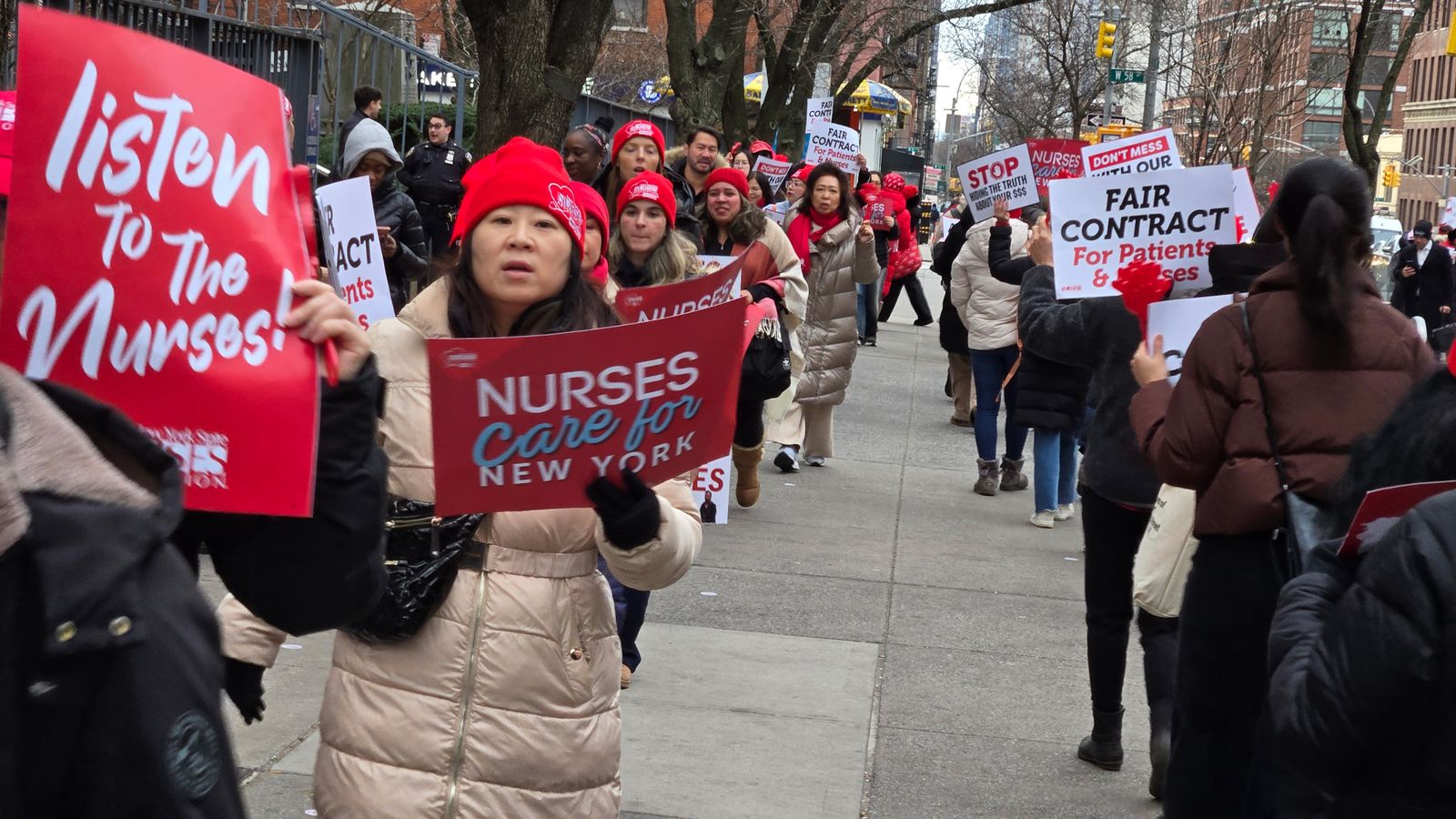
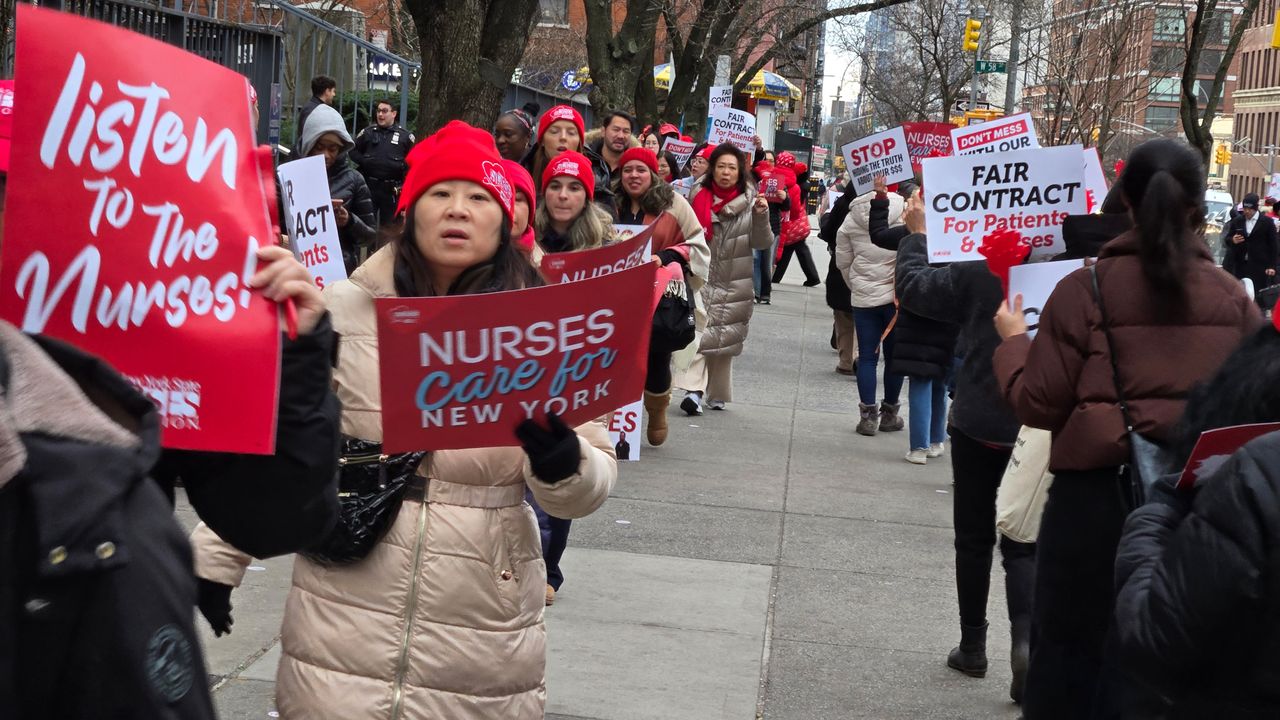
 Nurses on the picket line in New York City on January 14, 2026.
Approximately 15,000 nurses in New York City concluded their fifth day on strike on Friday. Mediated negotiations between the union, the New York State Nurses Association (NYSNA), and hospital representatives resumed for the first time since the strike began on Thursday evening for New York Presbyterian and on Friday for both Mount Sinai hospitals. Montefiore has still refused to return to bargaining.
As of Friday evening, no major movement has been reported over the key issues of nurse-to-patient ratios, safety and adequate health care coverage for workers.
The hospital executives remain intransigent. A New York Presbyterian spokesperson repeated their characterization of nurses’ demands for rational staffing levels as “unreasonable” and refused to continue bargaining on Friday. The hospital rejected the union’s revised offers and refused to make a counterproposal according to a NYSNA statement.
NYSNA also reported that New York-Presbyterian cut out rank-and-file nurses from negotiations. Hospital security on Thursday evening initially prevented nurses from attending the sessions, eventually allowing just 70 to observe. NYSNA accepted this arbitrary limit and resumed negotiations anyway.
Open bargaining is a critical issue for the strike, preventing backroom dealing, hidden clauses and rushed agreements that leave workers without full knowledge of their contents. Striking nurses must insist that it is a precondition for negotiating any settlement.
Meanwhile, Mount Sinai on Friday announced it would be extending its contracts with strikebreakers and is seeking to hire additional temps to resume a full surgical schedule. The hospital systems collectively have already spent an estimated $100 million in an attempt to break the strike.
The strike is approaching a critical juncture and not only because it faces the obstinate dictates of corporate management. There is immense support for striking nurses across the working class, and conditions are ripening for the potential expansion and transformation of the strike.
In response to the murderous ICE occupation in Minneapolis, which Trump is poised to expand, popular opposition has reached the point where several local unions in Minneapolis have been compelled to issue a call for a general strike on January 23.
Meanwhile, 31,000 nurses and other health workers in California and Hawaii delivered a 10-day strike notice to Kaiser Permanente, one of the largest healthcare companies in the United States. The strike would hit more than two dozen hospitals and other facilities in Southern California and Honolulu. The key demands are essentially the same as those in the New York City strike: safe staffing levels and pay increases to improve patient care, prevent burnout, and provide workers a modicum of economic stability.


The nurses’ strike in New York City is not simply a struggle against management and high-paid hospital executives. It is also an element of an intensifying class struggle that must serve as a rallying point for a powerful counteroffensive to fight for the needs of the working class against the profit interests that dominate every aspect of social life.
The NYNSA had sought to prevent a strike and has now isolated striking nurses by reaching last-minute deals with 11 out of 15 hospitals. Nurses should be warned that the NYSNA is likely to try to shut down the strike early, just as it did in 2023, when it ended the walkout after only three days with phony language on staffing ratios that did nothing to improve conditions in the hospitals.
This is why the WSWS had called on nurses to form a rank-and-file strike committee to assert control over the strike and ensure that there is no return to work unless their demands are met.
Voice from the picket line
The World Socialist Web Site spoke with striking nurses on the picket line at New York-Presbyterian on Friday. Addressing the outrageous situation where the hospitals have completely cut off health benefits to nurses who sacrifice day in and day out to care for sick patients, a striker told the WSWS, “I don’t have any health insurance at the moment. Even when I had my insurance, I couldn’t come to this hospital to see the specialist that I work with every day. And that’s one of the things that I’m out here for, because I think it’s atrocious that I help make these doctors great. I keep up with the technological advances, but I can’t be taken care of by them.
“And on the day I retire, I get no health benefits. They end literally on the day I retire.”
“We’re on the front line. We’re here all the time,” she added. “We only take the time that’s given to us. In my 36 years here, I got sick once and was out for two weeks. Other than that, I’ve been here. It’s not fair to have me have to come out here because you don’t want to give me health benefits. You don’t want to take care of the ratios to take care of patients correctly. And you don’t want to reduce the ability for violence to happen on the hospital premises. And then you wanna give us such a low rate, and tell us you’re not gonna pay for any of those things, and the raise you give us will not cover it all.”
Asked if they are receiving strike pay, she responded, “No, at this moment we’re not. We have to wait to get unemployment benefits. We are solely out here on our own. We have prepared ourselves, I paid things in advance, so that I’d be able to withstand some time.”
The WSWS raised widespread support for nurses from workers throughout New York and the call for a general strike in Minneapolis and beyond. “Oh, I support a general strike,” she responded. “We keep New York going. We were here during the pandemic, and we’re called essential and kept it going and kept it moving.


“They’re killing people out in Minneapolis. Listen, if they were killing people here in New York, I would support it. I support it out there as well.”
Other New York City hospital workers join call for expanded struggle
On Thursday, the WSWS spoke to workers at Bellevue Hospital in Manhattan, one of the oldest and largest public hospitals in the country and one of the city’s core safety-net hospitals.
A peri-operative nurse, working in the operating room for the last seven years, told the WSWS, “Right now, nobody has seen a real contract. It is like a staring contest between management and the nurses. Who’s going to blink first? The money is being allocated badly, and a lot of promises are not happening, and the money is going elsewhere.
“It would take all hospital [workers] coming together to have a united struggle. But a lot of people are not in unions, and some people choose not to be in unions. But it does not stop here. I feel it begins here. There’s this union, next it’s going to be another union, then another union. I wish we could pull everybody together and do a general strike. I think we would win. We would make some changes. But it has to be unity, getting everybody to do it.”
A home health aide who has worked at Bellevue for 13 years recognized in her work the same issues at stake in the nurses’ strike. “We are short-staffed,” she said, “which means I have to do somebody else’s job, too, maybe once a month, twice a month. I have three patients during my shift.
“The cuts to Medicaid affect the hospital,” she added. “They’re not hiring. But they shouldn’t have any budget cuts because everybody needs healthcare. And the billions of dollars too that they’re cutting for the elderly, especially for the elderly. They should leave it for the poor, not for the rich.”
Likewise, researchers at the hospital are also reeling from the attacks on health care and science. “I started doing research at Bellevue Hospital almost a year and a half ago,” one worker said. “With cuts to research funding, there have been layoffs. I can’t give you a specific number, but it’s like no one’s safe, essentially. When I say no one is safe, I mean no one is safe, including nurses.”
“People have been adversely affected by the lack of research going on at the moment. Most of our research is neurology-based, like Alzheimer’s. Old age is going to be the next pandemic, so to speak, because the world’s population is rapidly aging. There’s a very urgent need for making sure that this neurology research especially, is adequately funded. The kinds of diseases we’re going to see in the next couple of decades are pretty common at the moment, too. And if you’re talking about infectious diseases. Polio’s coming back. It was never eradicated worldwide in the first place, and now cases are popping up everywhere.
“I absolutely agree the working class is being squeezed in all kinds of ways,” she added. “I mean, you expect one thing, and then the next morning you wake up, and it’s like, oh my god, all hell has broken loose, and no one knows what’s going on.”
Get information about building or joining a health workers rank-and-file committee