
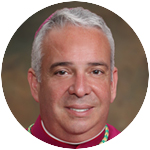
Archbishop Nelson J. Pérez
By CatholicPhilly Staff • Posted January 16, 2026
Archbishop Nelson J. Pérez reflects on the life and witness of Cardinal John O’Connor, former Archbishop of New York, in an Op‑Ed first published by the National Catholic Register in collaboration with EWTN. The essay appears in conjunction with what would have been Cardinal O’Connor’s 106th birthday; he died in 2000.
***
For generations, the archbishop of New York has held a singular place in the life of the Catholic Church in the United States — standing at the crossroads of culture, conscience and public witness.
Few shepherds embodied that national role more clearly than Cardinal John O’Connor, who died in May 2000 after nearly 16 years as archbishop of New York. This past year marked the 25th anniversary of his passing, and as the Church marks what would have been his 106th birthday on Jan. 15, it is fitting to remember a priest whose faith and courage shaped not only a local Church, but the moral voice of a nation.
Shared memory is a powerful tool. We use it to find shining examples of Christ’s compassion who can guide us today. Those of us who remember the long past have a responsibility to share it with our young people. They are the “now of God,” as Pope Francis said. They build up our Church with zeal, and they need saintly heroes.
Cardinal John O’Connor is one such hero, who lived a life of service, courage and humility before many of them were born. As a man who remembered the long past, he shared it with me when I was a young man. A towering figure in Catholic life, he was a role model for me in the mid-1980s, when I was young and trying to figure out life.
Before I entered the seminary, I was a traditional college student at Seton Hall and Montclair State University. I would go to St. Patrick’s Cathedral in New York for the 10 a.m. Mass on Sundays whenever I could. Cardinal O’Connor always celebrated that Mass. His preaching was the draw. His engaging use of language proclaimed the Gospel and tied it to the world around him in mesmerizing fashion. There were no notes, no prepared text. It always came from the heart. You could sense that the Holy Spirit was flowing through him and pouring out onto all of us. I remember thinking to myself at the time, “If I become a priest, I want to preach like that someday.”
Another memory involves a more personal encounter after I became a seminarian. It was summer and oppressively hot. I took a trip to the Big Apple with a seminarian friend. We decided to visit the vicar general of New York, who was a family friend. Picture two young men in sandals, shorts and T-shirts, sweating it out with a million other New Yorkers walking along Madison Avenue.
We rang the doorbell at our destination. Cardinal O’Connor opened the door — in full cardinal’s vesture. “Can I help you?” he said cheerfully, with a warm smile. Admittedly, I stammered a bit. I was awestruck and embarrassed. I shared why I was there, and the cardinal told us to come in while he found the vicar general. We found ourselves in the middle of a black-tie gala.
He didn’t have to answer the door. He didn’t have to welcome us or speak with us, but he did so with genuine hospitality. He was also pleased that I was studying to be a priest for his home Church of Philadelphia. It was a remarkable lesson in welcoming the stranger and seeing Christ in all those we encounter. Cardinal O’Connor had a deep and lasting impact on me that has resonated throughout my 37 years as a priest, with the past 13 years as a bishop.
His mark on the life of our Church and our nation extends far beyond my own cherished memories.
New York City is a place where sharp elbows are thrown. Cardinal O’Connor used that tough arena as a pulpit to teach the Catholic faith and to defend the sanctity of life and the holiness of family — positions that were not always popular. He devoted himself completely to the priests, religious and lay faithful whom he was called to lead, loving them in profound ways.
Though New York became his most visible mission field, he was first a Philadelphian. Raised in the city during the Great Depression, he was ordained a Philadelphia priest in 1945. He served in parish ministry and taught in Catholic schools before responding to his country’s call as a Catholic military chaplain in the Korean War in 1952. He went on to care for the troops fighting and dying through the Vietnam conflict and rose to the rank of rear admiral.
Along the way, he pursued rigorous intellectual formation, earning a master’s degree in clinical psychology from The Catholic University of America and a doctorate in political science from Georgetown University. He served as a bishop for the Archdiocese for Military Services and the Diocese of Scranton, Pennsylvania, before Pope St. John Paul II called him to shepherd New York.
There, Cardinal O’Connor became one of the most forceful and eloquent voices in defense of human life in our nation’s history. He founded the Sisters of Life to ensure mothers and their children would always encounter Christ and the Church’s support and compassion beyond his time in leadership.
He also defended human dignity, through his advocacy for working people, his outreach to the poor and marginalized, and his pastoral care for those suffering from the ravages of AIDS — much of it done quietly and away from public attention. This work was deeply moving to me as a young college student.
While a loud voice in the public sphere, his most enduring witness was pastoral. He saw God in all people and gave fully of himself to share Christ’s love with the Church of New York and the world.
As we look back on the just-concluded Jubilee Year of Hope, Cardinal O’Connor continues to be an example for us all. His episcopal motto, “There Can Be No Love Without Justice,” continues to challenge us to live our faith as missionary disciples of Christ.
He once hoped to be remembered simply “as a good priest.” Yet in remembering him now, it is clear that his life bore a saint-like clarity — teaching us, by word and example, how to love God, love our neighbor, and serve the poor.