
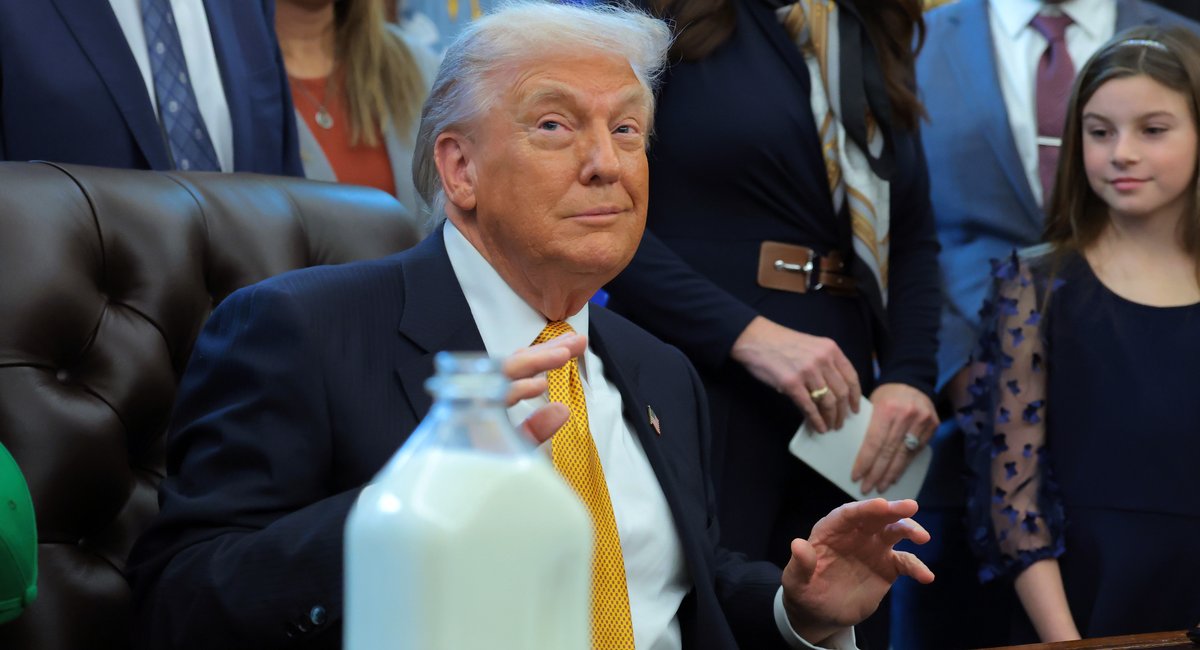
The Trump administration wants to make school milk whole again, but New York City’s public schools are sticking with 1% and skim.
On Wednesday, President Donald Trump signed legislation that reverses an Obama-era ban on whole milk at schools funded through the federal lunch program.
With a jug of milk at his side, Trump said he was “delighted” to sign the Whole Milk for Healthy Kids Act, calling it “a very important thing for our farmers, and I think maybe more important for our people.”
Federal agencies posted memes online featuring Trump with a milk mustache, or Health Secretary Robert F. Kennedy Jr. being transported to a nightclub after sipping a glass of milk.
Officials with New York City’s Department of Education weren’t ready to join in. They said the city isn’t planning any changes to its current milk offerings, which are limited to 1% and skim milk — regular and chocolate.
“Our universally free breakfast and lunch service — relied on by students across the city — is grounded in research-based nutrition guidance, coupled with regular student-led tasting and feedback,” said Isla Gething, spokesperson for the city’s public schools.
For more than a decade, the federal lunch program only allowed participating schools across the country to serve low-fat or non-fat flavored or unflavored milk, citing concerns about milk fat contributing to the child obesity crisis.
The new law adds whole milk to the list of options, as well as requires that a plant-based alternative be available if requested by a student’s doctor or guardian.
While federal guidelines have a limit on how much saturated fat is allowed in school meals, the new law exempts milk from being counted as part of that tally.
Kennedy said the shift is part of his “Make America Healthy Again” initiative and follows an overhaul of the food pyramid to promote meat and dairy. The National Milk Producers Federation championed the law.
Brooklyn parent Eva Bogaisky said she would be happy to have whole milk back on the school menu.
“I wish New York City would at least go to 2%,” she said. “My thought is that if the milk tastes better and creamier, more kids will drink it and that is probably a good thing.”
But so far, New York City isn’t changing its milk policy, which has a history of provoking strong responses from parents and politicians.
As Brooklyn borough president, Eric Adams denounced the sugar content of chocolate milk and said kids should drink more water instead.
“We need to encourage students to make healthier choices,” he said in a 2019 video measuring out the amount of sugar in chocolate milk.
As mayor, Adams said he was considering a chocolate milk ban, prompting Rep. Elise Stefanik to introduce a bill requiring flavored and unflavored milk options.
Pam Koch, associate professor of nutrition and education at Teachers College, Columbia University, said there have been some contradictory studies in recent years on the whole versus skim debate. But she said it’s good to stick with 1% and skim given the amount of saturated fat and ultraprocessed foods in most Americans’ diets.
“Is it crystal clear? No. But I don’t think we have strong evidence to suggest we should be going back on this long-standing practice of having only 1% and nonfat milk in school meals,” she said.
She also noted that while the chocolate milk in city schools does have added sugar, it’s less added sugar than in store-bought brands. She acknowledged that chocolate milk remains a “controversial” issue among parents and kids.