
Major focus includes Sustainable Future Fund and the Clean Air Initiative, advancing affordable clean energy projects, decarbonizing buildings with thermal energy networks, passing a Clean Fuel Standard, and achieving zero waste
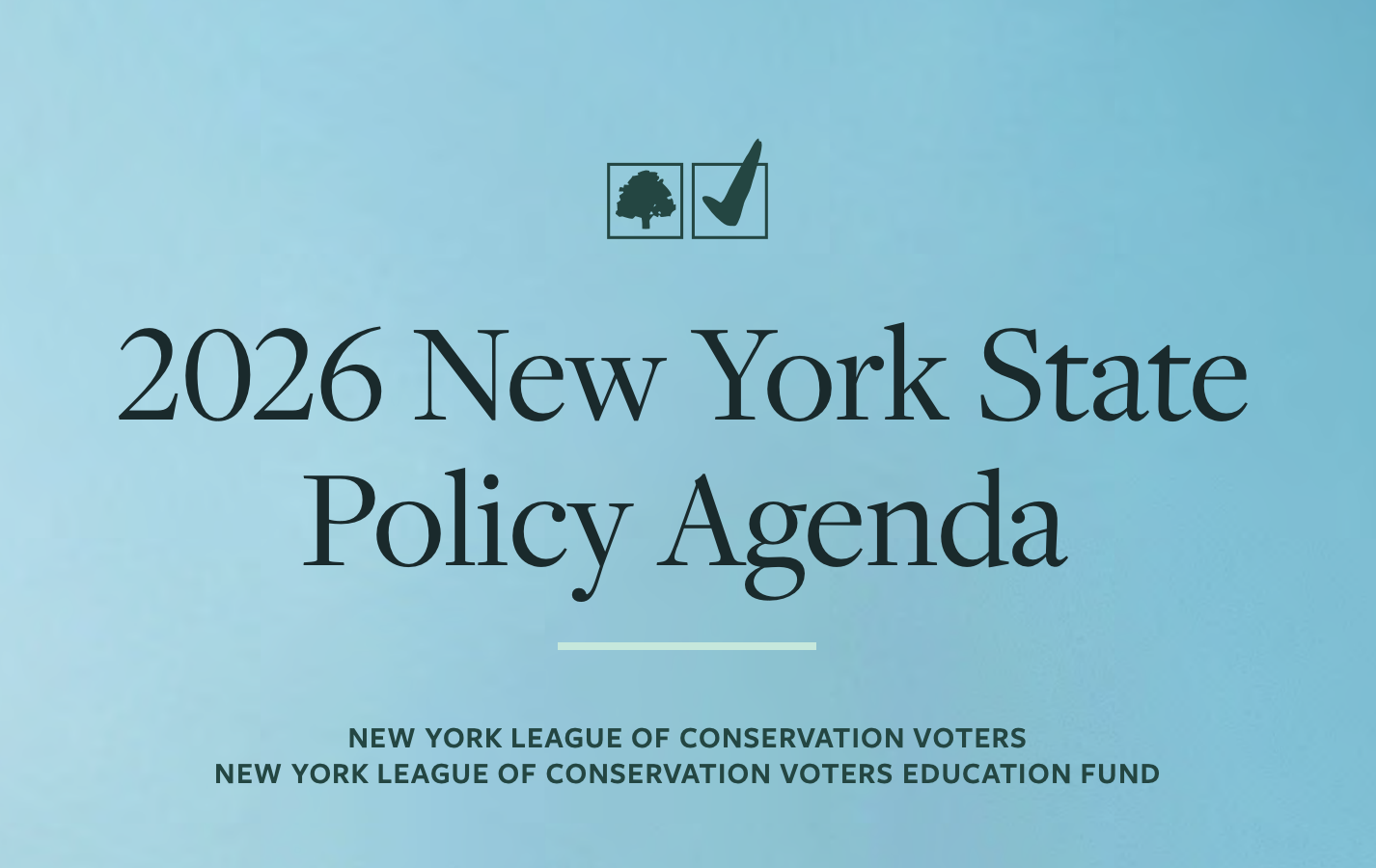
The New York League of Conservation Voters and NYLCV Education Fund are proud to release our 2026 State Policy Agenda, which outlines the League’s top priorities for the year ahead, including:
Invest an additional $1 billion in the Sustainable Future Fund and advance the Clean Air Initiative to make polluters pay and incentivize cleaner business models.
Defend offshore wind projects and advance programs and incentives to achieve 20 gigawatts of distributed solar by 2035 and six gigawatts of energy storage by 2030, while also making the permitting process for residential projects more efficient.
Deploying thermal energy networks (TENs) to decarbonize neighborhoods and public buildings
Pass a Clean Fuel Standard and electrifying public transit and school bus fleets
Making it easier for consumers to buy electric vehicles
Pass more extended producer responsibility laws, including for packaging
Expanding the Bottle Bill
Establishing minimum recycling content requirements
“New Yorkers are being squeezed by rising energy demand and higher costs at the very moment when the federal government is turning its back on affordable clean energy and American workers,” said NYLCV President Julie Tighe. “New York lawmakers must step up to defend our offshore wind progress and substantially increase the pace of solar energy and battery storage projects. We also need to hold polluters accountable, reduce emissions in our buildings and transportation sector, and dedicate substantial funding to environmental protection. This is a pivotal moment, and only with strong state leadership can we build a cleaner, healthier, more sustainable future for every New Yorker.”
The 2026 State Policy Agenda is at once a summary of NYLCV priorities for the upcoming legislative session and a roadmap for elected officials to follow in order to achieve bold environmental action. In addition to the priorities listed above, NYLCV will also advocate for:
Maintain $500 Million for the Clean Water Infrastructure Act (CWIA) in FY 2026-27, as part of long-term commitment of $4.5 billion over 5 years.
Fund the Environmental Protection Fund with at least $425 million in the FY 2026-27 NYS Budget on a pathway to a $500 million annual investment with no offloads
Fund mass transit capital and operating needs throughout the state, including the funding required to implement the 2025-2029 MTA Capital Plan.
Implement the $4.2 billion Clean Water, Clean Air and Green Jobs Environmental Bond Act
Replace the obligation for utilities to provide gas service to new customers with an obligation for the utilities to serve new customers with “zero-emission heat” and require gas utilities to transition to clean heat at the scale and timeline required by the CLCPA.
Plan for resilience against future storms and floods and other climate-related disasters, including the completion of the State Adaptation Plan and the implementation of the Bond Act Buyout Program.
Adopt a statewide policy for all public drinking water suppliers to create local lead service line removal programs.
Pass legislation that enables communities to raise local funds for open space conservation, community preservation, and water quality improvement, including drinking water source protection.
Accelerate preservation of the state’s farmland, strengthen regional foodsheds, and improve clean transportation options available for the movement of fresh food from farm to table, particularly in underserved areas.
Support access to the ballot box by advocating for the creation of a same-day voter registration statewide program, ensuring all New Yorkers have access to mail-in voting, and enhancing and clarifying automatic voter registration procedures.
The publication of this agenda follows a year in which the federal government has sought to roll back clean energy progress and dismantle decades of environmental protections that have been developed and supported by both parties. This moment demands state-level action to protect clean air and water, safeguard public health, and accelerate the transition to a clean energy economy.
The 2026 State Agenda, which was created with input from the NYLCV/EF Policy Committee, will drive the organizations’ advocacy and programmatic work throughout the year as NYLCV pushes for budget appropriations and legislation. Throughout the process, NYLCV/EF worked closely with New York’s leading environmental, public health, conservation, energy, environmental justice, and transportation organizations to identify the state’s most pressing priorities.
The full agenda is available here, and further details on some of the League’s top priorities are below:
CLEAN AIR INITIATIVE AND SUSTAINABLE FUTURE FUND
To help achieve the goals established by the Climate Leadership and Community Protection Act (CLCPA) and protect New Yorkers against the impacts of climate change, the state must deliver substantial investments that provide real, lasting benefits for workers, communities, and the environment. That includes advancing the economy-wide Cap-and-Invest program – known as the Clean Air Initiative – that uses market forces to cap greenhouse gas emissions and generate funds from polluters that will be used to pay for clean energy projects; and a second round of the $1 billion Sustainable Future Fund to invest in projects that will cut climate pollution while lowering energy costs, improving public health, and creating good-paying, union jobs. It is critical that these investments prioritize historically overburdened communities and advance environmental justice.
AFFORDABLE CLEAN ENERGY
New York’s ability to mitigate the worst potential impacts of climate change relies on the state’s ability to continue advancing toward a clean energy economy. To do that we must vigorously defend the offshore wind projects that are currently under construction from attacks by the federal government while also laying the groundwork for new projects when federal permitting resumes. We need to double down on the success of our solar energy deployment by advancing programs and incentives to achieve 20 gigawatts of distributed solar by 2035 and six gigawatts of energy storage by 2030, while also making the permitting process for residential projects more efficient. Public education in communities throughout the state is critical to the successful deployment of large-scale clean energy projects. To achieve these goals the State must have a coordinated plan to bring down costs for ratepayers and renewable energy developers and rapidly accelerate the deployment of distributed energy resources.
BUILDINGS
Buildings are the leading source of greenhouse gas emissions in New York State, meaning building decarbonization must play a critical role as we set out to meet the state’s goal of net-zero emissions by 2050. We can significantly reduce emissions and develop a 21st century workforce that sustains and grows middle-class union jobs by planning for the phase out of fossil fuel infrastructure for heating needs, tightening building energy codes, deploying thermal energy networks to decarbonize neighborhoods and state-owned buildings, and a host of additional policies.
CLEAN TRANSPORTATION
Transportation is one of the leading sources of climate pollution in New York, damaging our public health and concentrating air pollution in low-income communities and communities of color. Aggressive action is required to protect public health, promote environmental justice, and achieve the state’s target of net-zero emissions by 2050, including electrifying public transit and school bus fleets, making it easier for consumers to buy electric vehicles, and establishing a clean fuel standard that makes the dirtiest fuel providers subsidize low- and zero-emission alternatives.
ZERO WASTE
Solid waste pollutes our environment, damages ecosystems, and is an often overlooked part of the climate crisis, accounting for about 6% of New York State’s greenhouse gas emissions. The recycling system is facing numerous challenges that must be addressed to make New York’s waste management more sustainable. New York should develop a range of short-, medium-, and long-term options to fix the recycling market, including: passing more extended producer responsibility laws, including for packaging; supporting local recycling efforts, including through additional funding; expanding the Bottle Bill; standardizing a statewide list of recyclable materials; and establishing minimum recycling content requirements.