
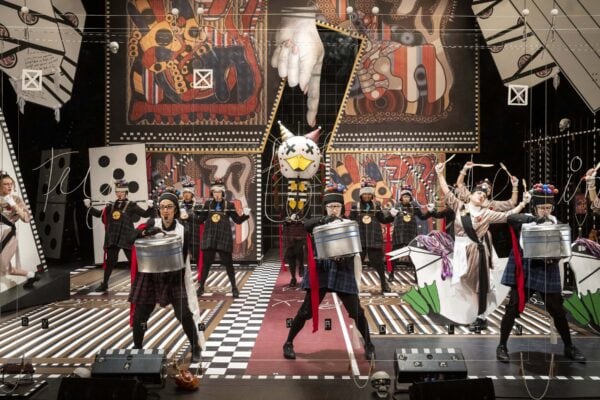
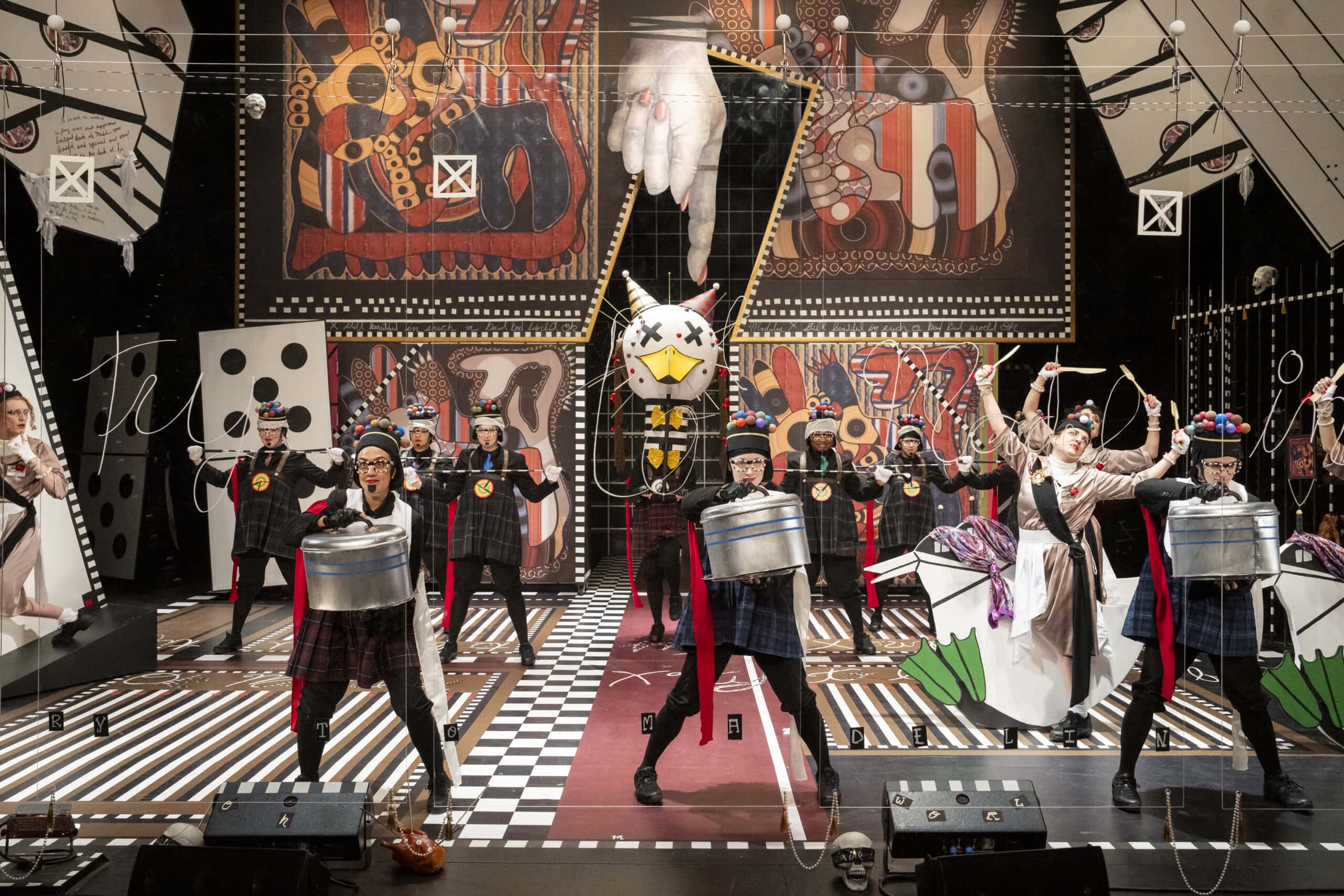
The company of Richard Foreman’s What to Wear. Photo: Stephanie Berger
You go to a Richard Foreman show for its geometry, for its lightning flashes of meaning amid a sea of puzzling byways, for the way it makes you feel like you’re tunneling into someone else’s strangest dreams–and by the same token, it’s almost useless, once you walk out, to try to encapsulate a story, or characters, or a message. In 2026, you also go for the now rare pleasure of spending another chunk of time inside Foreman’s singular mind. Foreman almost always directed his own work, and since he passed away in early 2025, we’re going to get only reflections and simulacra, moving ever farther away from the thing one might have experienced at the Ontological-Hysteric in any of its forms and locations.
The “post-rock” opera What to Wear (composed by Michael Gordon) premiered at CalArts in 2006 and is here restaged for Prototype at BAM by Paul Lazar and Annie-B Parson, with musical director Alan Pierson. The creative team includes the costume designer (E. B. Brooks) and one of the lead performers (Sarah Frei), as well as technical director/re-creator of the set Michael Darling, so–in much the same way as the ballerinas who danced for Balanchine became living archives to restage his ballets–we have a thread of connection to the original, though adjusted to make best use of the BAM Harvey’s depth and height. (A series of chandeliers in Joe Levasseur’s design keep rising and falling in a way that few spaces would allow, for example.)
And it’s indeed a sumptuous visual feast that makes excellent use of that space: Foreman’s trademark overhead webs of string and plexiglass panels, along with painted black-and-white-striped borders, frame in the space. Huge, elaborately painted panels hang at precarious angles overhead and decorate the floor. Brooks’s intricate costumes gesture to Alice in Wonderland’s pack-of-cards soldiers, Scottish kilts, seamstresses in a French couture house, and Carmen Miranda, among other things. (Ducks being one of the other things; lots and lots of ducks; Foreman reportedly originally gave Gordon free rein over the libretto, as long as the ducks stayed.) Games of chance are evoked throughout, with a lotto tumbler running across the stage like a manual lawnmower, giant dominos looming upstage, and random numbers popping up throughout, sometimes on multi-sided dice or placards that look like disassembled dice. Skull-topped poles are another frequent, macabre image, surpassed at the end by a bunch of scythe-wielding chefs with full skull masks.
The music, performed by members of the Bang on a Can ensemble, hits its hybrid rock/opera tones: spiky and melodic and discordant all at once, with countertenors, mezzo sopranos, and sopranos taking the leading roles. Foreman has a penchant for repetition in his language and both Gordon’s music and the libretto are structured on that sense of repetition and pattern, spiraling back over a few recurring motifs per scene.
Each of the ten scenes begins with a line of narration recorded by Foreman, establishing a topic on which the scene will then perseverate: to the extent that there is an overarching theme, the piece is about beauty and consumption, spinning from fetishization all the way to cannibalism. In the first half of the piece, these are mostly about Madeline X (played collectively by the four lead performers, Sarah Frei, Sophie Delphis, Hai-Ting Chinn, and Morgan Mastrangelo), striving for beauty in a world of lies, striving to understand her inner self. In the second half, the ducks start to take over: The Ugly Duckling, “banished from the realm of the oh so beautiful people.” A duck in a restaurant, trying to avoid being cooked for dinner. Ducks playing golf. A Great Duck (wearing a giant mask a la Deadmau5). In the end, we’re left with a Bad Duck and with Madeline: “Am I still beautiful?” the ensemble sings.
Like most of Foreman’s work, What to Wear defies simple description–and defies the viewer to make linear or literal sense of it. It’s theater of a singular kind, and I’m grateful to have gotten one more chance to spend time in Foreman’s world.