
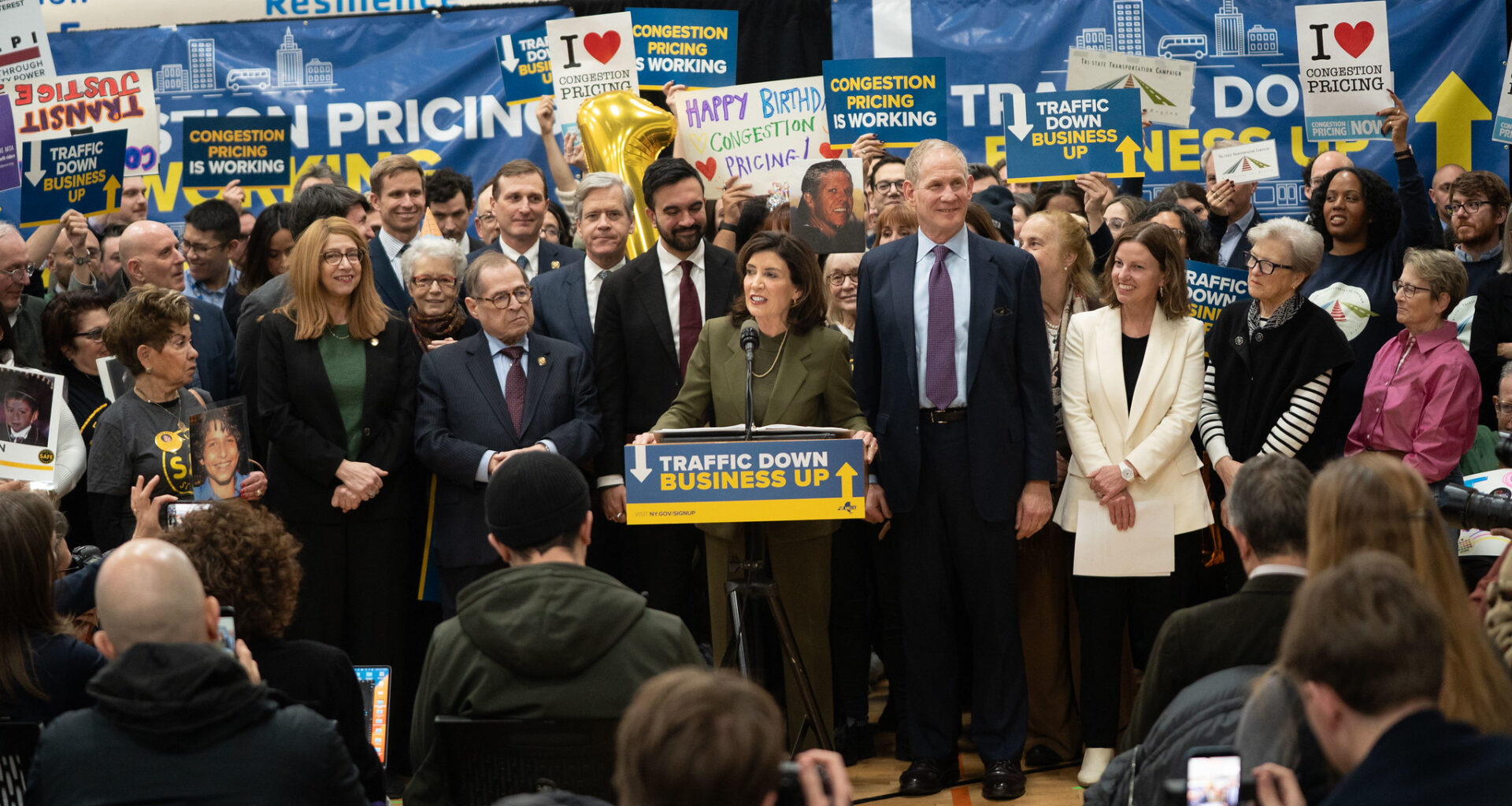
It’s been one year since New York made history by launching the nation’s first Congestion Pricing Program, and the results are in: less traffic, faster buses, better air quality, and millions of dollars going to improve our mass transit system.
“It takes bold leadership to advance policies that improve our communities and daily lives – especially when they aren’t universally popular at the start,” said NYLCV President Julie Tighe. “That’s exactly what Governor Hochul showed by advancing congestion pricing forward to deliver real results for New Yorkers.”
Congestion pricing – or congestion relief, to be more accurate – has proven to be a transformative success not just for Manhattan, but for all of New York City and the entire region.
Governor Hochul addresses the crowd at the one-year anniversary celebration.
“By every measure, this program has met or exceeded expectations: traffic and gridlock are down substantially, people are moving faster, air quality is improved, streets are safer and our economy is stronger,” said Governor Kathy Hochul at an event celebrating the one year anniversary of congestion pricing. “New Yorkers are benefitting from congestion pricing every day, and that’s why we have fought to stop any unlawful federal attempt to end this program.”
The numbers speak for themselves.
Since launching on January 5, 2025, 23.7 million fewer vehicles have entered the Congestion Relief Zone (CRZ) than during the same period in 2024. On a daily basis, vehicle entries into the CRZ are down 12 percent, or about 71,000 fewer cars per day.
Traffic delays inside the zone have dropped by 25 percent, and congestion is down 9 percent region-wide, including in parts of New Jersey. Congestion pricing isn’t just shifting traffic around, it’s reducing it altogether.
Travel times are down across the board, with some commuters saving up to 21 minutes per trip. Buses – a lifeline for working-class New Yorkers – are moving faster and more reliably, with some routes experiencing speed increases of up to 25 percent.
School buses are moving 5 percent faster than last year and arriving on time 72 percent of the time, up from 58 percent before congestion pricing. For parents, students, and educators, that reliability makes a real difference.
Commuter rails are also seeing improvements. Long Island Rail Road and Metro-North on-time performance was approximately 97 percent throughout 2025.
The improvements are especially striking on the bridges and in the tunnels leading into Manhattan, with the Holland Tunnel, Lincoln Tunnel, and Queensboro Bridge running 36 percent, 10 percent, and 21 percent faster, respectively.
“At its core, congestion pricing reflects a simple truth: we can’t drive our way out of the climate crisis,” said
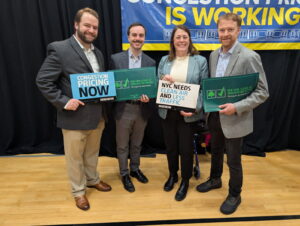
NYLCV’s Pat McClellan, Matt Salton, Julie Tighe, and Devin Callahan at the one-year anniversary celebration.
Tighe. “By reducing the number of cars on the road, it’s cutting congestion while strengthening the transit system millions of New Yorkers rely on.”
Congestion pricing is also delivering major public health and safety benefits. With fewer vehicles on the road, traffic injuries are down and emergency vehicles are reaching their destinations more reliably. These are lifesaving outcomes.
Throughout the year, there were indications that the air quality was improving as a result of the program, and those numbers are now coming into starker relief.
The average concentration of daily maximum particulate matter, or PM2.5, was reduced by 22% in Manhattan’s tolling zone during its first six months compared with projections of what they would have been without the policy, according to a Cornell University study. Particulate emissions declined 1.07 micrograms per cubic meter across the five boroughs, while the wider metropolitan region experienced a reduction of 0.7 micrograms per cubic meter.
What’s more, according to the study, is that the air quality benefits are compounding over time, with emissions reduction in the tolling zone declining by 0.8 micrograms per cubic meter in the first week; by week 20 that decline reached 4.9 micrograms per cubic meter.
Just as noteworthy is what congestion pricing is funding. In its first ten months alone, the program raised $468 million to modernize our subways, increase accessibility, and support good union jobs. That revenue will make our transit system more reliable, more equitable, and more resilient.
And importantly, congestion pricing is proving that vibrant streets depend on people, not gridlock, with business up in the CRZ and in New York City as a whole, according to the Governor’s office, who cited: an increase in office leases, sales tax receipts were up 6.3 percent across the city, Broadway had its best season in history – up 23 percent from the previous year – and restaurants and retail shops are also seeing a boost in business.
At NYLCV, we’ve long said that climate-smart transportation isn’t just about emissions, it’s about quality of life, economic opportunity, and public health. And one year in, congestion pricing is proving that we can deliver big, meaningful change that improves the lives of New Yorkers.