
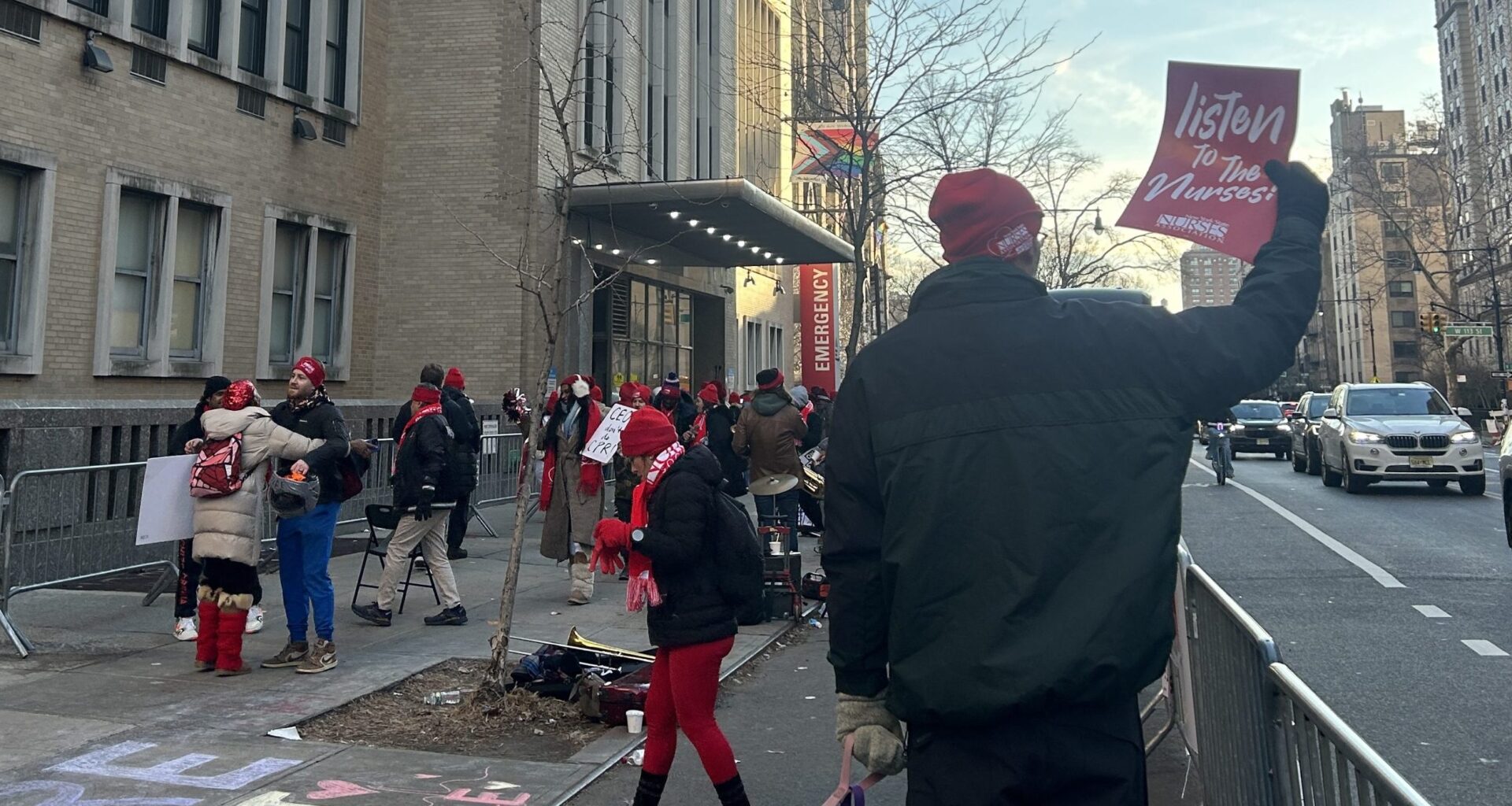
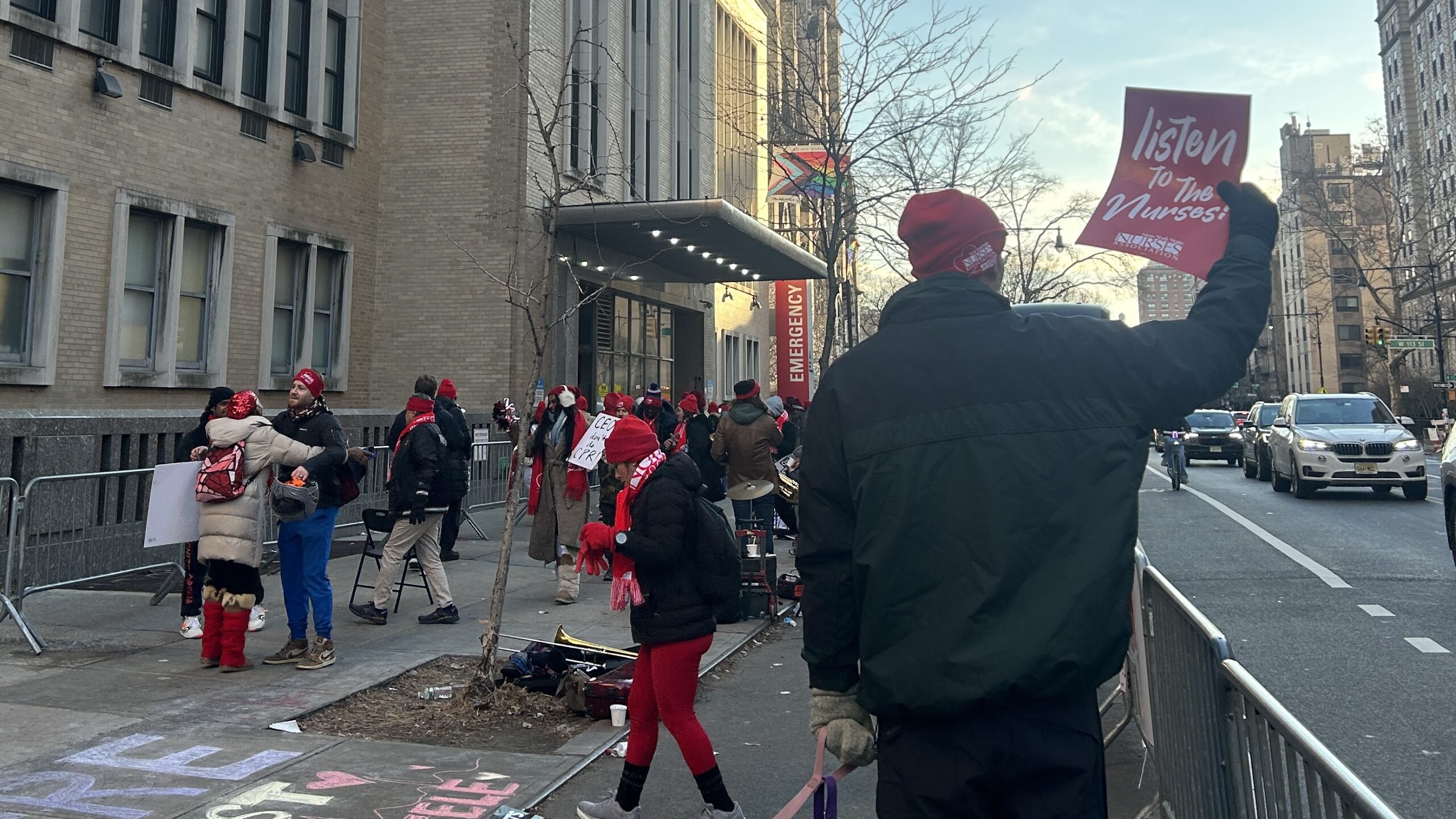
 Nurses on strike last Friday outside Mount Sinai Morningside hospital. Photos by Claudia Gohn
By Claudia Gohn
At eight on a freezing Friday morning, dozens of nurses and local supporters gathered in front of Mount Sinai Morningside hospital for the fifth day of New York City’s largest nurses strike in history. They huddled around a marshal (one of the leaders of the picket) who asked: “What are we doing about getting more folks out here? Are you in your unit chats, making sure people are coming out?”
As they marched back and forth in front of the hospital doors on Amsterdam between West 114th and 113th streets, they shook noisemakers and shouted “Safe staffing saves lives!” Some held signs saying “Mount Sinai Unfair!” and “Don’t Mess With Our Benefits.” Many wore bright red beanies, scarves, and headband ear warmers with the New York State Nurses Association (NYSNA) logo on them.
The nurses walk the picket line in four hour shifts, the marshal said. Hot coffee and breakfast pastries were provided Friday morning to keep protesters warm and fed, and a bus with the heat cranked up parked on the block, for brief respites of warmth.
The Mount Sinai Morningside strikers are among nearly 15,000 nurses on picket lines across the city – many of whom gather daily at several hospital locations run by Mount Sinai, New York-Presbyterian, and Montefiore.
The nurses in NYSNA who work at those hospitals have been without a contract since December 31, after their demands were not met during negotiations. Demands include safe staffing, workplace violence protections, safeguards against the use of AI in healthcare, and fair healthcare benefits.
Nurses that West Side Rag spoke with outside Mount Sinai Morningside said they didn’t see another option. “The three big hospital systems pretty much coordinated together to offer us a ridiculous, absolutely insulting package, which – we would note – it was obvious we would refuse,” said Jonathan Hunter, a nurse of nearly two decades who is part of the Mount Sinai Morningside and Mount Sinai West nurses’ negotiating committee. “They really didn’t do any negotiation during the last six months at all.”
The protesters’ chants and bells in front of Mount Sinai Morningside could be heard from blocks away by Friday afternoon. Cars and buses blasted their horns as they drove by, prompting cheers from the picketers.
“We’re holding up. We really feel strongly about our healthcare,” said Jaime Bowser, who has worked at the Morningside hospital for five years in the adult psychiatry unit. The nurses say one of their key issues is maintaining the health care coverage they have. “It’s good. We want to keep it,” said Bowser. “They’re trying to take it away from us. It’s imperative that we have it.”
According to the Mount Sinai nurses, changes proposed by management include redefining visits to doctors at the hospital where they work as out of network, meaning they would pay more for treatment there. “We are [exposed to] a lot of different kinds of diseases … If they change our plan, the nurses will have to pay a lot and will have to suffer [from these] problems,” said Shella Dominguez, a nurse at Mount Sinai Morningside.
On Friday afternoon, Mount Sinai Morningside and Mount Sinai West (at 10th Avenue and West 59th Street) hospital locations – which share a contract – went into new negotiations with Mount Sinai management. But after hours at the table, those talks ended with no agreement.
In a press release published on the first day of the strike, Mount Sinai stated that the striking nurses refused “to move on from [their] extreme economic demands, which we cannot agree to.” The hospital confirmed that it had hired 1,400 nurses to work in place of the strikers “for as long as this strike lasts.” (Those nurses are reported to be receiving $9,000 per week to cross the picket line.)
An Instagram reel posted to the Mount Sinai account at the start of the strike features the company’s CEO, Brendan Carr, saying “Walking through the hospital today, you could feel a sense of loss. You could feel that a key team member was missing, and you could feel that our team was divided.”
Divided, with each side in the bargaining accusing the other of spreading misinformation about details of the issues at stake. A lengthy press update from Mount Sinai on Friday gave the hospital’s version of “myths” versus “facts,” while on the picket line nurses disputed many of its statements – including Mount Sinai’s assertion that 20 percent of scheduled nurses still came in to work on the first day of the strike.
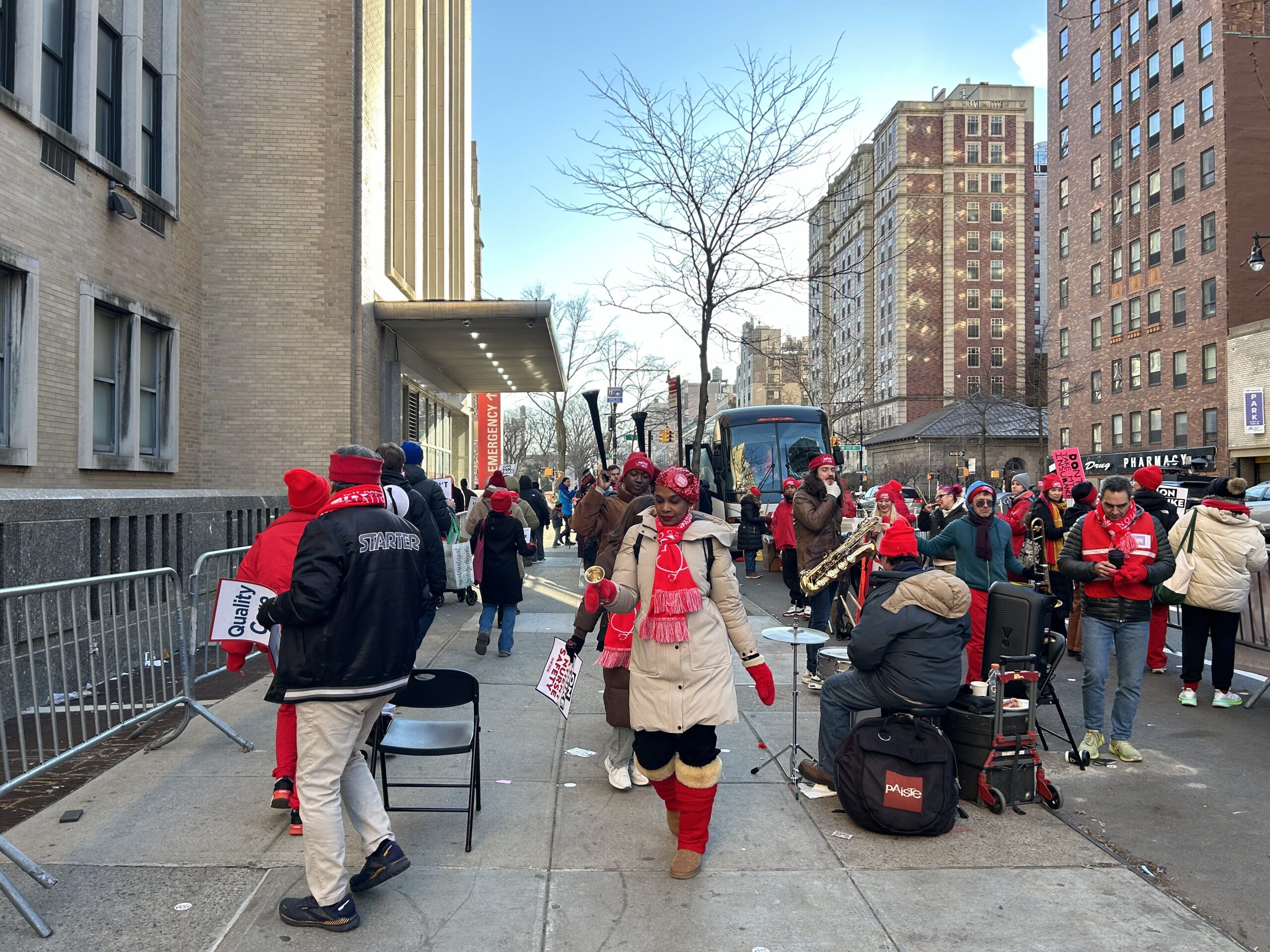 Live music outside Mount Sinai Morningside on Friday was meant to boost spirits and energy.
Despite the tensions there is still joy and community on the picket line. Throughout the first week of the strike, the Mount Sinai Morningside and West locations both kept energy up by bringing bands and speakers to play loud and energetic music. There were even occasional karaoke breaks.
This is not the first time city nurses have gone on strike, and some of the issues of the past are present again – like the nurses’ demand for safe staffing, referring to the ratio of patients to a single nurse. Elizabeth Hanover, a nurse in a surgical trauma unit at Mount Sinai Morningside, for example, takes care of five or six patients during her shift but says the number should be four or fewer, at least for her unit.
“They’re getting antibiotics all night. They have to use the bathroom and walk and we need to make sure that we keep them safe, too,” said Hanover. “So if we have five patients and we’re trying to do everything at once for one patient, there’s a bunch of tasks for one, the next one’s just waiting for the next task and it’s just going from one room to another.”
Multiple unions and organizations – including the Democratic Socialists of America – and local neighbors, including some former patients, came out to support the Morningside nurses. Armand Cruz, an intensive care unit nurse at Mount Sinai Morningside, said the strike and the union’s demands have an impact on the Upper West Side community.
“It’s not a matter of if, it’s a matter of when each of us ends up in a hospital like Mount Sinai,” he said. “And we can decide, in this time, what can we expect when that day comes, when it’s time for us to be patients. Do we want an overworked, understaffed, and underpaid team of nurses to try to take care of us, or do we want the contrary to that?”
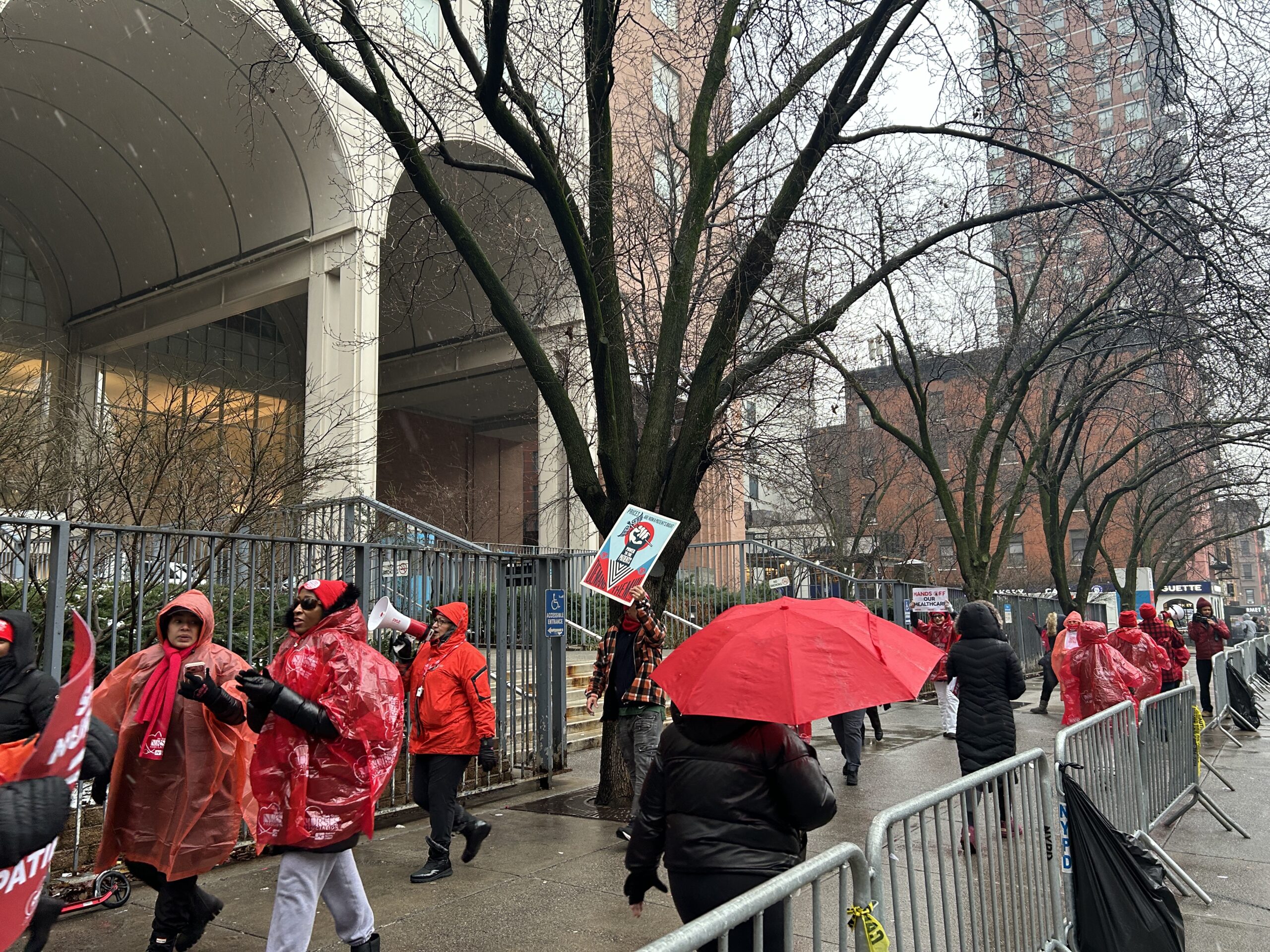 Strikers marched in rain and snow Sunday at Mount Sinai West.
It’s unclear how long this strike will continue. A 2023 strike at Montefiore hospitals and Mount Sinai in East Harlem only lasted 72 hours, but this one, now a week old, with one failed negotiating session, feels more contentious, say the nurses.
“It made a lot of us feel like they don’t value nursing. And like I said, nurses, they were the backbone. We all work as a team,” said Nataki Jarrett-Henry, an emergency department nurse at Mount Sinai West, about the unsuccessful negotiations on Friday.
Even so, Jarrett-Henry said she remains optimistic and hopes to be back inside taking care of patients soon. But for now, even a dismal weekend of rain and snow did not stop the picket line, where nurses continued their protest, their red hats polka-dotted with snowflakes.
Subscribe to West Side Rag’s FREE email newsletter here. And you can Support the Rag here.