

New York’s longest-running play may also be its most hated.
It is the lowest-ranked out of 28 live shows listed on the site Show Score, where a third of its reviews give zero, one, or even half a star out of five. A Reddit thread asking for thoughts on the play garnered responses such as “tired” and “on auto-pilot”. On TripAdvisor, one user warns: “Don’t waste your money!” Another pleads: “Kill me now!”
And yet, since 1987, Perfect Crime has been running eight times a week. Every performance stars the same actress, Catherine Russell; in nearly four decades she has missed only four performances, and has an “understudy”, per rules set by the Actors’ Equity Association, in name only.
I first witnessed Perfect Crime as a teenager in the early 2000s. All I remember from that experience is that it starred a blond, leggy knockout. Now 69, that knockout is still knocking about in the role of Margaret Brent, an inscrutable psychiatrist who may or may not have murdered her husband.
I’m not trying to avoid a spoiler with that phrasing: I couldn’t spoil Perfect Crime if I wanted to, as I have more or less no idea what happens over the course of this two-hour play, or why any of it happens. It’s a four-character murder mystery involving a married couple of psychiatrists trying to get away with having murdered their chef. There’s a detective on their trail making trouble, along with a patient of Margaret’s who I think gets off on simulating murder while wearing a dress. There are gunshots, and an intermission.
That is nearly all I can recall of Perfect Crime, I suppose because watching this play is what I imagine it would be like to experience the onset of dementia. Actions are taken for no evident reason; proclamations are made apropos of seemingly nothing. It somehow unfolds chronologically but not sequentially. It’s not a whodunit; it’s a whatwasthat.
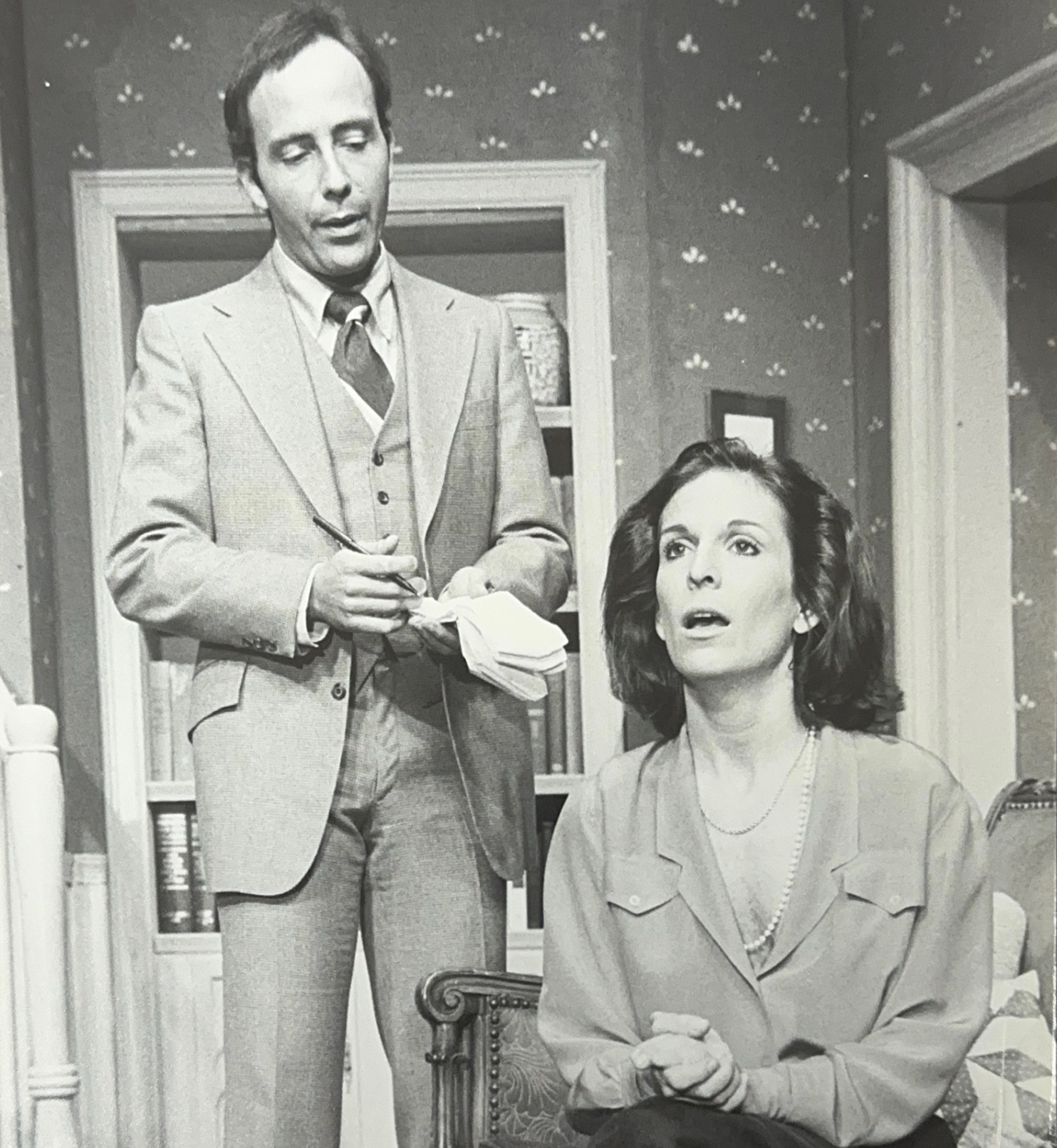
Russell and her co-star in an early performance
That’s not to say the show doesn’t have its admirers. If you can follow its plot, says one online review, you may very well find yourself “screaming in joy”. Others call it “clever”, “fun” and “thought-provoking”.
And so on it chugs, attracting a few dozen a night to the Theater Center, the no-frills performance space on West 50th Street where Russell is also the general manager. It is staged in a 199-seat theatre, but only about four dozen seats per performance are available for advance purchase on Ticketmaster. The show is a permanent fixture at TKTS, the Theatre Development Fund’s half-price same-day ticket booth. Russell added that most of the show’s tickets are sold on TodayTix, and that on average the show sells 50–60 tickets per weeknight.
• Broadway is a rip-off. See these four shows for under $100 instead
On January 5, I attended what a sign next to the theatre entrance informed me was performance number 15,429. It being a Monday night, when most other shows are closed, the turnout was unusually healthy with maybe a third of the theatre full. I counted only three people leaving at intermission. Most of the people I spoke to afterwards told me that they enjoyed the play. Two of them even claimed to have understood it.
I was not one of them, which colours my ability to appraise Russell’s performance. There is a rushed quality to the whole thing, including mundane acts like juggling multiple phone calls (Dr Brent is evidently able to place people on hold without pressing any buttons on her phone). Scenes that ought to be loaded with sexual tension instead feel weirdly antagonistic. At the same time, Russell has a magnetic, irrepressible stage presence, impossible to look away from as she barrels through the material. I found her fascinating.
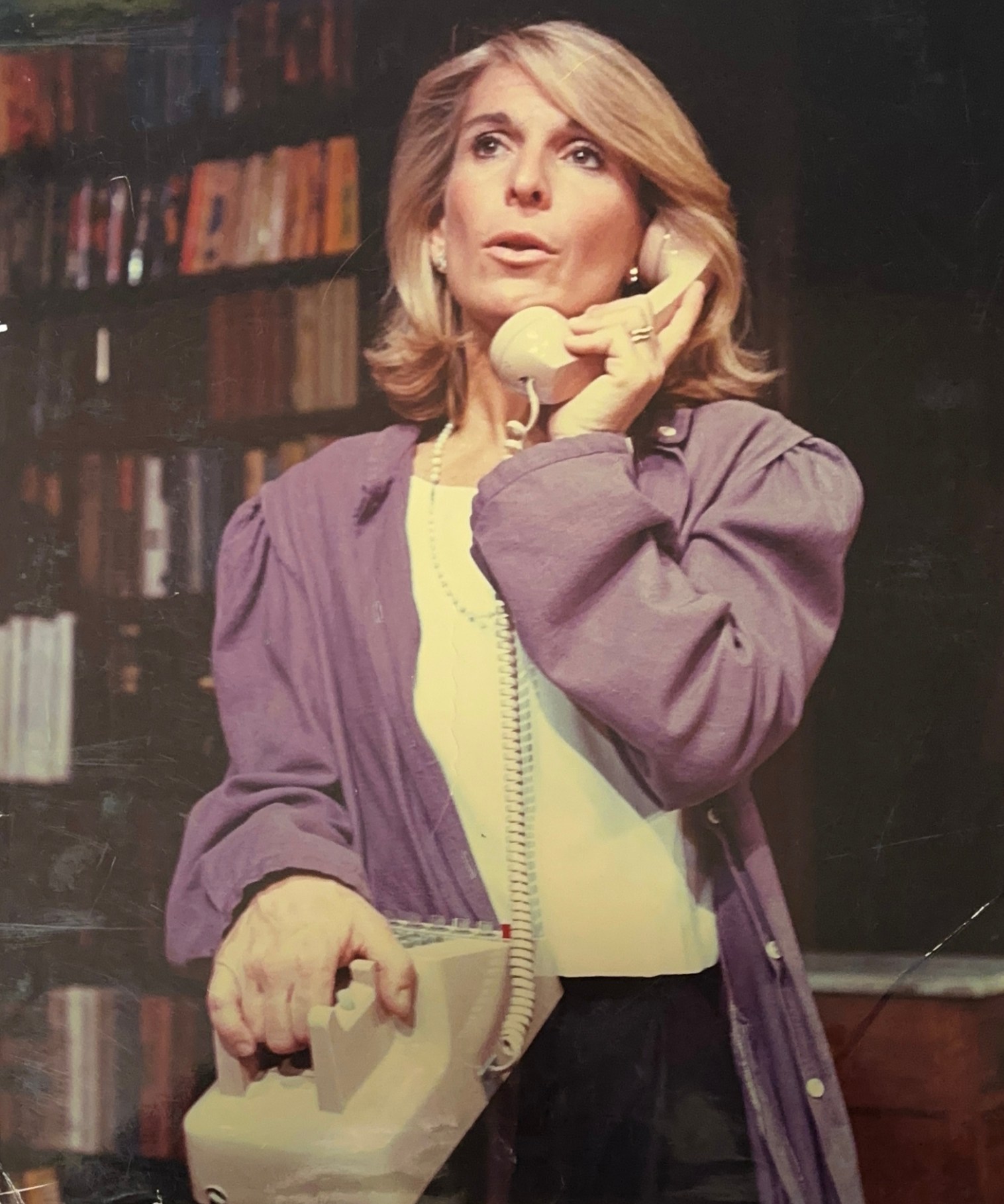
Russell as Margaret Brent
Two days later, I was back at the Theater Center, this time to interview Catherine Russell herself.
I wanted to know: what keeps this woman going? For 39 years — with the exception of Covid, which closed the show down for about 13 months, and for a handful of weddings — she has delivered eight performances a week, saying the same lines, walking the same paces and telling the same convoluted story.
Why, I wondered, would she give up nearly every night of her life to perform this baffling succession of scenes to a mostly empty theatre?
For happiness, as it turns out.
• Sonia Friedman on taking Mean Girls to the stage: ‘It’s women who do things’
I met the wiry, youthful, almost-septuagenarian on the fourth floor of the Theater Center. She greeted me warmly and as we walked together into the theatre, I wondered how long I could go without betraying my honest feelings.
Not long. “You forgot your notebook,” she said, handing me a small legal pad I’d left in my seat. I looked down at my perfectly legible notes, including: These characters don’t act like people and None of this makes sense.
Fantastic.
Russell rescued me: “If I got upset over everybody who didn’t like Perfect Crime, I’d never get out of bed.”
It also helps that the time Russell spends as Dr Brent takes up only a sliver of her professional life. Her other jobs are teaching English at Baruch, teaching acting at NYU and running the Theater Center, which has four performance spaces. In addition to Perfect Crime, the venue houses musical “parodies” of Seinfeld, Friends and The Office, which Russell sub-licensed.
When she is not busy with these jobs she manages two other off-Broadway spaces and two rehearsal studios, as well as Patzeria, a 46th Street pizza joint once owned by her late husband, the restaurateur Patrick Robustelli. She and Robustelli met when she was 40 — too late, she said, for her to have children, though she has two stepdaughters.
“I would have loved to have had a child,” she said.
That she has spent nearly 40 years doing the same play is unremarkable to her. “I just go to work every day,” she said. “I was raised to go to work.”
Surely she must get bored. Has she ever broken the fourth wall? Chastised an audience member for using their phone?
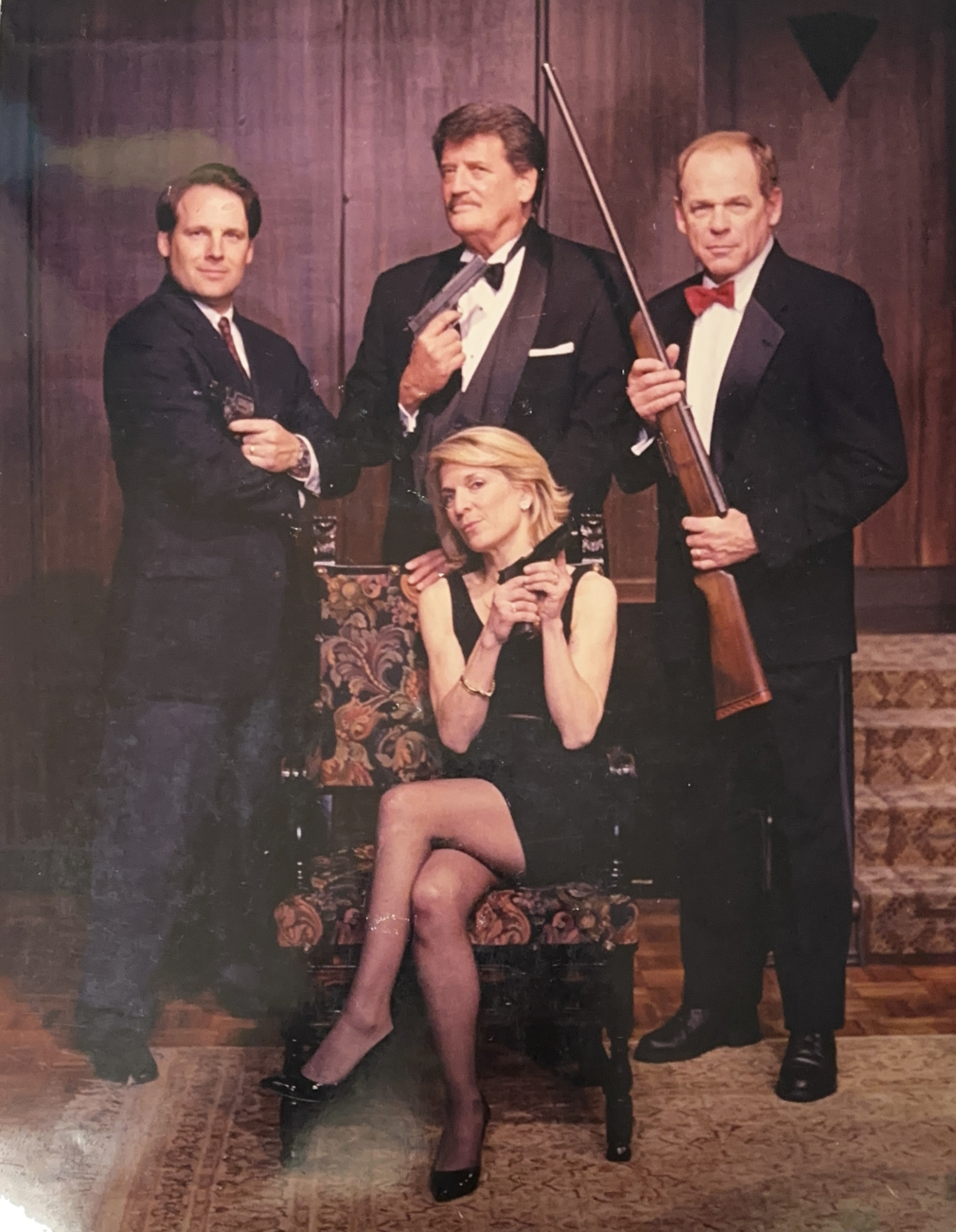
The cast of Perfect Crime
“I would never,” she said, seeming scandalised. “ Patti LuPone can do that. She’s a star. I’m just a working actress. I know my place in the universe.”
Her humility may have been a part of her upbringing. She was raised in New Canaan, Connecticut, as a Christian Scientist, a relatively modern Protestant sect that prohibits alcohol and discourages medical intervention — two proscriptions whose health effects, I suppose, balance each other out. Still a member of the tribe, Russell said she has never called in sick. “I’m super healthy,” she said, noting also that she can do 180 push-ups.
Russell graduated from Cornell University in 1977 with a degree in English and theatre. In 1980, she got a master’s in Educational Theatre from NYU, and began teaching undergraduates in 1981.
• Michael Riedel: Broadway can blame its greedy self for going bust
Perfect Crime found her several years thereafter, when she acted in a theatre company helmed by its writer, Warren Manzi. They initially put up the play as a 16-performance showcase, and then, with Manzi’s attorney cousin producing, launched its off-Broadway production. From there it took off, to everyone’s surprise.
“I didn’t think it would last six months,” Russell said. “And it just kept going.”
Russell credits the show’s early success to its “buzziness”: the play had once been optioned for Broadway in 1980, with hopes that Elaine Stritch or Mary Tyler Moore would star. That plan was shelved, according to Russell, when Manzi decided to take a stab at screenwriting in Hollywood.
But that was nearly 40 years ago. Now, people suspect it’s a “vanity production” she pays for herself — an idea she dismissed as ludicrous. “ If I had enough money to keep Perfect Crime running for 40 years, I’d own an island. I’d own a mansion. I do not.” She does, however, own a five-storey Hell’s Kitchen brownstone, purchased in 1998 by Robustelli, who she said was “hugely successful”.
When asked directly if Perfect Crime was making money, she said: “Yeah. Why not? Sure.”
However it manages to keep going, the play has put food on the table for scores of theatre professionals over the years. “ Lots of people got their Equity cards, and lots of people have great pensions,” she said. “Whether you like the play or not, I’m proud that it’s employed tons of people here and it’s helped their lives immensely.”
For Russell, there have been times when Perfect Crime is what made life bearable. After the death in 2019 of her husband, “the greatest love of my life … I had to come to work every day and get on stage, and that saved my life.”
“This makes me happy,” she concluded with a shrug. “Why should I f*** it up?”