
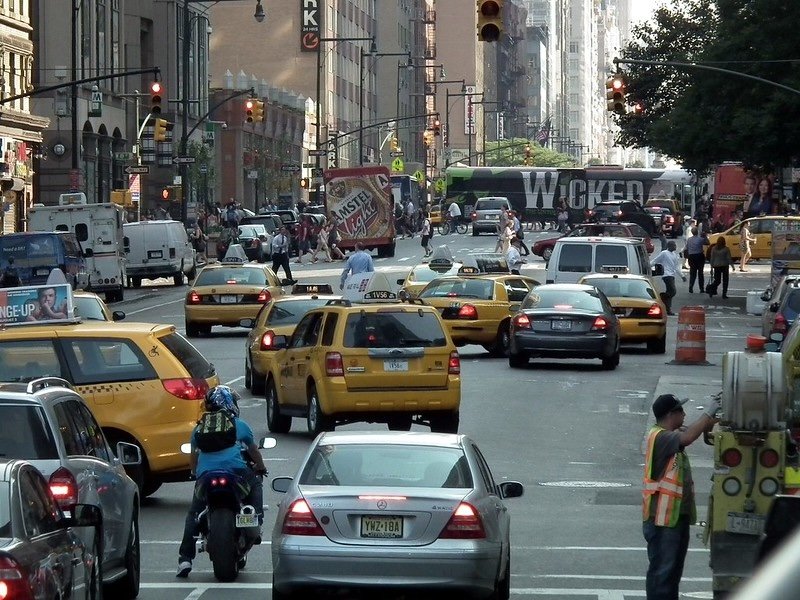
One year after New York City launched congestion pricing, initial findings point to millions fewer vehicles entering lower Manhattan, growing public transit use, and toll revenues nearing US$500 million for 2025.
A full understanding of how the program is affecting air pollution, especially in the overburdened South Bronx, awaits more data, but early studies give cause for optimism.
Traffic Down, Transit Boosted, MTA Coffers Looking Up
More than 21 million fewer vehicles entered New York City’s central business district in the first 10 months of 2025, an 11% reduction in traffic across all vehicle types compared with the same period in 2024, the Metropolitan Transportation Authority (MTA) found [pdf] in its first evaluation of the initiative. Transit got a corresponding boost. Bus ridership on routes serving the Congestion Relief Zone (CRZ, encompassing most roads south of 60th Street in Manhattan) increased 8% from the previous year between January and September, while subway trips rose 9%. The MTA also reported a 4% increase in pedestrians entering the CRZ, and a 70% drop in excessive honking reports.
Meanwhile, the transport authority’s coffers received a boost. Under the Traffic Mobility Act establishing congestion pricing in the city, the program must generate sufficient annual revenue to fund the US$15 billion in capital projects included in MTA’s 2020 to 2024 Capital Program.
As of October 2025, the program, which charges cars $9 and heavy trucks $14 to enter the CRZ during daylight hours on weekdays, had raised $467.8 million. (See here for NYC transportation economist and congestion expert Charles Komanoff’s take on why toll revenue is actually “slightly lacklustre”, and what the MTA can do to improve its shine.)
Projects slated to be financed through congestion pricing tolls include the purchase of 460 electric buses at a cost of $344 million, $929 million in accessibility renovations at passenger stations—including in long-underserved South Bronx neighbourhoods—and installation of 220 new overhead pantograph charging systems in depots across the city, costing $188 million.
Commercial Trucks Not Rerouting Through the Bronx
In the months leading up to the start of congestion pricing, environmental justice advocates worried that the program would find traffic-related air pollution surging in surrounding areas, especially in the South Bronx. One of the nation’s poorest neighbourhoods abutting one of the world’s richest (Manhattan), South Bronx has been overburdened with traffic and pollution, especially along the six-lane east-to-west Cross Bronx Expressway (CBE).
Anticipating that congestion pricing might push more commercial truck traffic onto the CBE, MTA planners did model a worst-case scenario that would see PM 2.5 concentrations around the expressway increase to 11 micrograms per cubic metre, up from 10.9 but remaining just below 12 micrograms—the U.S. Environmental Protection Agency’s mandated maximum for long-term exposure to the toxin.
Speaking with Inside Climate News ahead of the program’s launch, Mychal Johnson, co-founder of the environmental advocacy group South Bronx Unite, cautioned that any congestion reduction wins in Manhattan should not come at the cost of public health losses in a neighbourhood already choking on traffic pollution.
“Even one more truck is too many,” Johnson said.
Two months into the tolling program, students at the Roosevelt House Public Policy Institute at Hunter College, working under the direction of famed former NYC traffic commissioner Sam Schwartz (Gridlock Sam), offered early reassurance that congestion pricing in Manhattan would not lead to an uptick of heavy trucks through the South and North Bronx.
Comparing MTA bridge and tunnel data from January 8 to March 1, 2024, with data from January 6 to February 28, 2025, Schwartz and his team found “no evidence trucks are bypassing the zone and going through the Bronx.”
Further analysis published that September by StreetsBlog NYC added to the picture. Transportation guru Komanoff used more MTA data to show that an average of 72 fewer freight trucks used the Bronx span of the mammoth Triboro Bridge per day between January 6 and August 26, 2025, compared with the same period a year earlier.
The decline in freight traffic entering the Bronx correlates with shifts in commercial traffic in the CRZ. Between January and May 2025, fewer large trucks but more multi-purpose vehicles entered the relief zone compared to the same five-month period in 2024.
Air Quality Outcomes Uncertain
With fewer heavy trucks and millions fewer cars traversing the CRZ, improved air quality might be expected. An analysis published in early December in the journal Nature supports that view.
According to a team of systems engineers from Cornell, average daily maximum PM2.5 concentrations declined by 3.05 micrograms per cubic metre within the CRZ in the six months from January 6 to June 30 2025, representing a whopping “22% reduction from a projected average of 13.8 micrograms without the policy.”
Across all five NYC boroughs—Manhattan, Staten Island, Brooklyn, Queens, and the Bronx—average PM 2.5 concentrations declined by 1.07 micrograms, down 11% from what they would have been without congestion pricing.
But in sharp contrast, the MTA’s initial report records “no significant change” in PM 2.5 concentrations, either within or outside the CRZ. The same holds for levels of nitrogen dioxide, nitric oxide, ozone, and black carbon.
“Definitive conclusions about air quality changes” await a full year of air quality data, the MTA writes, adding that a comprehensive report on air quality will be published once all data is to hand and has been analyzed.