
This story was produced in conjunction with the NYCity News Service and with support from the Equity Through Data Project at the Craig Newmark Graduate School of Journalism at CUNY.
When New Yorkers choose a premium grade of octane at their local gas station, there’s a good chance they may not be getting the fuel they’re paying for.
An analysis of city Department of Consumer and Worker Protection inspection data by the NYCity News Service found that almost all gas stations in the city failed at least one inspection in the last two years — mostly for not selling the grade of octane advertised at the pump.
Of the 729 gas stations checked by New York City inspectors annually from mid-2023 to mid-2025, 702 failed tests of their octane, mid-grade gas blends or signage, records show. Failed octane samples lead the list with 1,135 condemnations, meaning the pump gets shut down until the problem is corrected. That’s compared to a relative handful of other infractions that include incorrect pump blends, bad diesel or displaying the wrong prices for gas.
Drivers are familiar with yellow stickers on gas pumps indicating the different octane ratings that they can choose from. Aside from trusting those labels, they have few clues about the fuel they are putting in their tank.
To thousands of New York drivers, the wrong octane level could lead to long-term problems for their vehicle’s engine.
“The very least, it’s going to cause premature wear,” said Mike Porcelli, a master mechanic and CUNY adjunct professor. “The worst, it’ll blow the engine apart.”
The Department of Consumer and Worker Protection says it is working to hold predatory businesses accountable. “As prices rise, New Yorkers work too hard to have their trust exploited by companies that cut corners and mislead consumers,” the agency said in a statement. “Conducting honest business isn’t a suggestion – it’s the law.”
A high-octane ripoff
Inside an engine, pistons travel up and down the cylinder thousands of times per minute, running on perfectly timed explosions at the top of their cycle. Different octane levels change the timing of these explosions.
Every manufacturer recommends a certain grade of gas for a car’s engine, which is usually printed near a vehicle’s tank.
If the octane rating is too low, the gas detonates before the piston reaches the top, pushing it backwards and potentially causing engine damage. If octane is too high, Porcelli explained, the piston fires late, leaving unburned gas that can damage the catalytic converter and cause excess pollution.
Mismatched fuel hurts New Yorkers’ wallets as much as their engines.
Mid-grade gasoline costs 53 cents per gallon more than regular-grade gasoline on average in the city, an analysis of American Automobile Association data shows. Premium-grade — usually a 91 to 93 octane-rating — costs an extra 37 cents per gallon above mid-grade, based on prices posted by AAA. That’s about four to six dollars extra to fill a tank than with lower-rated fuel.
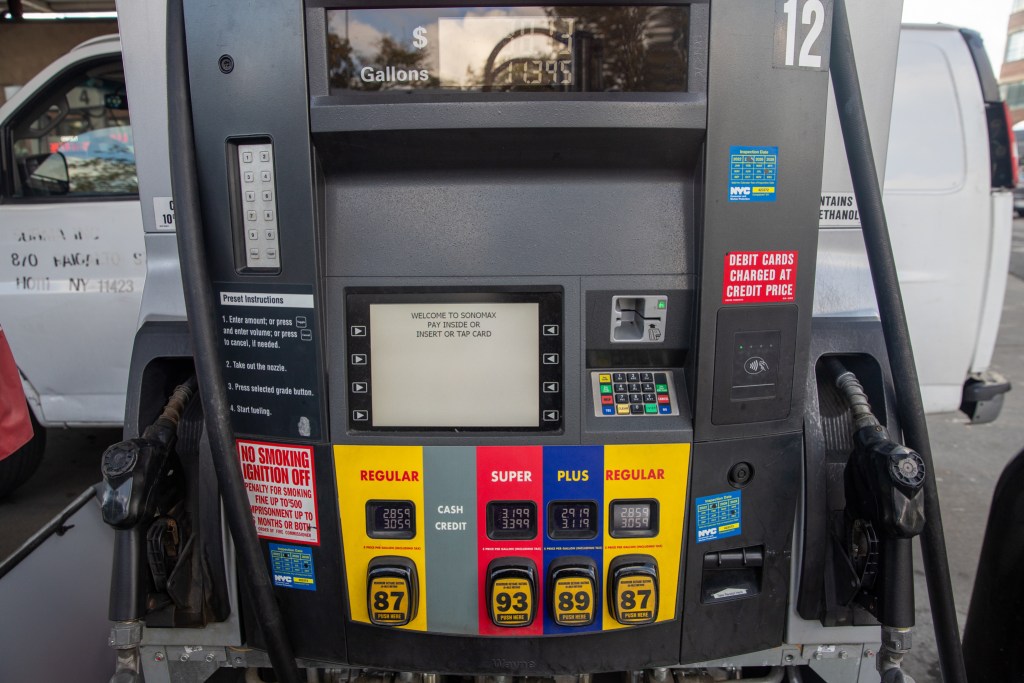 A gas pump in Greenpoint, Brooklyn, Oct. 22, 2025. Credit: Rosie Thomas
Octane levels in gasoline are unlikely to change over time, so any differences in ratings are most likely due to accidentally or intentionally filling a station’s underground tanks with the wrong product, experts say.
“My theory is that whoever’s operating this station is cheating and putting a lower-grade gas in the high-priced tank,” said Porcelli, who has 63 Automotive Service Excellence certifications.
Robert Sinclair, Jr., senior public affairs manager for AAA Northeast, was unaware of the number of stations in the city receiving citations for incorrect octane levels. When informed by NYCity News Service, he said, “I think people should be getting what they pay for. That’s why various government services exist — to make sure consumers aren’t getting ripped off.”
Putting pumps to the test
To better understand how the Department of Consumer and Worker Protection does its work, a journalist accompanied an agency inspector as he examined the Sonomax gas station at 278 Greenpoint Ave., in Brooklyn, on a day last fall.
City inspectors can arrive unannounced anytime a gas station is open, though they almost always visit on weekdays, one inspector said.
Inspectors begin by reviewing paperwork showing who delivered the most recent truckload of gas and when. This allows the inspectors to match prior tank levels to the current ones.
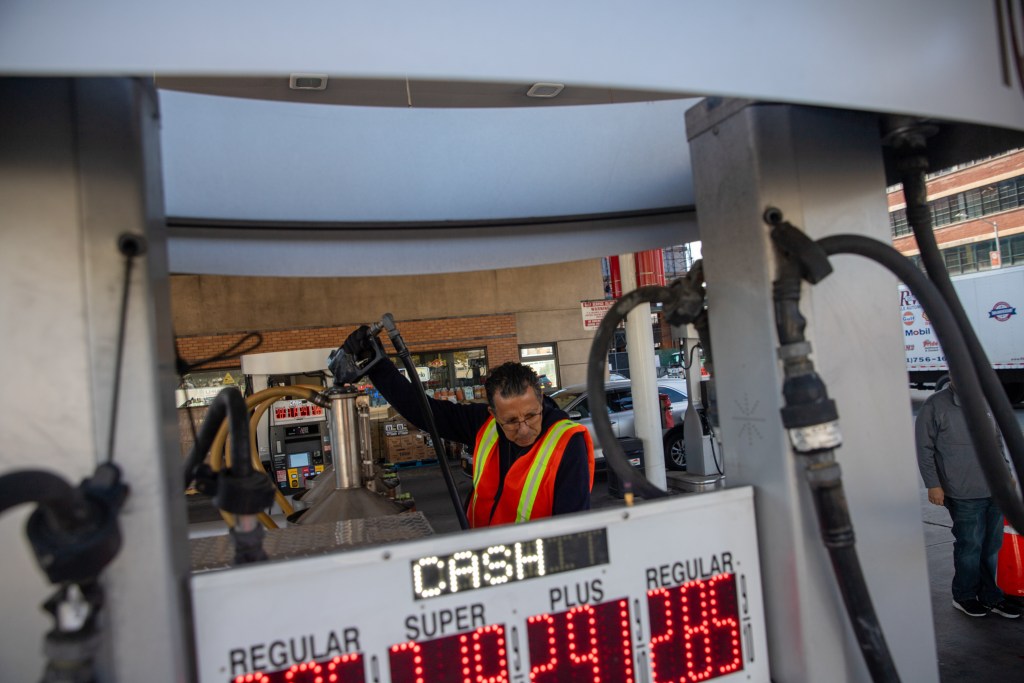 A Department of Consumer and Worker Protection worker inspects octane levels at a Sonomax gas station in Greenpoint, Brooklyn, Oct. 22, 2025. Credit: Rosie Thomas
The process is simplified by a receipt-like printout from the station’s system, showing the number of gallons, grade of gas and dates of prior deliveries. This is recorded by a digital monitoring system in the large underground tanks. The gas station is required to provide these numbers to allow inspectors to track fuel deliveries.
After getting the paperwork, inspectors check every pump. The inspectors arrive with a special pickup truck outfitted with a weights and measures testing laboratory built into its bed.
Tanks, levers and scales, all smudged with oil, make up the testing equipment in the back of the truck. The inspectors fill one of their tanks with five gallons of gas from the station’s pumps, then compare its reading to those displayed on the pump. If the measure matches within a fraction of a gallon, the pump passes inspection. If not, the pump is deemed inaccurate and gets shut down until repaired.
Octane readings are not as simple: Inspectors begin by filling a small gas can with just under one gallon of each grade of gas from the pump.
Then the inspectors place a barcode on the can and retain an identical barcode for their records, documenting the grade of fuel that is advertised. The cans are picked up every two to three weeks by a state-approved testing lab based in New Jersey, where the octane level is determined in a blind test — meaning the advertised octane level is not disclosed to the lab. New York City then matches the barcode from the results with its own notes to see if the octane levels match.
The Brooklyn Sonomax gas station only had two big tanks feeding the pumps — one with 87 octane and one with 93.
Regular octane tanks are accessed through a white manhole cover painted with a black border, while premium tanks are red with a white border. Mid-grade tanks have a blue cover with a white border, but are rare in the city. For the mid-grade product available at Sonomax’s pumps, a small device beneath each pump blends the two proportionately before delivering it to the nozzle.
The color coding is based on national standards and helps the delivery driver know where to fill the gas from his truck when visibility is low, according to the inspector.
Stiff competition for station owners
Gas stations make about three to seven cents per gallon of profit from selling gas and increasingly rely on the convenience store side of their businesses for revenue.
“I don’t think the gas station is making enough money today. I think competition is too much,” said Sam Jacoby, owner of the Sonomax station, which passed the inspection.
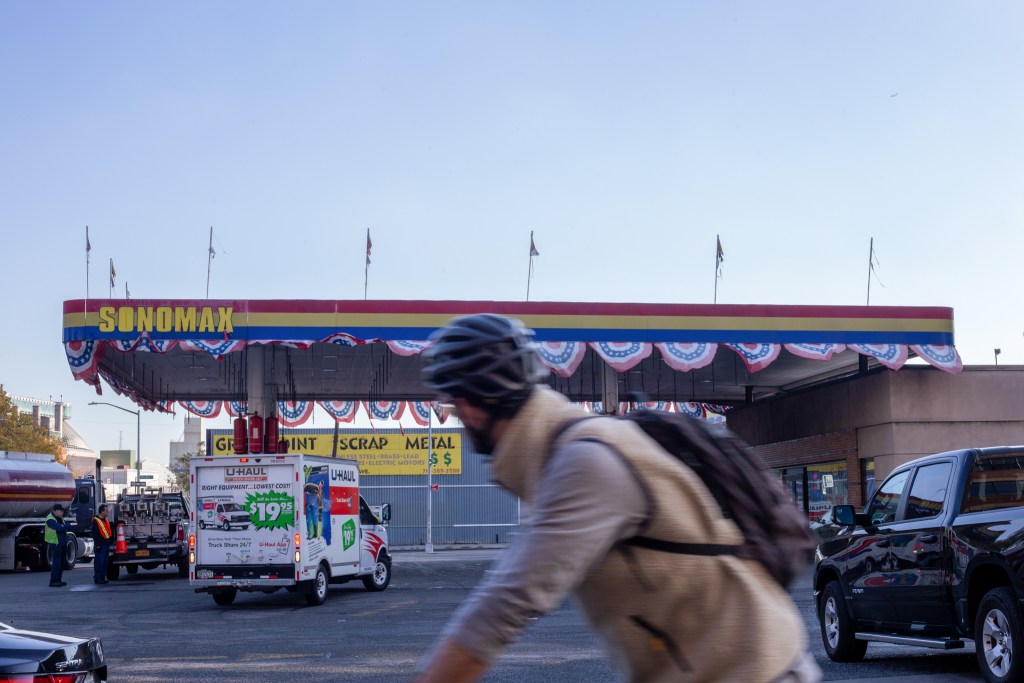 A Sonomax gas station in Greenpoint, Brooklyn, gets inspected on Oct. 22, 2025. Credit: Rosie Thomas
Besides competition from other stations, a recent surge in electric vehicles is also cutting into profits. “The more people using electric cars, the less customers you got,” Jacoby said.
Gas station owners who play games with octane levels do so at their own peril, he added.
“If somebody wants to go and mix up the gas and put the cheaper gas in the high octane, technically they can do it,” Jacoby said. “Legally, it’s not right. But if they want to do it, take the chance to get caught and lose the reputation — and the customer — it’s up to them.”
Jacoby pointed out that if the customer noticed the difference in octane levels, they could report it to the city. But identifying bad gas as the cause of an engine problem isn’t always easy for the average driver. A number of factors could be affecting their car’s performance.
Supreme drivers notice the difference
For ride-share drivers who burn through a tank per day while shuttling customers around the city, the octane difference is more obvious.
A group of drivers from the Independent Drivers Guild, a union of ride-share drivers headquartered in Astoria, said some stations have better gas than others.
Some noted getting a “check engine” light after filling up at certain stations. Others recall feeling the pedal vibrate differently after getting gas, a nuance only someone driving 12 hours a day might notice — and an indication that the engine was knocking from too low of octane.
“For seven years I rent the car. It’s a Camry. I’m talking about a very strong car, 2018. It takes any gas for the engine. To tell you there is a problem that means that gas is very bad,” said Majed Zegrar, a former driver and advocate for the driver’s guild.
For most ride-share drivers, price is the most important consideration when filling the tank. For station owners, narrow margins don’t change much whether gas prices rise or fall.
“When most of the drivers start the shift, they fill up the tank outside New York City, because it’s cheaper,” Zegrar said.
Related