
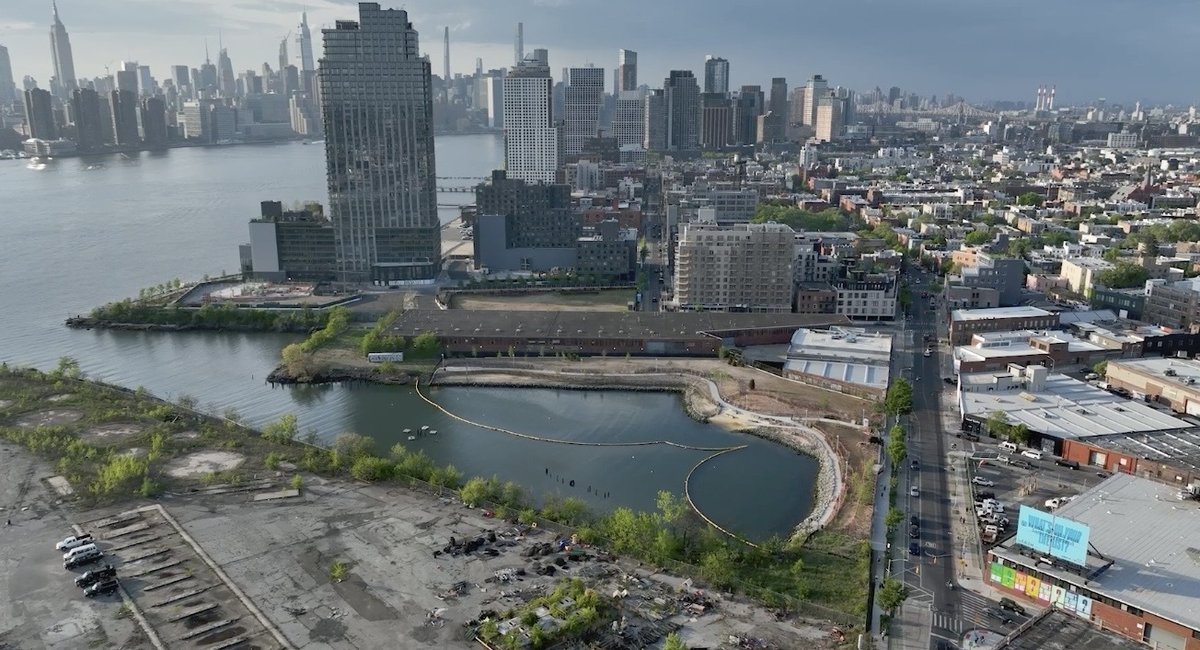
New York City’s latest housing development fight is approaching a decisive moment in Greenpoint, two decades and four mayors after a major neighborhood rezoning plan fueled skyscraper development along North Brooklyn’s waterfront.
Unfulfilled promises from that 2005 plan loom large in the debate over the proposed Monitor Point project, which comes before the local community board’s land use committee on Tuesday.
The real estate developer Gotham Organization plans to lease land owned by the MTA and construct a 1,150-unit apartment complex on Quay Street, with buildings reaching 600 feet tall — among the highest in the neighborhood — across a narrow estuary from the long-stalled Bushwick Inlet Park. The 28-acre greenspace was a centerpiece of the sweeping land use plan that transformed Greenpoint and neighboring Williamsburg, but remains years from completion amid legal battles over cleanup of the toxins left behind by fossil fuel companies.
The housing plan’s opponents argue that the project doesn’t deliver enough affordable housing and disrupts the area’s ecology. It has also come to symbolize the anger among residents who see yet another high-rise construction plan in a neighborhood that has produced more housing than any other over the past 15 years, while they are still waiting for a park promised two decades ago.
The developer behind the project has already made concessions. In response to local opposition to the plan, Gotham Organization announced in December that it would make 40% of the planned apartments, or about 460 units, affordable for low- and middle-income renters.
“We listened to feedback from neighbors facing the housing crisis daily, which is why we significantly increased our commitment to both a higher percentage and deeper affordability levels than other waterfront projects,” Gotham Organization’s President of Development Bryan Kelly told Gothamist in a written statement.
The company’s revised plan includes one 200-unit complex where all apartments would be priced for low- and middle-income renters earning 40% to 100% of the area median income — or roughly $45,000 to $113,000 for a single adult. It also includes a pair of towers on a shared platform with 950 units, about 260 of them deemed affordable at an average of 60% of the area median income — $68,000 for a single adult.
A sign protesting the Monitor Point development proposal in Greenpoint.
Christopher Werth / Gothamist
The new affordability commitments earned praise from top city officials, including Department of Buildings Commissioner Ahmed Tigani, who was the head of the city’s housing agency when the new plan was unveiled last month. But they weren’t enough to win over local leaders like Councilmember Lincoln Restler, who is demanding more affordable units.
“As is, I do not support the project,” Restler told Gothamist Friday. “On public land, we have to maximize affordable housing.”
MTA officials have argued that the deal gives the agency more cash needed to fund its capital improvement projects and transit operations. MTA Chair Janno Lieber said the MTA has an obligation to “retrieve market value” for its properties in a 2021 statement announcing the deal with Gotham Organization. An MTA spokesperson declined to comment and instead directed questions about the plan to the developer.
Restler said he would come around if the developer agreed to cap rents in “a healthy majority” of the new units, and if the city made “firm and clear commitments to our community about the future of Bushwick Inlet Park and when this park is going to be completed.”
The city, he said, has “done just an embarrassingly bad job” preparing the park site over two decades after approving the neighborhood rezoning plan.
Bushwick Inlet in Brooklyn where the city is constructing a park and where a developer has proposed residential towers on land owned by the MTA.
Scott Fraser
Katherine Conkling Thompson, president of the organization Friends of Bushwick Inlet Park, said the housing project is a “threat to the park itself” and that nothing should be constructed on the MTA-owned site.
Conkling Thompson said the buildings will destroy the area’s delicate ecology and could lead to flooding in Greenpoint, something she said she thought past city officials comprehended two decades ago.
“They understood that high-rise development 50 feet from the water and adjacent right up against a public park and a unique inlet tidal estuary would be poor planning,” she said.
The developers say the project will not interfere with the park plan.
Other project supporters caution against entangling the failures of the Bushwick Inlet Park with the current plan to deliver much-needed affordable housing a short train ride from Manhattan.
Howard Slatkin, who runs the housing policy group Citizens Housing and Planning Council, said that the Monitor Point plan unlocks a number of community benefits, including the creation of hundreds of affordable apartments during a dire housing crunch.
The Gotham Organization is also funding the relocation of a second MTA facility currently located on the site of the planned Box Street park, another long-delayed greenspace further north in Greenpoint. The housing project will open more waterfront access and create space for a new museum dedicated to the USS Monitor, the historic ironclad Civil War ship constructed in Greenpoint in 1861.
“It’s the subject of righteous frustration that it’s taken this long,” said Slatkin, who played a key role in developing the Greenpoint rezoning plan as an official with the Department of City Planning. “But the project ties together a bunch of loose threads that haven’t been dealt with.”
The community board meeting is scheduled for 6 p.m. Tuesday at the Polish & Slavic Center at 176 Java St. in Greenpoint, Brooklyn.