
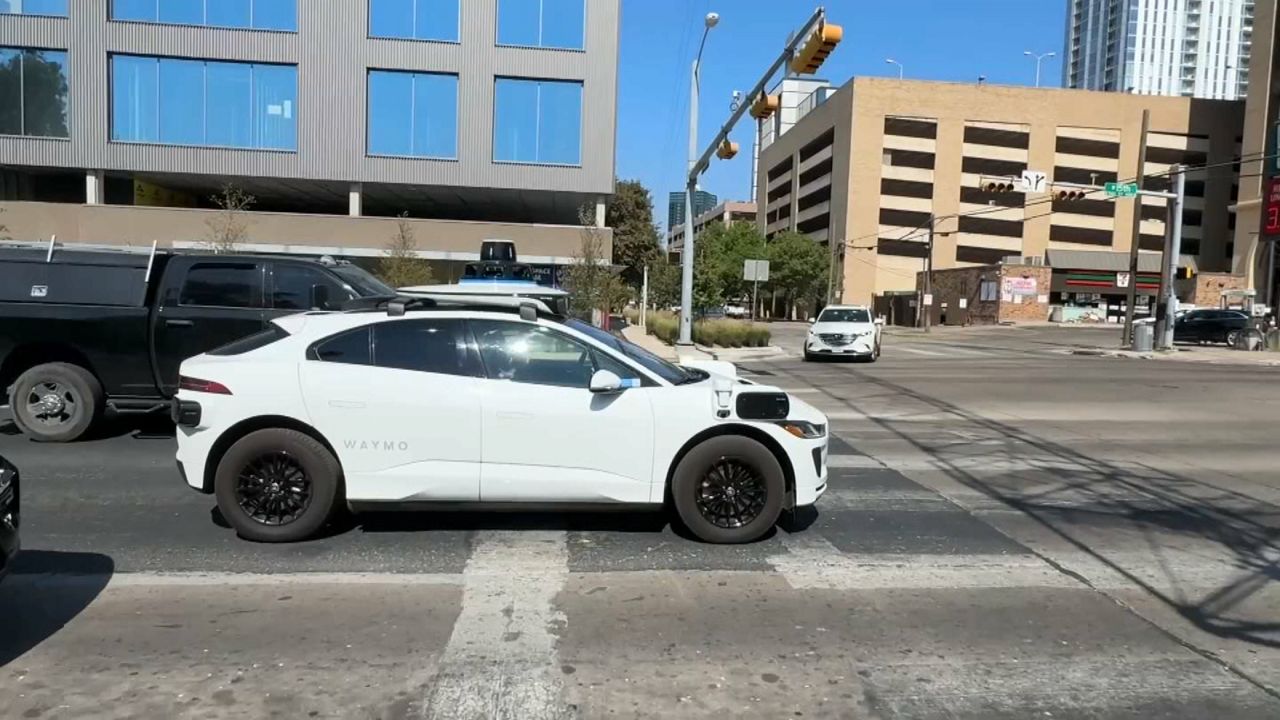
Waymo, the autonomous rideshare company, is already testing its driverless taxis in New York City, but not picking up passengers.
Eight test cars that must have a human at the wheel.
Now, the governor is proposing a limited number of licenses outside New York to operate without a driver, and it has for-hire-vehicle drivers in the city worried.
What You Need To Know
Gov. Kathy Hochul is proposing legislation to allow for a limited amount of autonomous rideshare vehicles to operate in New York outside of the city
For-hire-vehicle drivers in the city worry it will eliminate jobs for the 140,000 licensed drivers and thousands more yellow taxi drivers
Waymo is currently testing eight vehicles in the city with humans ready to take the wheel under a special permit
Pedro Acosta has been a professional driver for 25 years and drives for both Lyft and Uber.
He said while it affords him flexible hours to take care of one of his children who is in a wheelchair, it’s already become harder to make money.
“If there are so many people [on] the platform, you have to wait till a long time to get jobs sometimes,” Acosta said.
He worries it will get even harder now that the governor has proposed allowing for a limited deployment of for-hire autonomous vehicles, like Waymo, to operate in the state.
“There are over 140,000 licensed here in New York, and that means 140,000 families that are going to be without work,” Acosta said.
Gov. Kathy Hochul’s proposal excludes the five boroughs.
Brendan Sexton is the president of the Independent Drivers Guild, also known as IDG, which represents drivers and said it has already hurt them in other cities.
“We’ve seen some incremental loss in wages for drivers,” Sexton said. “You know, these algorithms are going to push the Avs more than they’ll push live drivers. And that’s going to have a detrimental effect.”
Waymo has less than a few thousand vehicles total operating in a handful of cities: Atlanta, Phoenix, Los Angelos, Austin and has the most in San Francisco with about 1,000.
A report in the “Economist” showed that in 2024, the number of people in San Francisco working for “taxi and limousine service” firms grew by 7%, versus the prior year. Total pay in the industry rose by 14%.
But there are also safety concerns.
Bhairavi Desai, executive director of the New York Taxi Workers Alliance said there is just not enough data.
“Our streets are not ready for driverless vehicles,” Desai said. “You know, these cars have not been tested enough. They’s actually not strong evidence that there are any safer.”
She and others pointed to what happened during a power outage in San Francisco late last year that brought many Waymo cars to a standstill, blocking traffic and emergency vehicles.
The company has acknowledged some issues, but noted its cars were able to safely navigate 7,000 unlit signals.
In a statement, a spokesperson said: “Our vehicles have 12x fewer crashes involving injuries to pedestrians compared to human benchmarks…. We have seen material improvement in our performance since our software update.”
Meanwhile skeptics argue New York City is very different than other cities.
Harry Campbell founder of The Driverless Digest said don’t underestimate the technology.
“Maybe it doesn’t have it dialed in at the start, but I do feel pretty confident that Waymo can, and, you know, other AV operators too, will be able to handle basically any city on the planet, with enough time,” he said.
Campbell said he does think New York City is very different than other cities when it comes to the rideshare industry: It’s heavily regulated and for most drivers it’s a full-time job.
So he thinks there could be some fees imposed on robotaxi companies to operate in the city that would go toward evening the playing field for human drivers.