
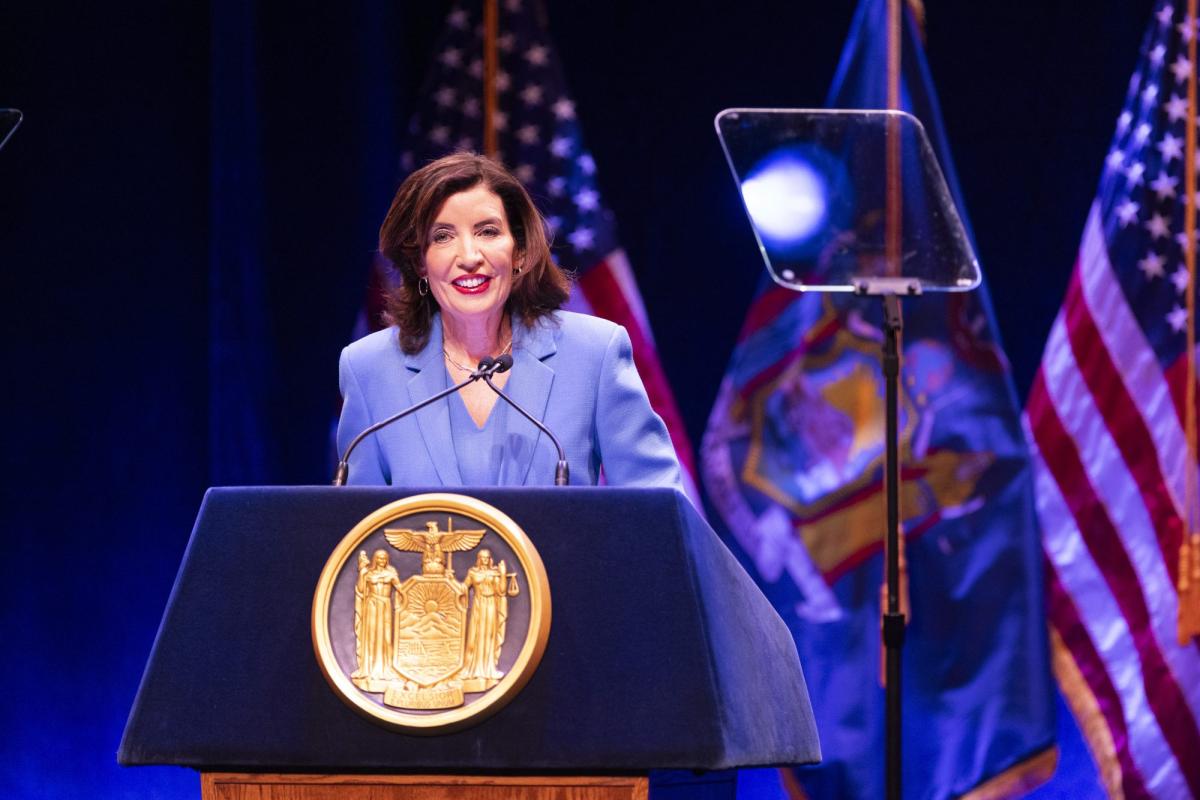
“Budget” likely isn’t the best word for describing the spending plan New York Gov. Kathy Hochul put forward Tuesday.
Yes, that’s the word used in the state Constitution to describe the package of appropriations and laws the governor must present each year.
But “budgets” are what families use to prioritize how they spend their income — an exercise in constant scrutiny, asking whether the cost of an expense is, first, accurate and if so, necessary.
It involves evaluating tradeoffs, hunting constantly for efficiencies and weighing the prudence of spending versus saving.
But New York doesn’t “budget” in any readily recognized or responsible way.
Hochul’s fiscal 2027 spending plan would increase state spending more than 6%, twice the expected rate of inflation.
That’s not a one-off: Spending had already ballooned 49% over the previous seven years.
The bloat has not been uniform.
Two parts of the state budget will next year make up more than half of the spending: New York’s share of Medicaid health-care costs, and aid to local school districts.
Medicaid, designed to cover the poor and disabled, has expanded to cover more than one-third of New Yorkers.
As Empire Center’s Bill Hammond has noted, the program spends more per resident than any state — and twice as much as New Jersey.
The state’s share of Medicaid costs doubled in just seven years, from $23 billion in fiscal 2019 to $44 billion today.
Hochul’s proposal will raise it to $48.5 billion.
The Hochul administration is seeking federal permission to cover another 1.4 million residents after Congress stopped funding a similar plan with looser eligibility rules.
Without fanfare, New York is sleepwalking toward the progressive dream of having Albany overseeing a single-payer health care system.
Get opinions and commentary from our columnists
Subscribe to our daily Post Opinion newsletter!
Thanks for signing up!
New York’s public schools, meanwhile, post middling results at the nation’s highest per-student cost.
A responsible budgeting process would have lawmakers questioning why the Empire State spends 31% more per student than Massachusetts — but gets left in the Bay State’s dust in every national ranking.
More than 80% of New York school districts have fewer students than they did just five years ago; most have seen enrollment fall more than 5%.
Hochul’s budget boosts aid so much that even the fastest-shrinking districts will get at least 1% more than last year.
Those are just the big-ticket items, but together they represent state lawmakers signing off on spending without providing anywhere near the necessary level of oversight.
No surprise: Senators and assembly members are more likely to be found posing behind a big check than squinting over a spreadsheet.
Every category of state spending has escaped serious scrutiny since the Great Recession because Albany isn’t subject to the same limits as families and businesses.
For governors and legislators, there is always the option to just take more money.
Former Gov. Andrew Cuomo and state lawmakers did just that in 2021.
Even as Congress was sending a deluge of mostly unnecessary federal pandemic aid, pols in Albany enacted the largest tax hike in state history, raising taxes on large corporations and high earners.
Since then that added revenue, plus stronger-than-expected tax receipts mainly related to booming global financial markets, allowed more spending.
These “temporary” increases have been extended, allowing such things as substantial new state spending on child care.
While Hochul seems, for now, to have sated New York City Mayor Zohran Mamdani’s appetite for higher taxes using state money, there’s a big risk to increasing expectations — not only for more funding, but for bigger increases.
Two years ago, Hochul warned “we can’t spend like there’s no tomorrow, because tomorrow always comes.”
New York may soon remember what a mistake it was to forget that.
Ken Girardin is a fellow at the Manhattan Institute.