
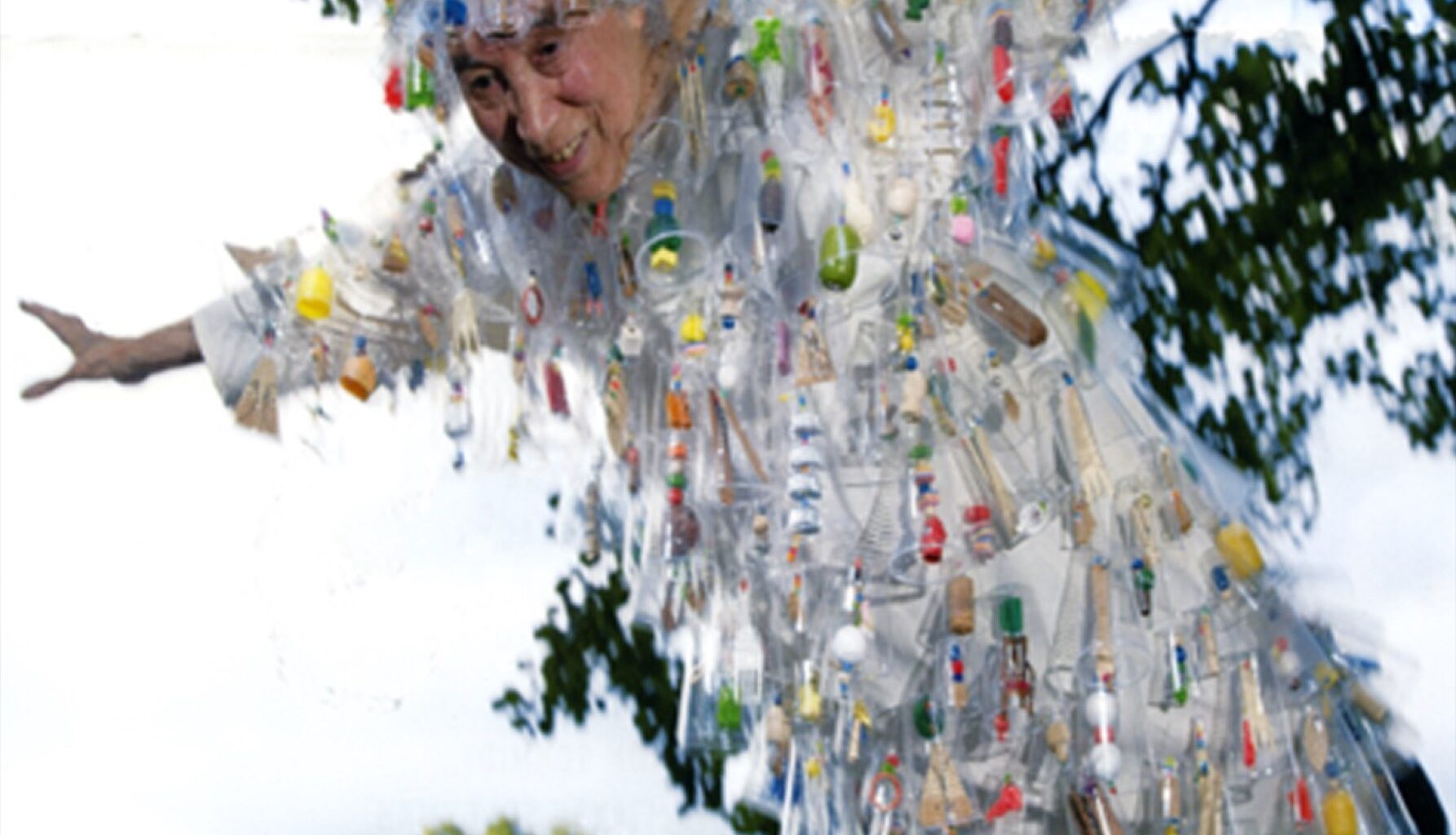
Takako Saito came to my attention through my research on women performance artists in 2022 on the Italian Fluxus website Foundation Bonotto. This website featured a 1989 video of Saito’s performance Silent Music. She blows milkweed seeds into the air and has the audience participate. Takako then goes into another room and makes music from bags of garbage and a bed spring to conclude the performance. I was moved by Takako’s use of nature as an ephemeral element and getting audience participation. The music she made out of the garbage was fascinating. The more I delved into Takako’s oeuvre, the more it became a story of her great skill and playfulness, her Fluxus games and the intimate way she made everything herself. I thought “here is a major Fluxus artist, a Japanese woman, who needs to be heard from and who has not had a one person show in New York in years.” I wanted to see more of her art and share it with others through a show at the Women’s Darkroom + Gallery in Brooklyn.
Foundation Bonotto told me that “Takako Saito doesn’t have an email address only a home address.” So, I wrote her a letter by hand. I did not hear from her for almost three months but I knew in my heart that we would be doing this show.
Then one summer day in 2023, I got a text from Takako’s friend, Professor Marc Schulz, who was in New York and had work from Takako! He was bringing work for a show at the Japan Society organized by Midori Yoshimoto for the Out of Bounds: Japanese Women Artists in Fluxus show. Professor Schulz came to the gallery and showed me box after box of Takako’s beautiful stamp drawings, photograms, wall hangings, collages, and needle drawings. He said that Takako wanted to do a show with me because she knew how hard it was for these little galleries to survive. She could see me, and I could see her, even though we never met in person. That is the power of her art.
We did the show Out of the Box, at the Women’s Darkroom + Gallery in 2023–2024. The show got a review and I sold some work, but for me, the most important part was writing back and forth with Takako. She was in her mid-nineties and dealing with health issues. She was organizing large shows in China and Japan and at the same time was worried about the studio she had lived and worked in for years. At age ninety-five, Takako, a renter since the 1970s, got kicked out and had to move into a smaller apartment. She had wanted to create the Takako Saito Workshop for people to come and make art after her death but her benefactor had died of cancer. Takako told me about how hard it was to move from country to country without a work visa when she was young and how she finally ended up in Düsseldorf, where she taught and lived for the rest of her life.
Though I only have four letters from her, they are long, multiple page affairs that were works of art with ink, drawing, and punched holes that created faces. In them she explained that she found inks reacted differently in the water from Reggio Emilia than Dusseldorf. In a cross between Surrealist alchemy and Process Art of the seventies, she began making “vegetable juice drawings” on translucent parchment (“pergament” in German) paper that she then heated from underneath with an iron to cause different visual reactions. She drew with different mixtures made from black ink, saffron, onion skins, sugar beets, tea, chamomile, blackberries, coffee, peppermint, beetroot and rhubarb juice. Carefully “controlled chance” use of materials and processes determined the images.
I miss Takako Saito. She always closed her letters: “Love, Takako Take care of your mom,” (who had just had hip surgery). Getting her letters in the mail was very moving and exciting for me. Death is so final, like the last page of a novel—but Takako’s story is one that I would like to go on forever.