
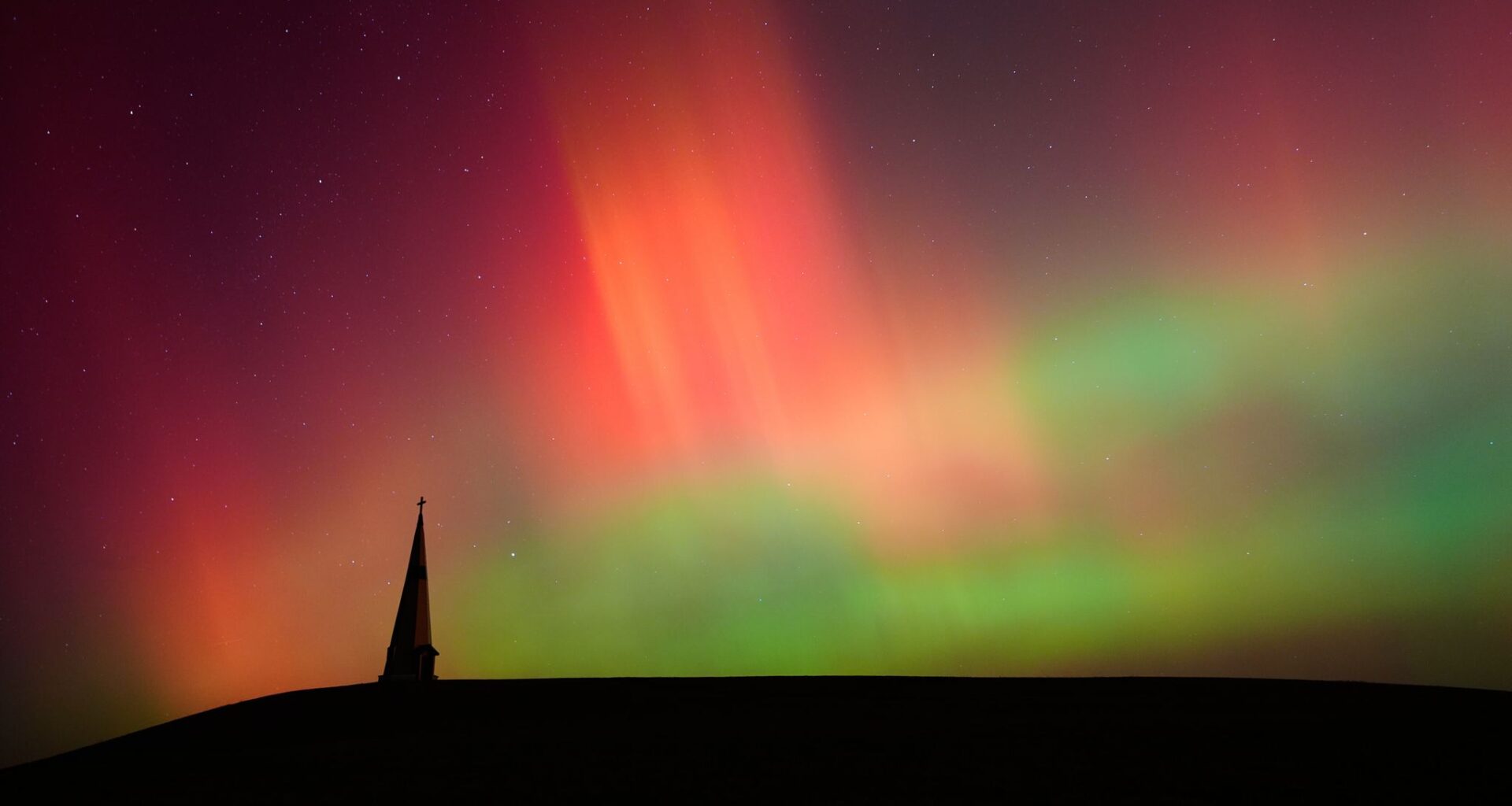
A strong geomagnetic storm that struck Earth on Monday could mean that the northern lights could be visible in New York again on Tuesday night.
The National Weather Service issued a severe geomagnetic storm alert on Monday when models showed a large coronal mass ejection originating from a solar flare on Jan 18. The fastest Earth-directed CMEs can reach our planet in as little as 15 to 18 hours.
According to NOAA, the shockwave from the CME struck the planet at 2:38 p.m. Monday. Residual effects could keep the auroras around for another night.
The event, according to NOAA’s Space Weather Prediction Center, comes amid an intense cycle of geomagnetic and solar radiation storms that peaked in 2025.
A geomagnetic storm is a disruption of the Earth’s magnetosphere triggered by an energy transfer from solar winds.
According to NOAA, these storms arise from irregularities in the solar wind that cause substantial changes to our magnetospheric currents, plasmas, and fields. The conditions for geomagnetic storms involve prolonged periods — many hours — of high-speed solar wind, with a southward-directed magnetic field. This opposite direction to Earth’s magnetic field eases the energy transfer from the solar wind into Earth’s magnetosphere.
The largest storms that result from these conditions are associated with coronal mass ejections. Storms also result in changes in the Earth’s radiation belts and changes in the ionosphere, including heating the upper atmospheric region called the thermosphere.
The sun operates on an 11-year cycle with roughly 5½ years of decreasing intensity followed by the same amount of time of increasing activity. The sun’s current trajectory peaked at a “solar maximum” in May 2025, according to NOAA.