
State lawmakers said Wednesday they need proof of over a billion dollars in savings that budget officials attribute to controversial changes Gov. Kathy Hochul made to a Medicaid home care program — announcing this week it’s more than double what they expected.
About 210,000 disabled or elderly New Yorkers who use the Consumer Directed Personal Assistance Program were placed under one company last year to curb soaring Medicaid expenses.
And state budget leaders Tuesday announced the five-year contract with company Public Partnerships LLC, or PPL, is paying off — saving the state up to $1.2 billion annually.
“It took bold action by the governor to address this thing,” state Budget Director Blake Washington told reporters in Albany. “She wore it for two years [and] there was lots of nonsense around it. It was completely indefensible.”
Hochul and Washington promised the transition to one company, putting 600 other smaller companies known as fiscal intermediaries out of business, would save at least $500 million. The budget director said the additional savings came from improved oversight, reduced fraud and administrative costs.
But several lawmakers said as issues persist with PPL, they doubt the company runs the program in a way that has saved more than double what Hochul’s administration anticipated.
Sen. Leroy Comrie, who’s been critical of the transition, is demanding to see more data.
“We need to see those numbers,” he told Spectrum News 1. “We still have patients that are in trouble. We still have folks that haven’t been able to get there, receive their pay, and that the entire system is crashing…They’re generating savings because they’re ripping people off.”
Sen. James Skoufis, who led an investigation into the transition last year after allegations of bid-rigging, also said he’ll be asking the Budget Division for detailed proof of the agency’s calculations.
“We haven’t seen any of that data; look, I hope they’re correct,” he said Wednesday. “I look forward to actually seeing the justification that demonstrates that that number is real and the savings are even higher than expected. I know that at the mid-year point last year, the savings were nowhere near what were anticipated. And so maybe there’s been some enormous upswing in those savings.
“I look forward to seeing those numbers,” he added.
Lawmakers said they plan to pursue legislative reforms to the program this year, regardless of the savings.
Skoufis on Wednesday said he and Senate Health Committee chair Gustavo Rivera have completed their probe into the transition. The senator expects to release the findings and introduce legislation to reform the program in the coming weeks.
“You’re going to be seeing some bills that speak to some of the very particular challenges and issues that cropped up during our inquiry and how we would like to respond to them,” said Skoufis, a Democrat from Woodbury.
Skoufis said he’s gotten more answers from the Health Department and Second Floor but wouldn’t share details of what his bill will include.
Disability advocates say workers continue to experience pay delays or inaccurate paychecks, and have since PPL took over April 1.
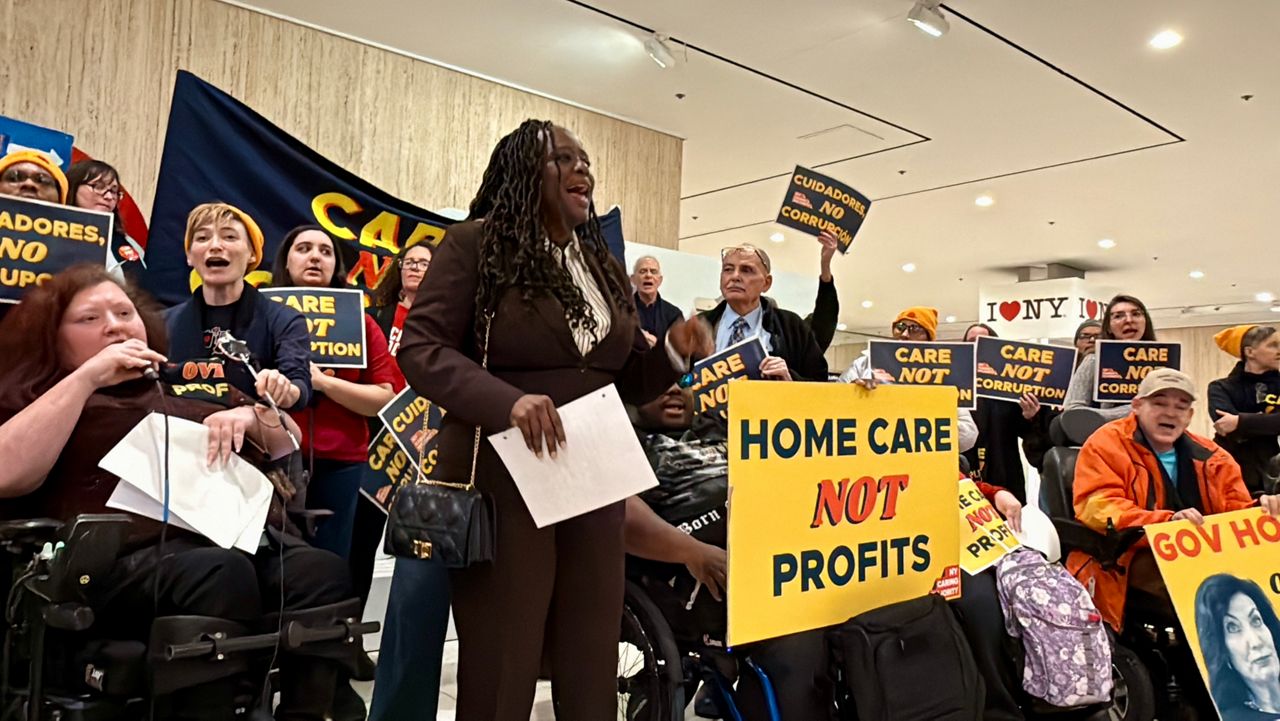
Dozens of advocates rallied in Albany on Wednesday — pressuring lawmakers to increase pay for home care workers and remove for-profit middlemen from Medicaid long term care services to save money.
They also support legislation to add fiscal intermediaries back into the program to give consumers more choices about their care.
“It was rolled out so quickly and, in my opinion, so carelessly,” said Sen. Cordell Cleare. “We have to make sure that people are getting paid and people are on those roles.”
But Hochul’s administration promises the $1.2 billion savings are real.
Washington said the changes have led to lower enrollment rates, with about 3,500 new enrollees in managed long term care per month before the transition and roughly 400 new enrollees per month now.
PPL has an admin rate of $68 per member per month, where rates were as high as $1,000 per member per month prior to the transition, according to the state Budget Division.
“Where we are today we’ve successfully landed the plane and we’re excited to partner with PPL,” Washington said.
PPL has paid 258,000 personal assistants in the state to date.
“The New York state Legislature chose to consolidate the Consumer Directed Personal Assistant Program for a reason: To provide much-needed oversight, save taxpayer dollars, and ensure continuity of care,” Patty Byrnes, PPL’s vice president of government relations, said in a statement. “PPL has delivered on each of those promises. To date, we have identified and eliminated improper practices under the previous system, put the program on track to save New York taxpayers over $1 billion, and paid all personal assistants who submitted fully compliant timesheets in accordance with program rules. We are committed to continuing these efforts and protecting CDPAP in the long-run.”