
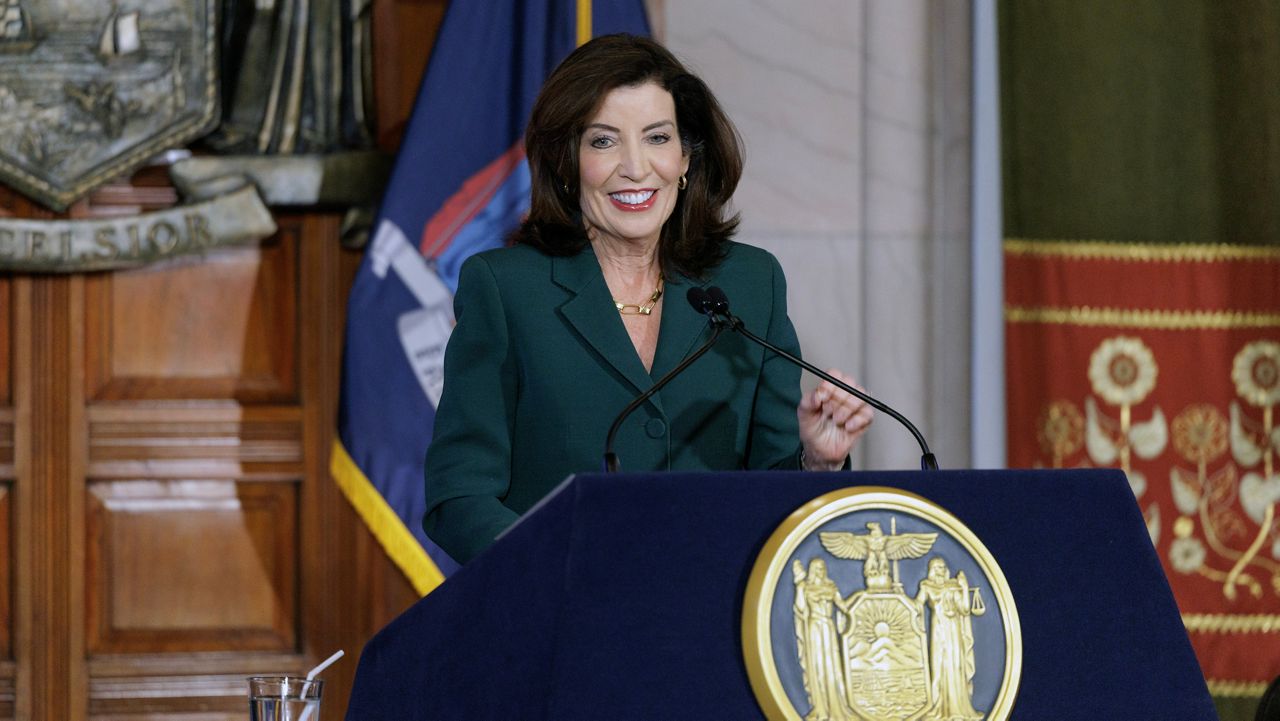
Many have noticed that New York Gov. Kathy Hochul’s executive budget proposal seems unlikely to inspire the kinds of budget battles we saw in 2025, but that doesn’t mean state lawmakers aren’t parsing through the plan with a critical eye.
During the state budget process, Assembly Speaker Carl Heastie can be found most weeks in the halls of the State Capitol expressing frustration to reporters over the tendency for governors to pack their executive budget proposals full of non-fiscal policy changes that he argues bog down the entire process and result in blowing past the April 1 deadline.
He was at least expressing some relief in a Wednesday afternoon news conference one day after Hochul unveiled her plan.
“There’s less policy than normal, so maybe I’m getting into the governor’s ear a little bit,” he said.
Last April, as the state budget process dragged on and the spending plan ultimately became the latest in 15 years, Heastie even took the step of proposing a bill that would allow lawmakers to get paid when the state budget is late if the governor included policy proposals.
For now, Heastie seems hopeful that Hochul and the legislature could be past budget squabbles by the time the trees in West Capitol Park begin to bud and the food trucks return to Washington Avenue.
“There is less article sevens, but there is still policy,” he said, not giving Hochul a complete free pass. “Governors feel like they have the most leverage during the executive budget process, but I’m encouraged that there is less than normal,” he said.
Whether or not that relative lack of policy is because Hochul has limited appetite to battle with the legislature as the spring days grow longer and election day 2026 grows closer is a story for another day.
Hochul wasn’t interested in entertaining that insinuation when taking questions from reporters after her budget address on Tuesday.
“Did you hear me say I’m taking on the high price of car insurance? That’s not going to be an easy lift,” she said.
But policy-lite doesn’t mean we won’t see budget fights.
Indeed, Hochul’s pitch to weed out car insurance fraud and modify who can claim damages is one of the items Heastie flagged as a potential sticking point.
“Those are probably the two biggest policy things, the insurance and the SEQR stuff,” he said, referring to Hochul’s push to update the state’s environmental quality review.
Agreeing with the governor at least on the point that taking on car insurance is a tall order.
“We have to figure this out because I do think victims of accidents need to have their settlements and their day in court, so maybe we’ll find something that works for everybody,” he said. “The governor is trying to deal with a problem, but I also know that we don’t want to leave victims of accidents without being compensated.”
Heastie added that he anticipates the governor’s proposal to exempt certain housing projects from SEQR to boost development will raise concerns at the local level.
“When you start to change the way that local communities do their reviews, that takes conversations,” he said.
The governor has insisted that the proposal would not override existing state environmental regulations or local zoning laws.
On the Senate side, state Sen. James Skoufis told Spectrum News 1 that there is much to be celebrated in Hochul’s proposal, but the lean toward New York City in the governor’s child care plan will likely result in a spirited discussion.
Hochul is proposing to fulfill universal pre-K statewide by 2028, as well as launching New York City’s 2-K program and expanding its 3-K program.
Upstate will benefit from expansions to the Child Care Assistance Program and pilot programs to for community-wide child care in three counties, Broome, Duchess and Monroe.
Skoufis wants to see a leveling of the playing field.
“There is going to be a bush for parity,” he said. “No one wants to take away child care from families in New York City. I support expanding access in New York City, but we should be increasing that access everywhere in the state.”
Even state Sen. Andrew Gounardes of Brooklyn agreed with his Orange County-based colleague.
“I think there is going to be a lot of interest from upstate members as well as downstate members who support this goal to close that gap as much as we can, even though we recognize it’s going to be a multi-year phase in,” he said.
Gounardes added that another point of contention will likely be pushing Hochul to go further on pushing back against the Trump administration on immigration.
Hochul has proposed protecting certain sensitive locations such as churches, schools and hospitals, as well as making it easier for individuals to sue if their constitutional rights are violated by federal officers.
“The governor is proposing to protect sensitive locations, many of us are pushing for a lot more, we have to do a lot more in the face of what’s happening across the country, and many of us are going to be pushing for New York For All,” he said.
New York For All strictly limits to which state and local law enforcement can interact with ICE, and is seen as essential among many lawmakers and advocates who are plotting ways to respond to the Trump Administration’s immigration policy.
Skoufis seemed to agree with the governor on not including the New York For All Act in the budget. The senator said he is behind the governor’s sensitive location proposal, but has concerns with New York For All.
“That seems to be a very, I would hope, non-controversial proposal that even more center-left Democrats like myself on issues like this can support,” he said of Hochul’s plan. “I want to do everything I can to protect immigrants who, regardless of how they came here, just want to live their lives, work, they pay taxes, their kids go to school, they don’t bother anybody and live peacefully. They should be protected at all costs. I don’t want to hamstring local police in coordinating with federal agents to remove people who are dangerous to our community.”
On the issue of whether or not to raise taxes on the state’s top earners — while individual progressive state lawmakers are certainly pushing for it in amid pressure from New York City Mayor Zohran Mamdani, those in the upper reaches of both chambers seemed to resist committing to a hike in their one-house rebuttals, which typically come out in mid March.
“You all keep asking me, you’ve been asking me since before she even presented her budget if we wanted to raise taxes,” Heastie said. “I always believe in having enough revenue for whatever it is the members want, and we will begin that process on Tuesday. Ask me this question in a month.”
Deputy Senate Majority Leader Mike Gianaris is likewise not quite ready to press go on a tax hike.
“Like the mayor, we are prioritizing making life more affordable for the people we represent. If the governor has a way of finding the resources to do that outside of raising revenue, we’re all ears,” he said. “The important thing is to make child care more affordable, make healthcare more affordable, make mass transit more affordable because that’s what the people want. If we find a way to do that outside of raising taxes, great. If the money comes up short, then we’ll have to have that hard conversation.”