
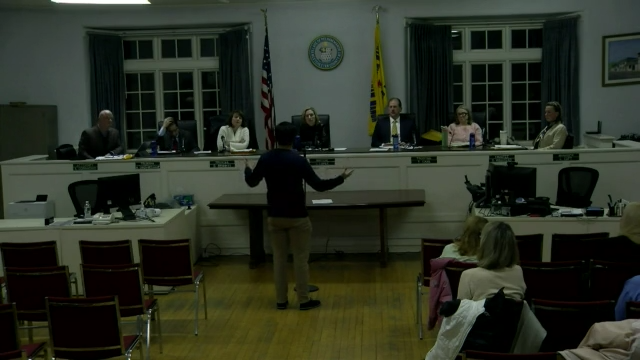
Ryan Kurtz before the Pelham Manor Board of Trustees on January 12
The hard-fought election for control of the Pelham Manor Board of Trustees ended last month with Republicans still in charge, but the issues that dominated the campaign–pedestrian safety, transparency and flooding–have not gone into hibernation. Neither have the village’s Democrats, who were among the residents who peppered Mayor Jennifer Monachino Lapey with questions and pushed for more openness from the board in a 90-minute meeting last week that at times grew contentious.
The January 12 meeting began on a somber note, as Lapey noted the death of her mother, Annette Cowan Monachino, just three days earlier. “Truly a more loving, compassionate, finer woman never walked the face of this earth,” she said. “We will miss her dearly and I thank her for her many contributions to this community.”
After hearing from Pelham Manor Fire Chief Michael Greco, and scheduling a hearing for a new law that would allow businesses in the area around Canal Road and Secor Lane to build office space in existing structures, Lapey opened the floor for public comment.
Manor resident Dana Thayer asked whether the Manor had ever considered creating a software application similar to the one used by the Village of Pelham which allows residents to report mishaps, traffic incidents, downed tree branches and the like.
Lapey said it sounded like a great idea, then asked Village Manager Lindsay Luft for her opinion. Luft voiced some skepticism and said there were matters that were higher on her list of priorities. “I’m always concerned about biting off more than we can chew at any given time, you know, moving from a certain system to a different system. Whether it’s paper based to electronic, you know, it’s an adjustment.”
Luft also expressed some concern about residents clogging the inbox with trivial complaints, like people sending in pictures of discarded pizza boxes. Finally, Luft said, the Village of Pelham app is not a work order system that’s managed by staff. “It’s a work order system that is initiated by the public,” she said. “And I just think that’s a big leap.”
Deborah Winstead, the newest member of the board and the first Democrat to serve as a trustee in years, pushed back on Luft’s concerns. “I think we can walk and chew gum at the same time and we should be able to implement something like this,” she said. “Lots of municipalities do it and they don’t fall off a cliff and I think that we should be able to do the same.”
Calls for a comprehensive traffic study
Next came Allison Frost and Pam Boyver, who have both served as co-chairs of the PTAC Pedestrian Safety Committee and urged the community in the past make the Manor safer. The women thanked the board for installing stop signs last year and for reducing the speed limit, but asked the trustees to do more.
“We would like to request that a village-wide traffic study take place, looking at everything and what innovative changes might be able to be implemented, such as curb bump outs and different things to slow people down,” said Frost, who also serves as chair of the Town of Pelham Democratic Committee.
Boyver raised the issue of pedestrians being forced to walk on the street in some parts of the village, owing to tree roots disrupting the sidewalks, or extra-large hedges crowding the pathway. Frost noted that the intersection between Black Street and Esplanade, near the Manor Club, also posed challenges for pedestrians trying to cross.
Lapey thanked the women for raising these issues, but said the village had conducted a nine-month comprehensive review some 18 months ago, which led to several new traffic laws passed by the board. Lapey then turned to Luft and asked for her input. Luft recited the detailed effort that went into the nine-month study, and then pointed out what she viewed as the drawbacks of a more comprehensive review.
“A village-wide study has the potential to take a significant amount of time and … there’s no guarantee the fruit it’s going to bear,” Luft said. “And sometimes with traffic studies on a large scale, the implementation of any recommendation that might come from it, there’s no guarantee that it’s feasible. Normally those high level studies look at things pretty broadly and then after they’re adopted or recommended… then they bring it to an engineer to see if it’s feasible, which personally I think can be a little backwards.”
Frost countered by asking why the engineer who conducted the review didn’t notice the potential problem at the corner of Black and Esplanade. “There are still many, many traffic and pedestrian safety issues in our community,” she said, adding that a comprehensive study was the best course of action. “It’s also not just like tiny acute problems as you say, and putting a Band-Aid over here and a Band-Aid over there. There are structural things that we can change.”
Deputy Mayor Breda Bennett defended the board’s work on traffic safety. “The one thing that I do want to get across is we definitely are not resting on our laurels,” she said. “That I can assure everyone here and the community. We are very proactive. Over the past several years AAA has recognized our Traffic Safety in Pelham Manor. We’ve received awards for the traffic study.”
Winstead expresses frustration
After more discussion about the need for a traffic safety review, Winstead jumped into the conversation in support of Boyver and Frost. “Actually I’m glad you’re here because I’ve been trying to work on this issue on this side of the desk and am not getting anywhere,” she said.
“So many people tell me on their streets…that there are problems and they would like a comprehensive traffic survey,” she said. “And if we don’t do one, it keeps us doing small, little hotchpotchy Band-Aid fixes here and there. Why not have somebody assess our village instead of saying beforehand, oh, we don’t think we’re going to be able to implement those fixes or they’re not going to be reasonable?”
Winstead cited a number of times constituents told her that they didn’t feel safe walking, riding a bike or taking their kids to school. She said she didn’t expect her fellow trustees to take her word for it.
“If I need to go and do my own survey, I’ll do it and I’ll collect all the problems that people are having here,” she said. “But this just seems ridiculous to me. We could make a plan… I don’t understand the resistance. I really don’t. It makes no sense to me.”
“I don’t think there’s resistance,” Lapey responded. “I think manager Luft is giving you her professional experience and her input.” The mayor said the village was about continuous improvement, and stressed the importance of listening to Luft as well as the highly qualified engineer who conducted the earlier study.
“Right,” said Winstead. “But none of that input sways me when she says I don’t think the report’s going to be any good, or we can’t implement the things or it’s going to be five years. We don’t know what we don’t know. Why don’t we at least figure out what we don’t know?”
Lapey explained that the board was very much in favor of planning and sound management. “I’m not saying no,” she said of a possible survey. “I think it’s something that’s worth discussing.”
Turning to Winstead, Lapey said, “This is a governing board, though. Our understanding is that we must work on this together. We don’t have one trustee go out on behalf of the village. We work together, we have a village manager and we work by consensus. But this is a very open-minded board.”
Toby Marxuach-Gusciora and Karen Gardner spoke next, pointing out the need for more enforcement of traffic rules at the intersection of Esplanade and the Boston Post Road. Lauren Perkins followed up by voicing her support for a comprehensive traffic and pedestrian safety study, as well as a comprehensive plan from the village.
Kurtz challenges the board’s process
Then came Ryan Kurtz, the Democratic candidate who had come within two votes of getting on the board in last fall’s election. He urged the board to consider the Village of Pelham app, and asked Lapey if the board could schedule a public hearing to gauge residents’ views on the app, as well as the topic of pedestrian safety.
“We typically put things on our agenda where we’re ready to act,” said the mayor. “It’s a legislative agenda for the most part. I would want to hear from a few more of my colleagues, a few more residents. I think it’s a great idea to continue looking at things.”
“I don’t know that I’d necessarily agree that something should only be on the agenda when it’s ready to be presented to the public,” Kurtz said. “I mean, all of the discussions of this board are supposed to be public.” Lapey affirmed that all board discussions were public.
He then asked how the trustees could have a proposal if they hadn’t discussed it in public.
“Well, we don’t have a proposal right now on your specific initiative, which is the survey or the app,” Lapey said.
“Right, but my point is that if the discussion happens in front of the public… then why would it not be on the agenda to discuss even if there’s no proposal? Like, where’s the discussion happening?”
“Discussion is happening,” Lapey said. “We introduce ideas. So, for example, Manager Luft and the board introduced a potential local law to change zoning. We just started talking about it and what’s the rationale behind it…. Now we’re going to set a date for public hearing to hear from you, and Manager Luft and the board will give more information. That’s a process. That’s a very proactive, transparent process. This board is about open and transparent government. Happy to consider all topics, all initiatives. You can’t realistically adopt everything. Anyone who tells you that they can is probably not understanding.”
After Bennett continued to defend the work done on behalf of pedestrian safety, Kurtz said the public was not seeing what’s happening.
“I’m just saying that if you were to ask anyone in this room what the scale of the current Traffic Safety program is, no one has any idea,” he said.
Lapey defended the communications put out by the Manor board, describing the effort as “incredibly robust.”
“It’s box-checking though, respectfully,” he said.
“I respectfully disagree with you, Mr. Kurtz,” said Lapey. “I don’t know any village that pushes out more content than we do.” When Kurtz shrugged about the difference between quantity and quality, Lapey insisted that the Manor’s communications were strong.
Village Manager Luft in the spotlight
Kurtz then circled back to his request on pedestrian safety, asking if the engineer behind the Manor’s nine-month traffic assessment could show up in six or eight weeks and answer questions from the public. “Would that be something that you’d be open to?” he asked Luft.
“He may not be comfortable with that,” she said.
“Well, you could make him,” Kurtz responded. “I mean, you’re paying him. You could say we expect you to come in and answer questions. I’ve been to a number of meetings at Siwanoy where they have their engineers and their architect. Community relations is an important part of what these people do, so I’d be shocked if the engineer refused.”
“I’m not saying that he would refuse,” said Luft. “I’m just saying, you know, it would need to be something that would be defined. It’s something that we would need to, you know, look at pretty thoroughly.”
“Sorry, look at what aspect of it thoroughly?” Kurtz asked.
“Just the whole picture,” Luft said.
A few minutes later, Lapey zeroed in on Kurtz’s question about board transparency, saying. “So… how does the public know anything? You know it because we’re here and we’re talking.”
“But because you’re saying things does not always mean they have actual substance,” he replied.
“If I’m telling you something, it has substance.” Lapey replied firmly.
“Ok,” he responded. “So can can we put something, can we have items on the agenda to follow up on these? It’s a simple, direct question. Can we put traffic safety on the agenda on a certain date?”
Lapey agreed to put the question on the agenda during an upcoming monthly report from the Pelham Manor Police Department’s chief.
“I will tell you that the data shows that this is a safe community,” she said. “Is there room for improvement always in life? Absolutely. Are we open to suggestion? Yes, every day of the week and twice on Sunday. But we have to vet these different options and determine what’s in the best interest of the entire village. Not saying no.”
Lapey pointed out that Luft’s schedule was busy, managing an organization with almost 100 employees, and that it would make sense to let some work on this matter take place. Winstead volunteered to help take the next few steps to move the issue forward.
Lapey agreed, but said she should meet with Luft first. “I met with her,” said Winstead, “and all I heard was no.”
“I don’t think that’s a fair assessment,” said Lapey.
“It’s a very fair assessment,” Winstead replied. “You weren’t there.”
“It wasn’t a fair assessment because you weren’t told no,” said Bennett.
“I was told no,” Winstead said. “I was told all the reasons it wouldn’t work.”
“This is why it would be great if these conversations happened at the meetings where there’s actual deliberative processes,” said Kurtz.
“That’s what we do,” insisted Lapey.
“It isn’t,” said Winstead. “When do we do it?”
“We’re we’re doing it right now,” said Lapey. “We have open public comment. We’ve been talking about this for 45 minutes now.”
Kurtz gets heckled; Owen-Michaane appeals for calm
Kurtz wound up his time in front of the board trying to settle a point with trustee Maurice Owen-Michaane over the question of the size of the pipes on storm drains and whether they would be sufficient to handle catastrophic storms that happen only once in a decade or in several decades. When he mentioned what the Village of Pelham was doing, he got heckled by a few attendees in the back, at least one of whom suggested he was taking up too much time.
Owen-Michaane appealed to the crowd for calm. “We’re all neighbors. Let’s not be angry to each other.”
To conclude the meeting, Lapey recognized Scott Wolfgang, who expressed his fervent support of the mayor and the trustees.
“I’ve lived in Westchester for 40-plus years now,” said Wolfgang. “I’ve been in Pelham for 15 years and I wanted to take this opportunity just to thank you guys for such a great job that you do… I think you guys do a fantastic job weighing what can be done with what can be afforded…It really pains me to have a certain group of residents basically attacking you all… We have no debt. Taxes are low, services are great. Like, you just make my life easier. And it’s unfathomable to to me that for some reason that offends people and I don’t really understand it. And I don’t think that people really appreciate the job that you guys do and how well you do by our neighbors. So I just wanted to to thank you and I appreciate all the work that you guys do.”