
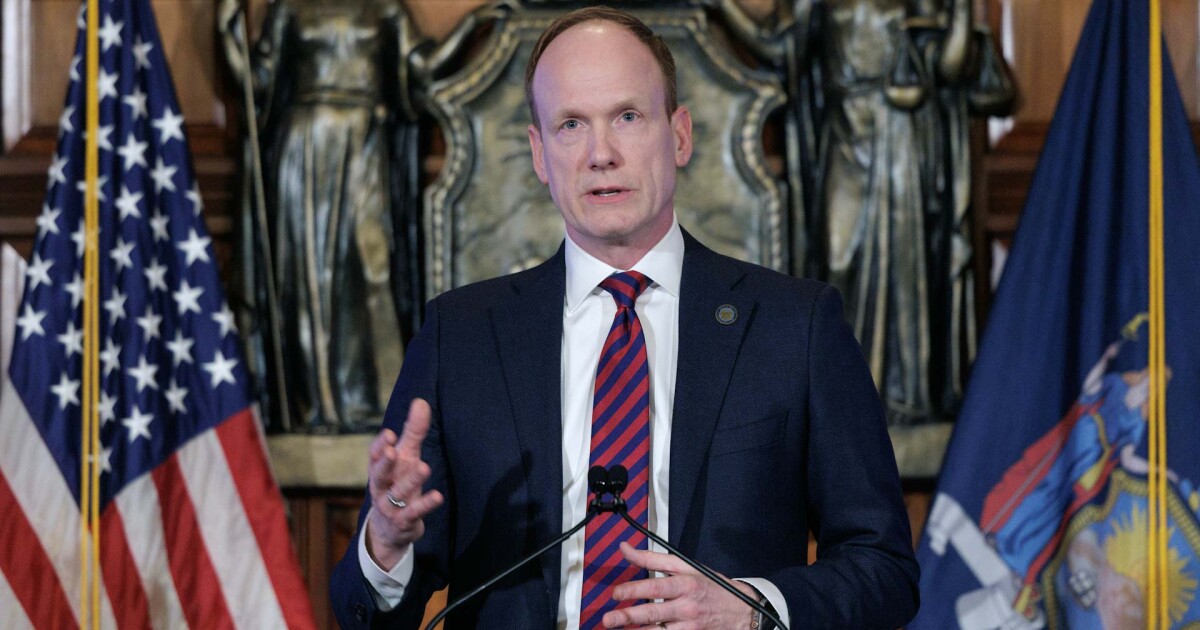
 State Budget Director Blake G. Washington said New York has had far better revenue than projected in fiscal year 2026, which helped shrink its out-year budget gaps.
Mike Groll/Office of Gov. Kathy Hochul
New York Gov. Kathy Hochul on Tuesday proposed a budget roughly the same size as last year’s as the state attempts to weather federal funding cuts.
Processing Content
Her budget would increase spending on social programs and does not increase taxes, as Hochul treads a fine line in a year in which she is up for reelection.
The $260 billion budget proposal is $6 billion bigger than last year’s; for comparison, the fiscal year 2026 budget was $17 billion bigger than fiscal 2025’s.
The budget projects New York State will receive $10.3 billion fewer funds from the federal government in fiscal 2027, a more than 11% decrease from last year.
Some of the drop in funds is from pandemic relief ending, but $3 billion is a loss of recurring Medicaid funding, Hochul said in her budget address. To make up the gap, New York must increase its operating funds around 5%, to $157.6 billion.
The cuts in the One Big Beautiful Bill phase in over time; eventually, Medicaid cuts from the bill are projected to cost the state and its healthcare systems as much as $13 billion per year.
Hochul’s proposal includes roughly 11% higher spending for Medicaid and 4% more spending for schools.
Many New York Democrats, including members of the legislature and New York City Mayor Zohran Mamdani, urged the governor to raise taxes on the wealthy. Hochul refused.
“We’ve managed our money responsibly,” the governor declared in her State of the State address a week earlier. “And that means we can make transformative investments in our future without raising taxes, without saddling the next generation with mountains of debt.”
Hochul would extend corporate tax rates currently in place and add the state’s nicotine tax to nicotine pouches. She also proposed ending taxes on tips, mirroring the federal policy created this year.
The flashiest component of the budget is a pilot program for universal free childcare for two-year-olds in New York City. In FY 2027, the state would increase spending on pre-kindergarten and childcare by $1.7 billion.
Universal childcare is the main point of partnership between Hochul and Mamdani, who was inaugurated on Jan. 1 after campaigning on bold promises like free buses and a rent freeze.
Mamdani’s plans aside, the city needs more revenue just to maintain its current programs.
New York City is facing a substantial budget gap for fiscal years 2026 and 2027. Comptroller Mark Levine estimates that the city will have to close a more than $10 billion gap when it drafts its 2027 budget.
State revenues have greatly exceeded expectations in FY 2026, state Budget Director Blake G. Washington said, because when the state drafted the budget, economists were panicked about tariffs and pessimistic about the federal reconciliation bill.
The state’s rainy day fund is set to stay level at $14.6 billion. Hochul’s proposed budget would create outyear gaps of $6 billion for 2028, $9 billion for 2029, and $12.5 billion for 2030.
The Citizens Budget Commission President Andrew Rein praised Hochul’s refusal to raise taxes and her focus on affordability, but argued the state’s spending levels are unsustainable.
“Instead of layering on new unaffordable spending, the State should target programs to those in need and fund them by scaling back less impactful spending, including wasteful economic development programs and school aid to shrinking and wealthy districts,” Rein wrote. “These smart choices would increase the State’s capacity to deal with federal hits and help stave off a self-inflicted fiscal reckoning that would lead to harmful cuts.”