
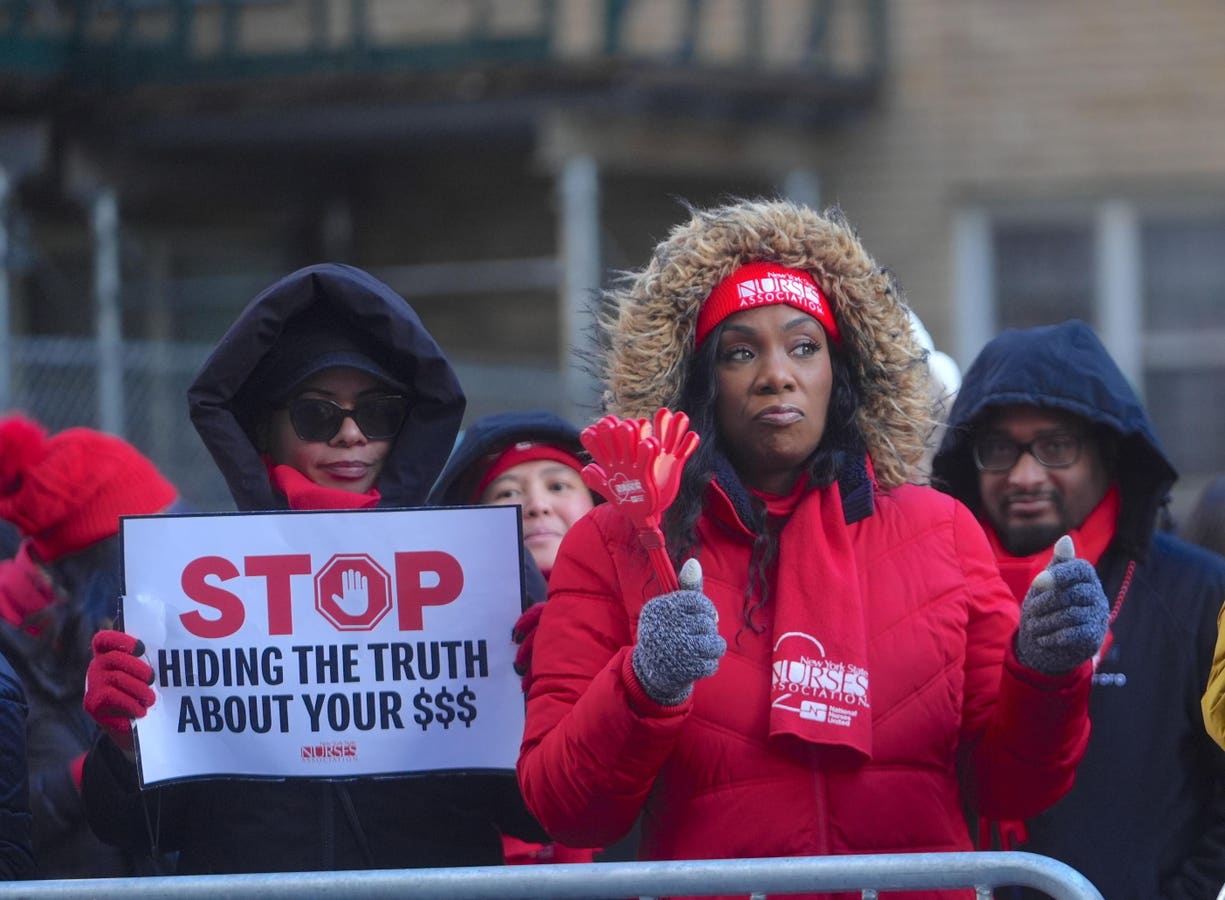
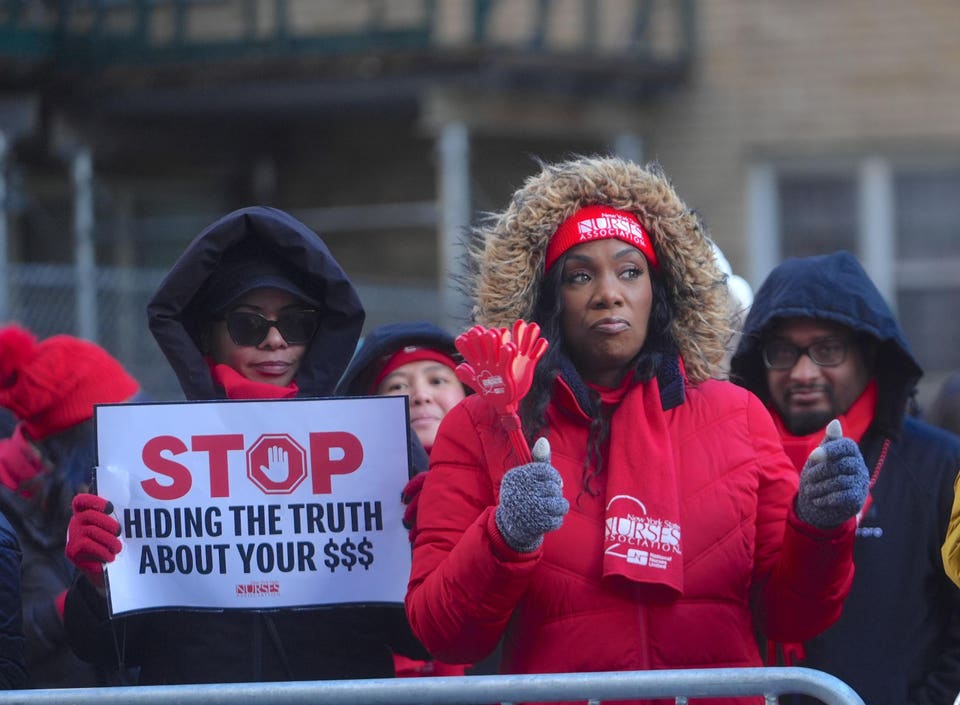
NEW YORK, UNITED STATES – JANUARY 12: Nearly 15,000 nurses, who are the members of New York State Nursing Association (NYSNA, walk off their jobs at five privately-run hospitals, including Mount Sinai Hospital, Mount Sinai Morningside, Mount Sinai West, Montefiore Einstein, and New York-Presbyterian in Manhattan, in the Bronx on Monday, January 12, 2026, in New York City, United States. (Photo by Selcuk Acar/Anadolu via Getty Images)
Anadolu via Getty Images
It’s 7:00 a.m. at NewYork-Presbyterian Morgan Stanley Children’s Hospital’s emergency department, but registered nurse Arthea Morgan is not reporting for her shift.
On a typical morning, Morgan would walk into a waiting room crowded with flu cases, chronically ill children and adolescents, and anxious parents hoping to be seen by one of New York City’s busiest pediatric emergency departments. Instead, for the past week, Morgan and her colleagues have been outside on the picket line, demanding safer working conditions, lower patient-to-nurse ratios, protection from workplace violence, and higher wages to keep pace with an increasingly unaffordable America.
Like so many nurses, Morgan—a veteran registered nurse with more than 34 years of experience, much of it spent in New York-Presbyterian’s pediatric emergency room—says her decision to enter the profession was driven by a calling she felt as an adolescent.
“When I was in high school, we went to career day, and I was so intrigued by the nursing table,” Morgan told Forbes while on strike.
That interest, she said, followed her into the next stage of her academic career.
“I went to college thinking I would be pre-med, then switched to nursing,” Morgan recounted. “I never looked back—from the first day of clinicals to now. I knew it was my niche. I love taking care of patients, talking to them, and no two days are ever the same.”
Morgan is one of more than 15,000 registered nurses currently on strike at NewYork-Presbyterian, Mount Sinai Hospital, Mount Sinai Morningside, and Montefiore Hospital. Described as the largest nurses’ strike in New York City history, the walkout comes just months before Medicaid cuts included in President Donald Trump’s “One Big Beautiful Bill” are set to take effect.
NEW YORK, NEW YORK – JANUARY 12: Nurses from New York-Presbyterian/Columbia University Irving Medical Center strike outside the hospital on January 12, 2026 in New York City. Nearly 15,000 nurses from New York-Presbyterian/Columbia, Montefiore Medical Center and the main campus of Mount Sinai Hospital, NYC’s biggest hospitals, have gone on strike. The union representing the nurses says they are demanding higher wages, more security at hospitals to reduce violent episodes and shootings, and a commitment to ensuring minimum staffing ratios. (Photo by Michael M. Santiago/Getty Images)
Getty Images
It also came days after millions of Americans saw their health insurance premiums rise following Congress’ failure to extend Affordable Care Act subsidies.
The strike, which has forced New York’s largest hospital systems to fly in costly travel nurses and operate with higher patient-to-nurse ratios, is unfolding as the U.S. health care system grapples with a CDC-declared “moderately severe” flu season.
This flu season, rougher than average, is straining emergency departments nationwide, including Morgan’s.
“Every day, we’re being asked to take on more and more patients than…is safe,” Morgan said. “We’re stretched thin. We’re working longer hours, we’re skipping breaks, and we’re pushing ourselves to the limit, and currently, it’s just not sustainable.”
She said the dangers are imminent.
“It puts nurses at risk,” Morgan said, “and even more, it puts our patients at risk.”
As Morgan echoes the calls of her New York State Nurses Association colleagues on the picket lines, her reflections tap into a national frustration shared by millions in the nursing profession. A recent study by Joyce University of Nursing and Health Sciences found that 74% of nurses report feeling emotionally exhausted at least once a week.
More than half say they regularly skip meals and breaks because of workload demands, while nearly half struggle to sleep most nights due to work-related stress.
The study also found that 74% of nurses were required to work overtime three or more times in the past month, while an alarming 53% of registered nurses say they are seriously considering leaving the profession altogether.
Morgan said she and her colleagues of all ages are already experiencing this reality.
“It’s disheartening that they come in, wide-eyed, bushy-tailed, expecting to be able to give the type of care that they learned in their clinicals,” Morgan said about her younger counterparts, “to stay for a year and then leave because of the unsafe situations. We need these hospitals to hear not only our veteran nurses, but our younger nurses.”
In New York City, those pressures have reached a breaking point. As hospital leadership remains focused on margins, operational efficiencies, and executive compensation, nurses like Morgan say they continue to work under conditions that compromise both patient care and their own safety.
Nonprofit tax filings compiled by ProPublica show that Dr. Steven J. Corwin, president and CEO of NewYork-Presbyterian, reported compensation totaling approximately $23.3 million during the most recent fiscal year available.
“There are more than 15,000 nurses on strike saying the same thing,” Morgan said. “We all can’t be wrong.”
For Morgan and other nurses, the struggle continues.
NEW YORK, NEW YORK – JANUARY 09: Attorney General Letitia James speaks during a press conference as nurses from Mount Sinai Hospital strike outside the hospital on January 09, 2023 in the Upper East Side neighborhood of New York City. Thousands of nurses from Mount Sinai’s main hospital and at three locations of the Montefiore Medical Center in the Bronx went on strike at 6 A.M. after failing to reach a contract agreement on Sunday. While on strike, the nurses are negotiating for higher pay and increased staffing as they attempt to reach an agreement on a contract. NYSNA members reached a contract agreement with several other hospitals across the five boroughs in recent days that avoided similar strikes. (Photo by Michael M. Santiago/Getty Images)
Getty Images
“Not only are there not enough nurses to care for patients in a timely manner, but just weeks ago, this same hospital laid off nurses, stretching us even thinner,” Morgan said. “And it couldn’t come at a worse time. We are knee-deep in a flu outbreak—the worst the city has seen. Infants, children, and adults are coming into these hospitals critically ill, and we have fewer nurses and nurse practitioners available to care for them.”
For more than two decades, U.S. News & World Report has placed NewYork-Presbyterian among the nation’s best hospitals. Its children’s hospital ranked among the top in the country and #1 in New York State.
However, when it comes to working conditions for registered nurses, the New York State Nurses Association argues the hospital has fallen short—a concern echoed by New York Attorney General Letitia James.
“Nurses put their lives on the line every day to keep New Yorkers healthy. They should never be forced to choose between their own safety, their patients’ well-being, and a fair contract,” James said in a statement. “As our state faces a historic flu surge, our communities are counting on New York’s hospitals for high-quality, reliable frontline care.”
James went on to criticize leadership.
“Meanwhile, hospital management is threatening nurses’ health benefits, rolling back hard-won staffing protections, and doing too little to address workplace violence,” she said.
It is a workplace Morgan describes as both deeply rewarding and increasingly untenable. She takes pride in the lives she and her colleagues save and the families they support, but says chronic mismanagement and a persistent shortage of available beds have made providing care far more difficult.
“In health care right now, many of our patients aren’t staying in the emergency room for hours—they’re staying for days,” Morgan said. “They’re waiting because our ICU beds are full, our operating rooms are backed up, and mental health facilities have no available space. There’s simply nowhere for them to go.”
Compounding that strain, pediatric emergency departments have increasingly become the front line of a health care system under pressure. Rising insurance costs have left many families without coverage, while the absence of paid family leave has forced working parents to delay seeking care for their children.
Morgan said this often brings about serious consequences.
“For a lot of the families we serve, especially working mothers and single mothers who can’t afford to miss work, they’ll wait a day, two days, even three days before coming in,” Morgan explained. “By the time they arrive, sometimes we only have enough time to scoop that child up and rush them to the trauma room.”
With registered nurses often bearing the brunt of federal policy gaps, Morgan and her colleagues in the pediatric emergency department have become the first stop for far too many families—particularly those without access to a primary care physician.
For Morgan, helping these families, many of whom can’t afford to take time off work for a routine visit, is a burden she feels personally.
“If that were my child, I’d want everyone in the hospital to stop what they’re doing to keep them alive,” Morgan said. “That’s the level of care we try to bring every single day.”
The United States remains one of the few developed nations without a federal paid family leave program—a reality that has pushed working mothers, including some of Morgan’s patients, to take their advocacy to Capitol Hill.
Rep. Ayanna Pressley with Bobbie for Change advocates, Michele Lampach, Iskra Lawrence and Dawn Huckelbridge
Lelanie Foster
Public figures such as Iskra Lawrence, Whitney Port, Hannah Bronfman, Meena Harris, Sophia Li, Jaycina Almond, Anna Malaika Tubbs, Lelanie Foster, and Dr. Max Goldstein, have joined in this advocacy effort.
During the Capitol Hill meetings, parents also heard from Representative Ayanna Pressley (D-Mass.).
“Regrettably, the suffering of women in America has become so unremarkable to our society that it’s become systemic, cultural, and normalized,” Pressley said. “And to those who believe that care and paid leave can wait, I would simply ask—who raised you?”
It is a question that nurses, many of whom are women, are asking on the picket lines in New York City.
While they have drawn support from James, newly sworn-in New York City Mayor Zohran Mamdani, Representative Alexandria Ocasio-Cortez (D-N.Y.), and Senator Bernie Sanders (I-Vt.), some of the Democratic Party’s most prominent and influential leaders have remained conspicuously silent.
For nurses on strike, that silence raises a pointed question: whether party leaders will stand with registered nurses calling for safer staffing and patient care—or with hospital executives and multimillion-dollar management teams defending the status quo.
NEW YORK, NEW YORK – JANUARY 12: Mayor Zohran Mamdani speaks during a press conference as nurses from New York-Presbyterian/Columbia University Irving Medical Center strike outside the hospital on January 12, 2026 in New York City. Nearly 15,000 nurses from New York-Presbyterian/Columbia, Montefiore Medical Center and the main campus of Mount Sinai Hospital, NYC’s biggest hospitals, have gone on strike. The union representing the nurses says they are demanding higher wages, more security at hospitals to reduce violent episodes and shootings, and a commitment to ensuring minimum staffing ratios. (Photo by Michael M. Santiago/Getty Images)
Getty Images
For Morgan and her colleagues, those questions underscore a central point: the strike is not about wages, but about safety and the basic resources needed to protect patients.
“We are the ones at the bedside—staying late, holding patients’ hands, calming their fears, and saving lives,” Morgan said. “This has never been about money. It’s about providing the best possible care for our patients.”
Eager to return to demanding, but deeply rewarding shifts, Morgan said she would much rather be back in the emergency department than on the picket line.
But she argues hospital management has left nurses with little alternative.
Since the strike began, NewYork-Presbyterian has relied heavily on travel nurses to maintain operations. According to Bloomberg, some of those out-of-state nurses are being paid as much as $9,000 per week, not including housing and travel costs—far exceeding the cost of retaining unionized staff nurses.
The disparity has become a central point of contention for the union and for New York City Mayor Zohran Mamdani, who has questioned why hospitals are willing to pay premium rates for temporary staffing rather than invest in long-term patient safety and workforce stability.