
This article was featured in New York’s One Great Story newsletter. Sign up here.
For limited durations, in isolated contexts, it’s a party. On a Thursday morning the number of protesters outside the brutalist building from which ICE conducts its menace in Minneapolis swells from 25 to at least 100 by early afternoon. Spirits are high. At times there is topical music (“Fortunate Son”; Ray Charles’s “America the Beautiful”); now and then someone will dance in the street. There is a dog in booties wearing a serape, led around by a man in a cape with a cardboard sign that reads SHAME. There is a quiet clown and a loud man in a wide-brimmed hat waving a giant American flag. “ICE out,” shouts someone next to me over and over into his megaphone; his beanie reads ABORTION YOU BETCHA.
Whipple is what we call this standing protest, the ominous structure across the street, and the social-justice-oriented Episcopal bishop for whom the building was named long before it was filled with Minnesotans snatched from the street. An SUV squeals out of the complex. “Oh!” says a woman next to me. “That was a happy Nazi!” Our boots scrape against the ice. A woman walks around with a box of disposable hand warmers before placing it next to a growing collection of other boxes — granola bars, water, almonds. All of us stare in the direction of a parking lot just past a chain-link fence, through which we can see many cars and the occasional agent. Sometimes a robot voice comes from that direction. “This is the federal protective service,” the voice will say. “Get off federal property and stop obstructing.” The man with the dog puts his hand to his ear performatively. “What’s that?” he says. “Hmmm?”
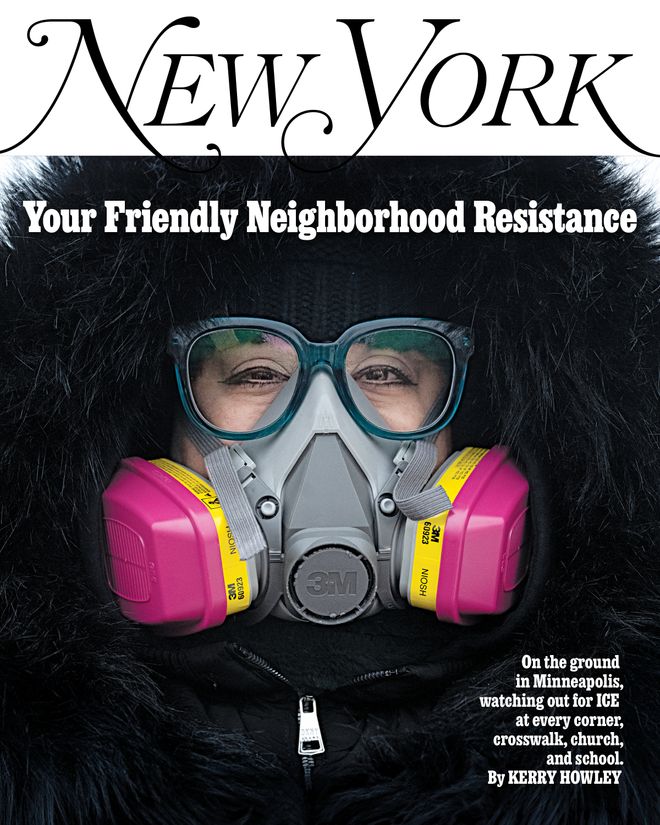
Your Friendly Neighborhood Resistance
More agents gather; I can see them only dimly through the fence, but the crowd begins to prepare. “Do you have a mask?” a woman asks calmly, and before I can answer she has placed a disposable mask with a respirator in my gloved hands. I am standing next to Liz, a 37-year-old in a pom-pom beanie who recently quit her job in corporate event planning. “You should put your mask on,” she says pleasantly. “You should probably put that on,” another man says. “Do you have goggles?” A sign behind me reads YOUR GRANDMA HATES YOU.
There are three, then six, then 30 agents outside the federal building, across the street from the protesters, head to toe in black — vests, face shields, helmets, batons, tear-gas launchers, pepper-ball guns, sidearms. Protesters are supposed to stay off the street in front of the Whipple Building, but sometimes they step into the street. What you feel about what happens next will depend on what you believe to be the proper response to this violation of social order. The agents cross the street and keep walking, an undifferentiated mass of black except at their center, where Border Patrol boss Greg Bovino has chosen to draw attention to himself in a black scarf and long dark greatcoat.
If you grow up in New England the war made relentlessly real to you is the Revolutionary one. Men came to this land in ridiculous red coats and farmers in plainclothes drove them to humiliation and ruin. Minnesota, unlike most midwestern states, was founded by New Englanders, who brought their colleges and town squares and the moral rectitude some call sanctimony well west of Connecticut. The president claims to have won the state “three times,” but no Republican has won Minnesota since before many of the Whipple protesters were born. The state is a provocation to the kind of man who thinks the middle his.
The agents come all at once with a kind of mechanical sameness. The jeers from this side grow louder: “TRAITOR! FUCK ICE!” They shove protesters onto a snow-covered patch of dry grass; others trip trying to back up. “FUCK YOU! SHAME ON YOU!” An agent forces a fallen protester back down and slips on the curb. Somewhere in the mêlée a photographer has a knee pressed into his back.
I catch an older white guy on his way out and talk my way into his car rather than stay for the tear gas. He’s a retired bus driver studying to be a “master naturalist” who told his wife he’d leave the protest if things got too crazy. “I don’t have real goggles,” he says and pulls a pair of swim goggles from his pocket. He’ll take me anywhere I want.
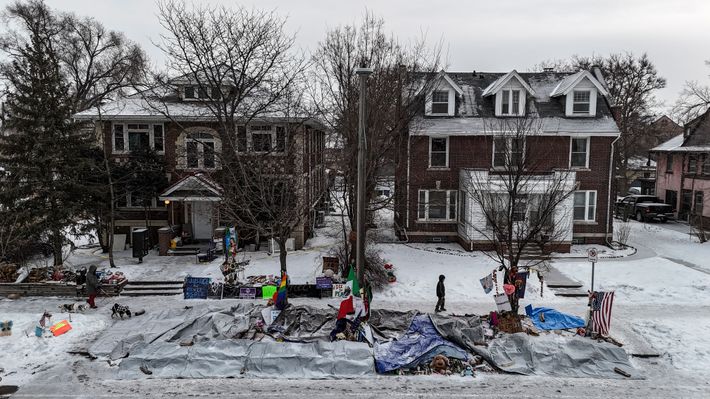
A memorial to Renee Good at the site in South Minneapolis where she was shot.
Photo: Stephanie Keith
A “DAY OF RECKONING & RETRIBUTION” was the promise the president made to Minnesota, though it remains unclear who or what required avenging. Somali immigrants, we were told, were “garbage” perpetrators of a billion-dollar fraud, but the vast majority of accused Somalis in Minnesota are citizens, which is to say this is not a problem that can be addressed by the 2,000 DHS agents who arrived there around January 5 and who, within 48 hours, had shot a woman in the face. A thousand CBP agents landed after that.
In mid-January, the number of federal officers in the Minneapolis–St. Paul area stands at nearly double that of regular police, and five years post–George Floyd, local law enforcement and their most progressive critics may agree on at least this: ICE is a threat to the city. The litany of ICE lawlessness is now familiar: citizens tackled, handcuffed, and detained at their places of work; tear gas deployed outside a high school; legal immigrants detained for days; peaceful protesters confronted with guns. The very term racial profiling has come to seem precious, carrying as it does the memory of a time when people in power would deny doing it.
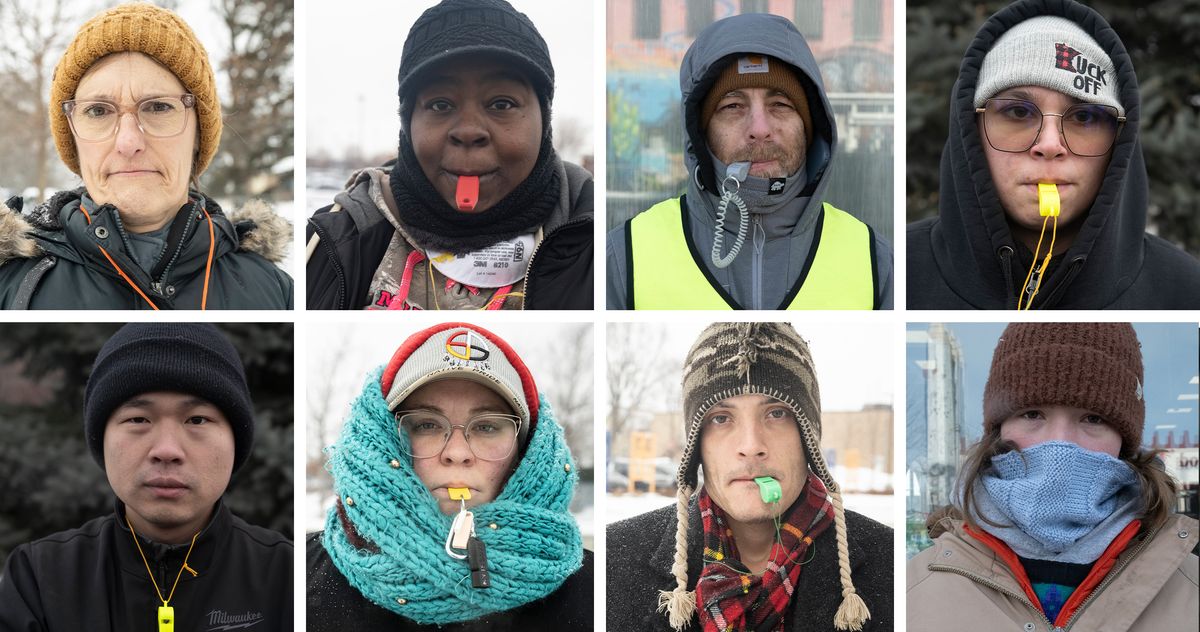
A couple of weeks into this incursion, the Twin Cities are settling into a new rhythm, a relation between occupied and occupier. “There he is with his little bottle again,” sighs Emma, standing near her house in Frogtown, across the street from an ICE agent in an unmarked car. Every so often she blows the pink whistle attached to her zipper and points at the car; in response, he looks out his driver’s-side window straight at her, picks up his canister of pepper spray, and shakes it. Emma is a 30-something part-time music librarian in a gray beanie and purple coat and mittens that make her hands look comically large. She and the agent have been at this for 45 minutes: She makes him visible with her whistle; he taunts her with his pepper spray. It is ten degrees, windy, snowing. In the distance, we hear whistles — other neighbors pointing out other agents. Emma whistles; he shakes his little bottle.
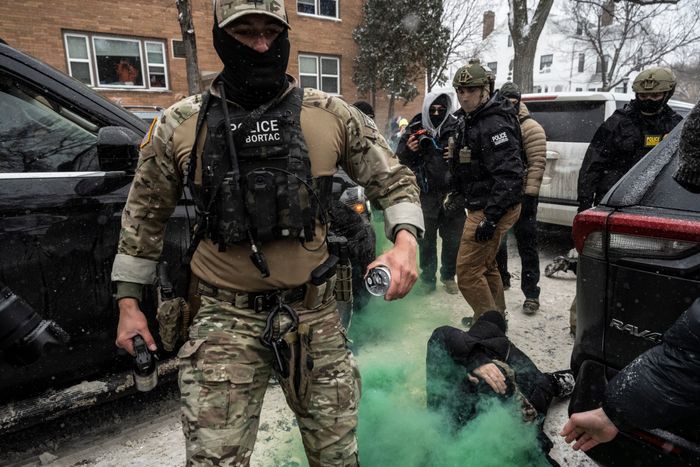
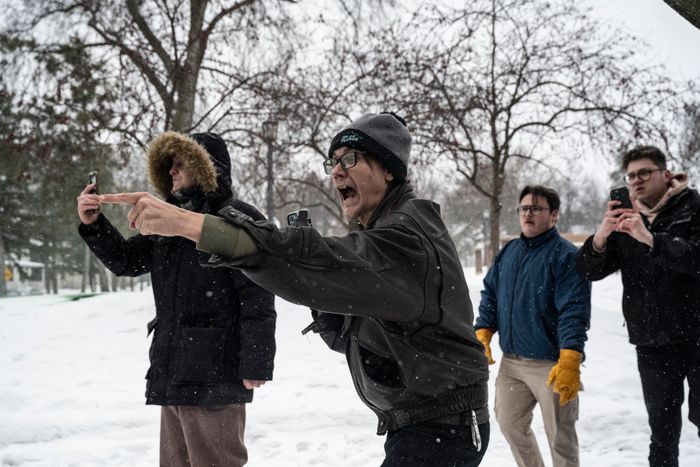
From left: Federal agents confront locals near Mueller Park in Minneapolis’s Uptown neighborhood. Photo: Stephanie KeithProtesters yelling at Border Patrol agents. Photo: Stephanie Keith
From top: Federal agents confront locals near Mueller Park in Minneapolis’s Uptown neighborhood. Photo: Stephanie KeithProtesters yelling at Border Pa… more
From top: Federal agents confront locals near Mueller Park in Minneapolis’s Uptown neighborhood. Photo: Stephanie KeithProtesters yelling at Border Patrol agents. Photo: Stephanie Keith
One becomes accustomed to seeing pedestrians casually carrying the same gas mask, a 3M pink-and-yellow respirator. At a traffic circle in South Minneapolis, I watch a black Suburban trailed by three or four observers go around the circle once, twice, three times, like a train around a Christmas tree. “ICE-hunt purgatory” is what one observer calls it; he once followed an agent around a single city block 25 times. The day after I leave Whipple, I go back. It happens again — the party, the ominous gathering of agents, the confrontation, the tear gas — all of it. The chaos is both real and routine, a stasis that will hold until it doesn’t.
“I can’t leave my house because I don’t want to get arrested,” Junauda Petrus, the poet laureate of Minneapolis, told a mutual friend. She’d already been arrested ten years back when she was part of a protest blocking I-94 in response to the killing of Jamar Clark. “The poet laureate shouldn’t get arrested, right? Or maybe they should?” In the house she’s not really leaving she’s wearing a tie-dye hoodie and hot pants and knee-high socks, and she tells me about this one time when she read a poem called “Ritual on How to Love Minneapolis Again” at a school down the street, a poem, as she puts it, “about girls with henna-laced fingers and hijabs and Norwegian immigrants teaching Caribbean immigrants how to navigate winter.”
As she was reading a kindergartner, “the cutest little boy,” sidled up to her. “This,” he said, “is a long poem.” She laughed. Last week, when Renee Good was killed about a mile from where we sit, Petrus did not recognize the name of her fellow poet. It took a little while to connect the dots: queer moms, this part of town, a child at the local school. The kindergartner had been Good’s son.
The takes that trouble me come not from the bloodthirsty MAGA types (who do us a service in revealing the clarity of their longing) but from those who would define the center as existing somewhere between Good and her killer. In the Free Press, our leading chronicle of the knowing sigh, Kat Rosenfield writes as if she were astonished by Good’s naïveté, the world this misled leftist thought she inhabited, in which she and her wife would have “laughed about their confrontation with the agents later that night, maybe sharing a bottle of wine after their son was in bed.” I don’t know. I’m not an activist, a protester, an organizer of anything. I move about the world pretty freely. It was news to me that a federal agent could, without consequence, execute a woman in her car in response to a traffic violation. The world is not what it was yesterday. We reconsider our limits. We recalibrate our relationship to power.
It is the misfortune of Minnesota’s ICE contingent to have invaded the state with the second-highest levels of social trust, trailing only Utah. Many activist networks were formed in 2020; we are seeing, Petrus says, Minnesotans call upon the “muscle memory” of the George Floyd protests. In mid-January, a neighborhood organization for a part of town called Whittier put out a call for a meeting to organize a “Neighborhood ICE response”; more than 800 people showed up at the local elementary school and formed a tidy line extending well beyond the door. (“Why a line?” I ask someone later. “Because we are in Minnesota,” he says.) In the cafeteria, in their big coats, adults struggled to get their legs through benches attached to long lunch tables. Because there were too many Minnesotans to fit in a single room, officials and parents and teachers went room to room giving the same speeches about how to help neighbors in hiding. They then gridded out the rooms, dividing the neighborhood into smaller subdivisions. Close neighbors met one another (“Oh, you live on the other side of the museum”) and formed hyperlocal Signal groups. At the first sighting of an agent, someone could ping the group and draw them outside. Their favored tactic was noise. They would make it impossible for ICE to conduct raids in secret.
If the whistle is the sound of resistance, the sensation is the never-ending vibration of a half-dozen chats on the phone in your pocket and all the anxiety that suggests. There are Signal chats for every neighborhood, chats devoted to finding out about other chats. ICE vehicles are often unmarked; there are chats where locals type in license-plate numbers and other residents check the numbers against a database of ICE vehicles. Idling in her rental car scrolling Signal, New York’s photographer came upon a photo of a Nissan Rogue with California plates: her car.
In the days after Good’s killing, school superintendents reported a sharp drop in attendance among Latino students. Mutual aid takes place at the door: Here are groceries for the week. Yes, I can call your workplace and explain why you won’t be there. María Pabón Gautier, an executive at a housing nonprofit, relates with professional distance the changing scope of her work. I ask what everyone else is missing. There is a long pause. “I have had to completely shift how I move in this world,” she says, and she inhales and her voice is suddenly unsteady. “Give me a second.”
“I am Puerto Rican,” she says. “I send my kids with their passports to school. I’m having conversations with them about safety: Am I safe at school? A week ago we had an incident where there was a school bus with the STOP sign open and kids were getting on the bus and it was surrounded by ICE agents. And this is 7:20 in the morning and — just — you get that fight-or-flight response.” At first her 9-year-old was carrying her passport in her backpack; now it’s in her back pocket. “I have to prepare them for it if they get stopped,” she says. “I said, Do not engage. This is not the time to be cussing at anyone. But she said, Mom, if I create enough noise, my friends can get away.”
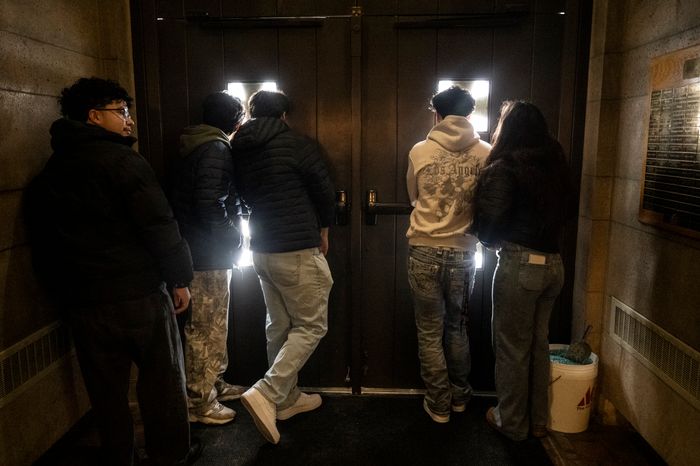
Teens at Sacred Heart Church in St. Paul look out the window after ICE was reported to be in the area.
Photo: Stephanie Keith
The night I arrive in the city I hear that a man has been shot and make my way to the scene in North Minneapolis after dark, walking toward flashing police lights, stopping occasionally to turn away and let the burn of tear gas clear from my eyes. It is loud — helicopters, whistles, the pop of flash-bangs — and the crowd is young, though at least one woman pushes a walker toward the police tape. A man in Crocs and no coat has his arms crossed inside his hoodie; his sleeves hang limp. Another man lies facedown in the middle of the street; he looks dead, but I’m told he is just trying to create a barrier. Friends find one another and hug.
For a long while, neighbors, perhaps 50 of them, yell at the empty street, across the police tape, toward flashing cars in the distance. A line of agents approaches slowly, and the vibe shifts hard. There are nine of them, armed, in helmets and masks and boots and gloves. They stand silent and still behind the tape.
A man points out federal agents deployed on his street. Protesters and federal agents clash in near Mueller Park. Photo: Stephanie Keith
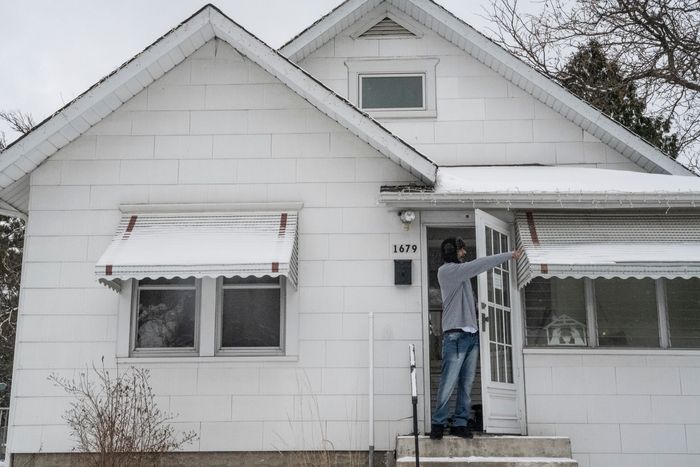
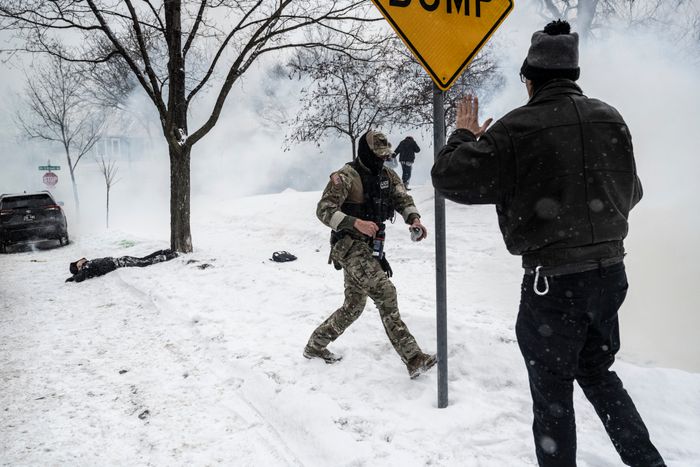
A man points out federal agents deployed on his street. Protesters and federal agents clash in near Mueller Park. Photo: Stephanie Keith
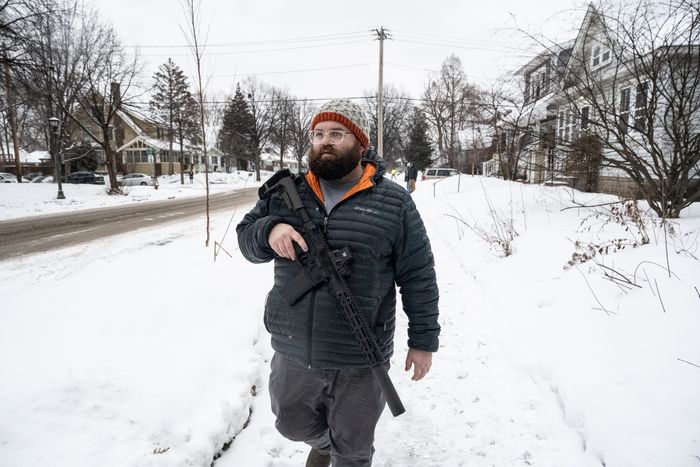
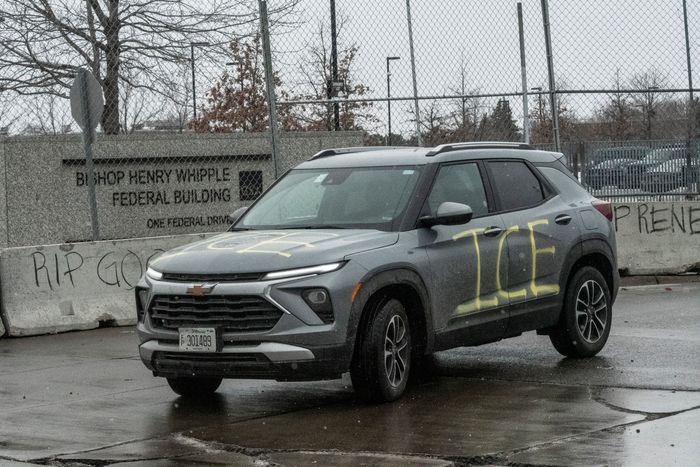
A man in St. Paul patrols his block. A vehicle spray-painted “ICE” leaves the Whipple Building. Photo: Stephanie Keith.
A man in St. Paul patrols his block. A vehicle spray-painted “ICE” leaves the Whipple Building. Photo: Stephanie Keith.
Later, ICE agents will come at us from two directions, surprising the crowd, taking back the sidewalk, rendering the air unbreathable. They will drop more flash-bangs and deploy a tear-gas canister in the direction of an SUV full of children on their way back from a basketball game; a 6-month-old in the car will, according to his mother, lose consciousness and be hospitalized. When the ICE agents descend on us, I will run across a snowy hill, down an icy alley, alongside a stranger, a small-voiced woman in a dress, a preschool teacher. I will ask for a ride to a Taco Bell, which I will find locked, and end up talking to two 20-somethings (piercings, beanies) who are there to help the Taco Bell employees get home safely and are too young to hide their satisfaction when they say they can’t possibly tell me any more than that. They are part of a resistance now. They have secrets.
But it is this moment on the street that summons a pulse of adrenaline each time I call it back. These people aren’t settled in for a long stretch of action; there are no boxes of hand warmers. These are neighbors carrying phones and bike helmets, breathing warm clouds of air into the cold when they might otherwise be at home placing dinner plates in the dishwasher. When the agents walk toward us, when the void behind the police tape is replaced with a line of masked, armed men in vests, the crowd unleashes an extraordinary level of invective. It is a chorus of jeers that rises and falls with its own internal rhythm. A woman yells with her entire body, “GO BACK TO TEXAS MOTHERFUCKERS. WE HATE YOU. GO HOME. FUCKING GO BACK TO PRISON WHERE YOU FUCKING BELONG. NAZI. WE HATE YOU. TRAITOR! GET OUT!” The crowd rides this river of catharsis. A white woman in a beanie points as she yells, each statement crisp and cold: “ICE ATTACKS PREGNANT WOMEN.” A white man points both his middle fingers and releases a teeth-baring yell, and it seems as if he were drawing a current from the pavement straight out of his mouth. “YOU LITTLE BITCH,” yells a Black woman. Against the wail of distant whistles, the crowd passes from one character to another and comes together: “SHAME. SHAME. SHAME.”
The impulse to drive hostile invaders from your home lives in your body in a place too deep to name. I finally bought a gas mask. You should get one too.
Thank you for subscribing and supporting our journalism.
If you prefer to read in print, you can also find this article in the January 26, 2026, issue of
New York Magazine.
Want more stories like this one? Subscribe now
to support our journalism and get unlimited access to our coverage.
If you prefer to read in print, you can also find this article in the January 26, 2026, issue of
New York Magazine.
One Great Story: A Nightly Newsletter for the Best of New York
The one story you shouldn’t miss today, selected by New York’s editors.
Vox Media, LLC Terms and Privacy Notice