
STATEN ISLAND, N.Y. — Museum curator Rylee Eterginoso says “Here You Are” is an apt name for the Staten Island Museum’s triennial exhibit because it feels “ambiguous.”
“What does ‘here’ mean? Who is ‘you?’” Eterginoso said in a preview of the show on Thursday. She describes the exhibit as “dreamlike.” Each artist, she said, offers a reflection on what it means to be “here” and what it means to be “you.”
“It’s a really rich exhibition,” she said.
Eterginoso and Janice Monger, Staten Island Museum president and CEO, worked together to present the museum’s second triennial exhibit. Eterginoso described a triennial as a “glimpse into an era.”
The last triennial, titled “Yes, And,” was an open-call, and included 33 artists. This time, Eterginoso and Monger selected the seven featured artists – all with ties to Staten Island.
Defining work
Artist Gabri Christa said her work is hard to define.
“It’s often called screen-dance or dance-film,” Christa said. “It’s like a multimedia, experimental film.”
Christa’s semi-autobiographical film, Kankantri, plays on a loop in the exhibit.
Filmed entirely in Suriname, the wordless video follows a woman’s dreamlike journey meeting with different ancestors. She practices dance rituals with ancestors from various cultures.
“It’s about embracing heritages, to become whole,” Christa said. She said she wants people to be “curious, not afraid.”
The piece was filmed primarily in a synagogue in Suriname, reflecting Christa’s own ancestry. Part of the inspiration for the project, Christa said, was discovering she had some Jewish lineage on her father’s side. Her rich heritage includes Surinamese, Chinese, and Dutch, too.
Christa first thought of making the film on a trip to Suriname years ago.
“Many different cultures live peacefully in Suriname,” Christa, a Staten Island resident, said. The synagogue she filmed the project in is located beside a mosque, “and they share everything.”
Christa also remarked on the shared history of New York City and Suriname.
“The Dutch and British traded Suriname for New Amsterdam,” Christa said – linking the two historically.
‘Regular’ people on Staten Island
A photograph of a family in tableau greets exhibit visitors. Taken by photographer Olga Ginzburg, the image depicts a family gazing at the sky on July Fourth.
Ginzburg, a Staten Island native who returned to the Island, has had her work featured in publications, like the New York Times. She photographs regular people living daily life, often on Staten Island.
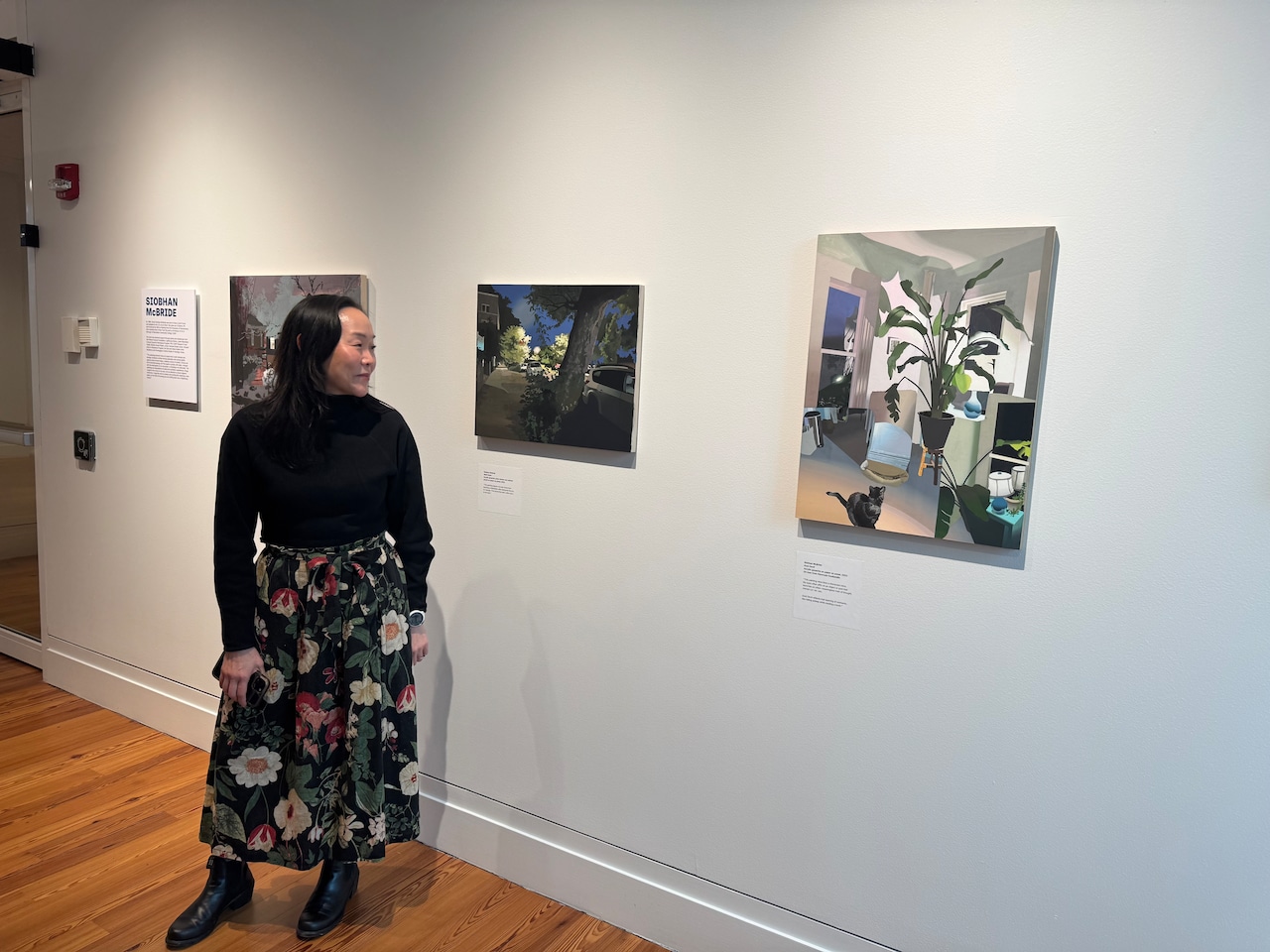
Siobhan McBride’s familiar yet eerie paintings sit across from Ginzburg’s photographs. McBride was born in Seoul, South Korea and grew up in Queens, but lives on Staten Island now.
“Siobhan’s work represents the tone of orientation and disorientation, the disorder, and the magic of ordinary life,” Eterginoso said. “The familiar spaces we sometimes take for granted.”
McBride’s paintings appear realistic at first, but reveal a confusing jumble of textures up close.
‘An earnest self-portrait’
In the back of the gallery on a wall is a collage of Roemello Agjmurati’s work.
Agjmurati, a Staten Island native, decided to make one poster every day for a year.
“It’s really an earnest self-portrait,” Eterginoso said. “It feels so deeply personal.”
Lea Simoniello’s abstract paintings depict, “just how hard it is to have a body,” Eterginoso said.
Simoniello’s oil painting works explore themes of gender, trauma, relationships and the body.
Simoniello paints on found materials, according to Eterginoso. This often informs the shape her work takes.
“He’s very informed by skate culture and 90’s and early-2000’s NYC,” Eterginoso said of Arjuna Routté-Prieur. His work often depicts urban landscapes and sometimes includes spirit-like figures.
Routté-Prieur is a fifth generation Staten Islander. This is the first exhibition to show his work alongside his mother’s, who passed away last September. Lenore Routté’s work is on display next to her son’s.
“Lenore grew up with a DIY-ethos,” Eterginoso said. “She believed every scrap has creative potential, it can be used.”
The exhibit includes glassware, capes and a painting by Routté.
Eterginoso says the artwork Lenore created also has utility.
“They’re not just objects that are static, they’re meant to be used,” Eterginoso said. “There is life in them.”
Beside a window on the right side of the exhibit is an unassuming collage. It’s a collaborative work by the mother and son, from 1994.
His crayon scribbles are visible across a black canvas. Routté’s typical quilt-like style collage renders a sunlike centerpiece.
The exhibit opens to the public Saturday, January 24 with a public reception from 2 p.m. to 4 p.m. The triennial exhibit will remain on display through October.