
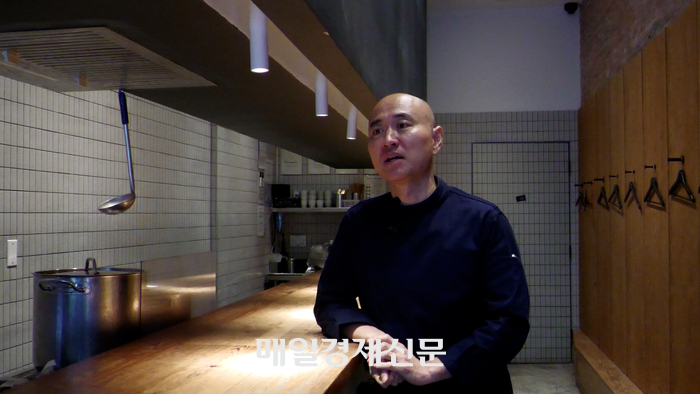
 사진 확대 Chef Ok Dongsik
K People/Ok Dong-sik Chef Interview
2023 Open New York Store Still Open Run
Fit Wells “Tastes More Than A Bowl of Soup” Highly Commended
Korea’s unique ‘Cool Taste’
American Shintobul with local ingredients that are not rejected by New Yorkers
The store, located on 30th Street in Manhattan, New York, has 13 seats. The recently opened Queens Bayside branch also has 15 seats. Every day at opening time, there is a queue in front of the store. It’s not just because there are fewer seats. From this year on, the reservation system has been changed to a first-come, first-served basis. This is because there are many customers waiting even after making a reservation. In fact, even though it is a single menu of gomtang, it is still crowded with people who come to enjoy the taste of Korea.
Pete Wells, a renowned flavor columnist for the New York Times, said, “A bowl of soup makes you feel more than just a bowl of soup. The exact balanced soup is the reason why people in Seoul and New York line up,” he said.
He properly aimed at New Yorker’s sensibility and was selected as the “eight best dishes in New York” in the first year of the 2023 opening. It is still Okdongsik, a pork bone soup that cannot be tasted without labor waiting outside the door.
Chef Ok Dong-sik, who met at a Manhattan branch on the 19th, said, “Pete Wells described it as a ‘cool taste’, and I was surprised to the point where I got goosebumps.” Pete Wells said, “It’s a pleasant feeling of well-being when you eat a neatly balanced meal.” Chef Ok calls it the seventh taste. It is the very taste of soup or soup that Koreans like. “After the consistent response from the locals in the United States, I think of it again. Korean or foreigners feel the same way about food after all.”
Chef Ok Dong-sik found the popularity of pork gomtang, which shook the New Yorker, in Shinto Buddha. It means that you have to eat what comes from your own land to fit your constitution. He said, “It’s Korean food, but there’s no reluctance to taste it with local ingredients in the United States.” One test conducted after entering New York. I once made the cheonggukjang to my employees from Korea. He spat it out because he said he couldn’t eat it. Next time, I fed him cheonggukjang made of American beans, and he quickly emptied two or three bowls. He said, “Since I had the idea of eating Korean food in the United States, I have decided to use local ingredients. That’s why I run a farm here and grow food ingredients.”
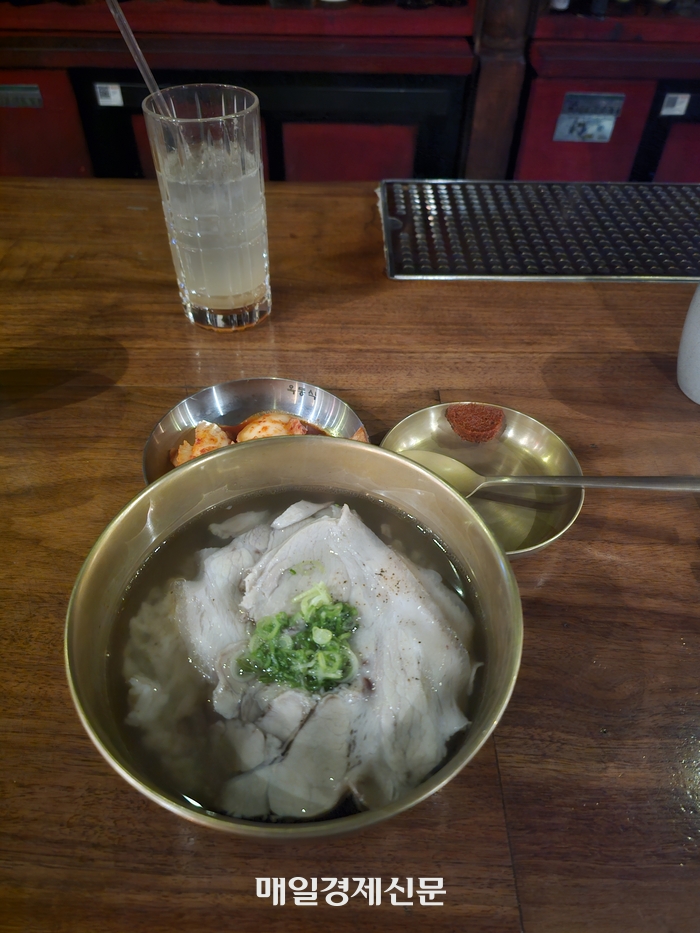 사진 확대 Okdongsik’s pork soup
K-food in its heyday opportunity to globalize Korean food
“Long run”
K Food needs government support to succeed
“There is a desperate need for someone to realize the taste of Korea rather than money”
New York, called the global capital, is also a huge competition for food from all over the world. Now, Korean food is gaining popularity regardless of the menu and is proudly establishing itself as New York’s food (食) culture. In 2024, “Jung Restaurant” was selected as the first Michelin three-star Korean restaurant in the United States. From fine dining and Korean BBQs to gimbap, tteokbokki, and baked sweet potatoes, it is the heyday of K-food, which lines up locals in every store.
Chef Ok said, “Korean food seems to have become global to some extent,” but added, “This is a very important time for Korean food to become a standard of taste.” They say you shouldn’t be so popular that you don’t neglect the basics.
“In Korea, most of the food is sweet, salty, and spicy. I will go back to the past and discover and show the real taste of Korea that I used to eat when I was young. That way, the genre of Korean food can be long-running.”
This is why artificial seasoning is excluded as much as possible in pork bone soup and seasoned only with salt. The next goal after Gomtang is to open a Korean vegetarian restaurant in New York City. Starting next month, fermented soybean lump will be floated with American beans and soybean paste and soy sauce will be made directly. They use thoroughly localized ingredients, but they compete with Korean recipes rather than American recipes in New York. In addition, it is to add Korean hand taste and food culture.
For the success of K-food, he asked the government for “people” rather than money. “Cooking is also done by humans after all,” he said. “I hope that professionals who can embody and serve the taste of Korea will provide visas or other support so that they can work abroad.”
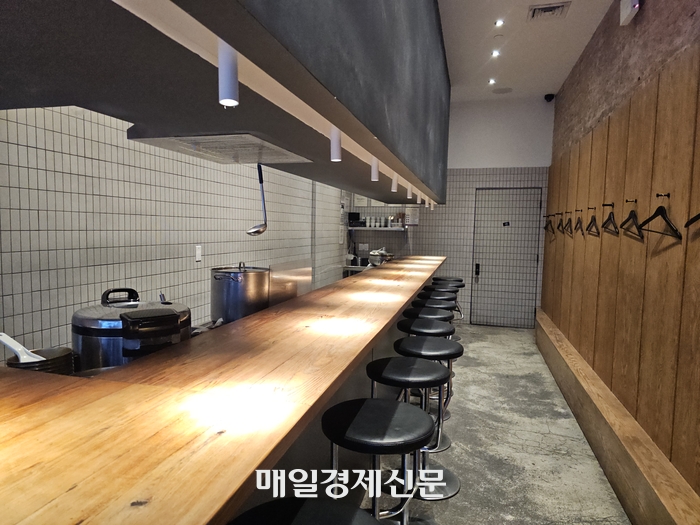 사진 확대 a jade-style interior in Manhattan, New York
“A black-and-white chef appeared to promote Korean beef soup”
Criticism of Team Korea’s beef soup “I made a mistake, but I don’t care”
” If I went to the final, I would have made seaweed soup thinking of my grandmother”
Eventually expanded branches in large U.S. cities starting with “Gomtang is the dish of my life”
LA
The appearance of Netflix’s “Black and White Chef,” which is still a hot topic, became a big turning point for him. After the broadcast, there is a reservation war between the chefs. Chef Ok received great response by defeating his strong opponents, but he also won the viewers’ resentment in the team match.
“I came here because I wanted to let you know that Korean food is not just kimchi and bulgogi in foreign countries. It’s easy for chefs to fall into their own world, but it was also an opportunity to see the dishes of great chefs in person and get a glimpse of their authenticity toward food.”
I was disappointed when I heard that it was a “black villain.” “Of course, there were mistakes in the team match, but I don’t mind the negative evaluation,” he said. “Even if I look at the store review, there are likes and dislikes, and I think the viewers are too empathetic to the chef they support.”
The theme of the final was cooking for me. Unfortunately, Chef Ok was eliminated and watched on TV. “If I went there, I would have made seaweed soup. My grandmother, who raised me instead of my parents when I was young, often made me seaweed soup. I still remember saying that I didn’t want to spit on my grandmother because I didn’t like the sticky taste.”
Because of that memory, he still cooks seaweed soup with the best seaweed and the best sincerity.
He left Kumoh Technical High School and aimed for the Air Force Academy before joining the army as a non-commissioned officer. After being discharged from the military, I took three attempts at medical school. I was attracted to the culinary department in the fourth class and changed the direction of my life to this place. It’s a life history with many twists and turns. “It may be a bowl of gomtang to others, but for me, it’s a food that contains all of my life. It’s a cooking life that I started with an accidental opportunity, but I feel that it’s important to me culturally and industrially as I do it.”
“Okdongsik” plans to open branches in major U.S. cities every year, starting with Los Angeles (LA) this year. It currently operates overseas branches in the United States, Paris, Tokyo, and Hawaii. The globalization of Gomtang is not in the plan for the quality of taste. “Food is the power to connect people. That’s why it’s more fun for three or four people to eat than two. Eating the same food in the same space is also the meaning of Okdongsik (屋 食).”