
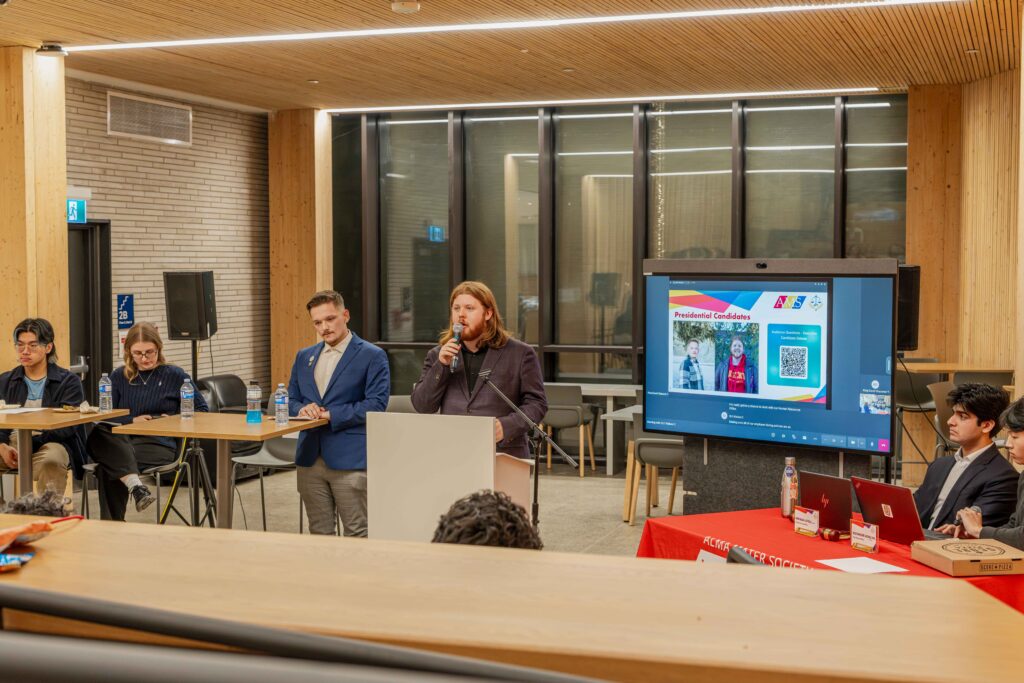
Candidates’ debate offered a glimpse into the 2026-27 AMS student leaders’ goals and ambitions for a student-focused AMS
On Jan. 23 at 6 p.m., four AMS executive candidates participated in debates in the Agora of the JDUC. The debates were split into positions, with each candidate delivering three-minute opening and closing remarks, three questions per candidate, and 1.5-minute rebuttals. The debate ended with each candidate answering questions submitted by the audience.
Vice-President (University Affairs)
The uncontested candidate running for Vice-President (University Affairs) (VPUA), Edward Sy, HealthSci ’27, was first to take the debate podium. In their opening remarks, Sy emphasized building a stronger community at Queen’s, rebuilding trust between the AMS and students, and increasing engagement and communication with the University students he’ll represent.
During the question period, Sy emphasized re-evaluating AMS priorities, recommending new advocacy town halls to better align budget decisions with student concerns and utilizing summer consultation processes with AMS commissions to collaborate on the budget and sustainability goals.
Sy also highlighted the importance of providing students with resources to educate themselves about what’s happening in various levels of government and how it might affect them, to increase engagement, collaboration, and to fulfill the VPUA’s government relations duties.
“I think one of my biggest plans […] is to ensure that the average student is empowered and educated on what’s happening at the various levels of government, both within the AMS and how we’re showing up for you folks at the municipal or provincial level,” Sy said.
In their closing statement, Sy reflected on student leadership and trust, stating he hopes to provide more opportunities to use their voice and communicate with the AMS. He reiterated his campaign pillars—accountability, community, and efficiency—and stated his goal was to “ACE” the student experience.
“I want students to know that student leaders at AMS are supposed to be there to support you,” Sy continued, “And when it comes to how your voice shows up at the table, there are so many avenues that I hope to be able to create.”
Vice-President (Operations)
Running unopposed for the position of Vice-President (Operations) (VPOP), Avery Papoulidis, HealthSci ’27, outlined her three campaign pillars: equal support for AMS services, a more connected and accessible AMS, and transparent, student-focused operations. Highlighting her past leadership experience, particularly her work as Assistant Manager of Marketing and Events at Queen’s Pub, is influential in shaping her goals.
“If it weren’t for my work at Queens Pub, I wouldn’t be standing in front of you all today or running for this position,” Papoulidis said. “I’m running because I care deeply about how AMS services are supported, how financial decisions are made and communicated, and how students experience the AMS as a whole.”
She addressed the AMS’s projected deficit by emphasizing data-informed decision-making, including evaluating AMS services and breaking down costs and student feedback. She also proposed re-evaluating AMS services and shifting the budget presentation earlier in the academic year to provide students with a more transparent and accountable AMS, that roots future financial decisions in student voices.
“A half a million-dollar projected deficit is significant, and I think that students deserve to see a clear return for every dollar spent and understand where their student fees are going in a way that makes sense,” Papoulidis said.
Papoulidis also spoke about strengthening overlooked services like the AMS Food Bank, calling for better marketing, signage, and cross-service collaboration. She emphasized affordability, vowing to keep AMS fees low and to explore external funding, such as grants, to support essential student resources.
“If elected, my focus will be on making sure every service feels heard and supported, that transparency is meaningful and accessible, and that collaboration is something more,” she continued, “I want to help shift the AMS culture from reactive to proactive, from isolated to connected, and from vague to clear.”
President
Presidential candidates Dreyden George, ArtSci ’26 and Alex McArthur, ArtSci ’27, laid out competing visions for the AMS during the debate.
George opened by pointing to past AMS roles and campus involvement, framing his campaign around affordability, transparency, and engagement. He cited previous work negotiating reduced transit costs for students in the Bus-IT fee negotiation and strengthening governance processes through his experience chairing the AMS Board of Directors.
McArthur positioned his platform around representation, collaboration, and transparency. He also highlighted experience on the AMS Board of Directors, where he serves as a student director and personnel chair, along with his involvement as drum major for the Queen’s Bands, emphasizing a leadership style rooted in listening and working across student groups.
The debate featured opening statements, six moderated questions directed to both candidates, closing statements, and an audience question period.
During the moderated question period, candidates were asked about Queen’s adoption of artificial intelligence tools. George said the University’s use of AI should be carefully scrutinized alongside provincial policy, raising concerns about data security, environmental costs, and institutional readiness.
“I do think there’s a concern of an accelerated embracing of artificial intelligence with security data measures possibly being a bit too lenient, and also not secure enough,” he said.
McArthur said Queen’s shouldn’t move too quickly, calling for clearer communication about how student data is stored and protected, and cautioning against overreliance on AI in place of human supports such as teaching assistants, saying “I don’t think the University should go all in and say everything is done by AI now, I think that’s not beneficial to students.”
On University policy reform, McArthur focused on orientation, criticizing the current split-weekend structure and advocating for a model that better supports incoming students and student leaders. He said the change has meant “less and less turnout events on the second weekend because students were already dealing with assignments.”
George emphasized harm reduction, arguing that restrictions on alcohol at sanctioned events can push students toward less safe, unsanctioned gatherings, and said the AMS should pursue change through coordinating advocacy. He said without sanctioned spaces, “students are forced to go into house parties or host house parties.”
Questions also covered oversight of the Internal Affairs Office, modernization of AMS operations and communications, and how each candidate would respond to criticism while in office. Both repeatedly returned to transparency as a guiding principle in their answers.
Voting in the AMS elections runs Jan. 28 to 30, with results set to be announced at the election reveal event at The Queen’s Pub at 6 p.m. on Jan. 31.
Tags
AMS debates, AMS executive election, debate, Elections 2026
All final editorial decisions are made by the Editor(s) in Chief and/or the Managing Editor. Authors should not be contacted, targeted, or harassed under any circumstances. If you have any grievances with this article, please direct your comments to journal_editors@ams.queensu.ca.