
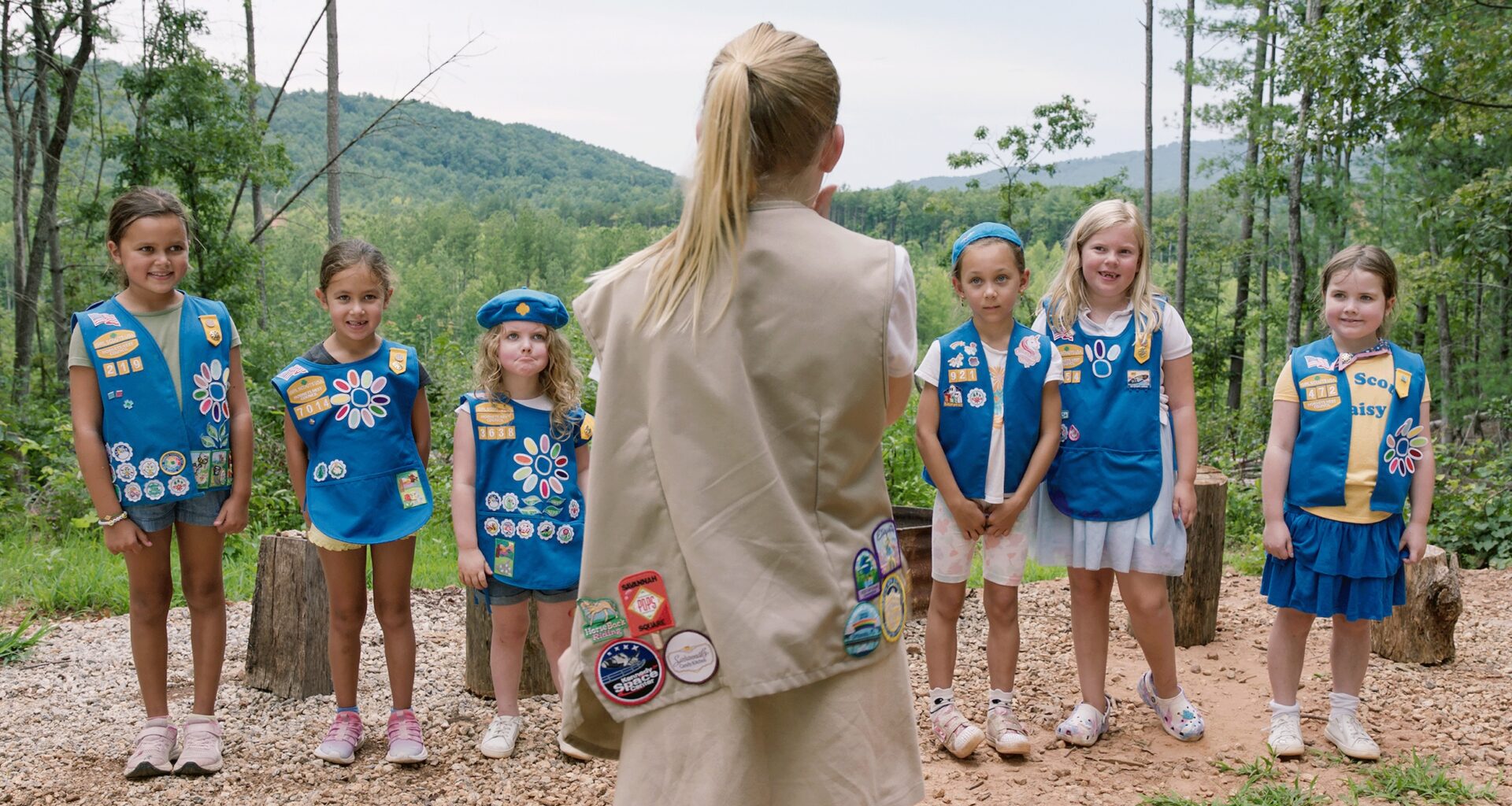
D: Could you talk a bit about the casting process? How did you find your protagonists—and why these four?
AN: Casting this film was loads of fun. I wanted to feature Girl Scouts of different ages and backgrounds who are super passionate about selling cookies, whose personal growth during cookie season would be just as important as their sales goals. My producers and I took a grassroots approach, working with nonfiction casting consultants Whitney Adams and Dan Bell to connect with as many Girl Scouts as possible through social media, schools, and troop leaders around the country. Whitney completed Zoom interviews with more than a hundred families, and then I interviewed several dozen of them.
Unpredictable elements are the best part of documentaries for me, so I looked for each Girl Scout’s distinctive visual world and singular motivation for selling cookies, as well as her potential to surprise me. I was particularly interested in girls whose imaginations were active, and who the camera could observe as they made tough choices and faced challenges.
There were a few instant fits during the casting process, and we began to shape the ensemble around them. For example, Ara, the youngest Girl Scout in the film, created a video of herself talking about cookies, which was incredibly natural, funny, and memorable. Once the casting was narrowed down, I visited several Girl Scout families for a few days so we could get to know each other without filming. I met with their troops, listened to their questions and ideas, and was very transparent about my creative process and the type of collaboration and care that’s important to me with the people in my films. Fortunately, we ended up with fabulous Girl Scouts to film with during cookie season.
D: I was surprised to learn that you consider this latest film to be a thematic continuation of your prior works, which are mainly centered on artists and architecture. How does Cookie Queens fit into your oeuvre?
AN: As a director with a background in art and architecture, I began telling stories rooted in these fields. My previous documentaries highlight remarkable artists and designers, focusing on universal themes such as self-invention, value, and the dynamic between individuals and institutions. I see Cookie Queens as a continuation of my exploration of those ideas, as our protagonists are naturally creative spirits who find themselves up against structural and institutional norms that they’re challenging, even resisting, in their own ways.
The Girl Scouts in this film have entrepreneurial minds, and they’re constantly performing when they create songs, slogans, dances, pitches, and videos to sell cookies. I was interested in the camera showing them “turning on and off” as performers. Family and educational structures like schools, sports teams, or scouting organizations are among the first institutional authority figures we encounter in our lives, and I wanted to make a film that takes girls’ voices seriously as they engage with those dynamics.
At the same time, Cookie Queens also marks an exciting stylistic evolution for me as a filmmaker. I don’t see my films as a collection of similar items, but as a living body of work. My prior films blended observational and archival footage. My decision to tell this story entirely in present tense—without any interviews—required me and my DP Antonio Cisneros to be especially patient, adaptable and attuned to the girls as we filmed; and then for me to work diligently with my editors Kim Roberts and Jeanne Applegate to shape scenes without external scaffolding, generating meaning in juxtapositions between the storylines. I’ve never wanted to define my work by subject matter, but rather by my willingness to take risks and discover singular ways of telling each story.