
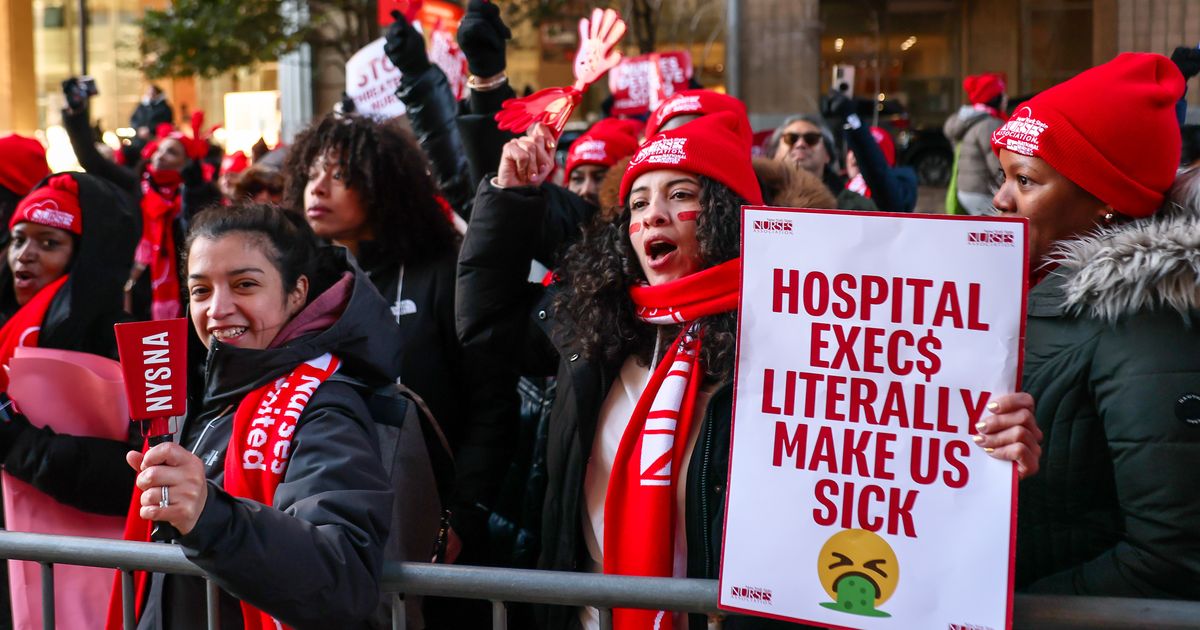
Photo: Michael M. Santiago/Getty Images
With the nurses strike now in its third week, New York City hospitals are limping along with an army of hired travel nurses, licensed RNs who take short contracts across the country for high pay in hospitals with high demand.
But even with elective surgeries postponed, staffers say that patient waiting times are increasing — and that the well-paid replacements are struggling to meet the demand. “It’s a very hard job to be a traveling nurse. But also, New York City, for a lot of people, is a very different beast,” says one social worker within the Mount Sinai system, one of the three hospital systems affected by the strike. “It’s clear when people don’t have experience in a city like New York.”
For example, the social worker says, “there are certain things that nurses in the intensive-care unit know that should be very normal for ICU nurses to know how to do. But I’ll go in to check on a patient, and there are five travel nurses at their bedside just trying to crack the code of how to do this thing.” Then there are the administrators milling about the floor, trying to be helpful but getting in the way. “At any given time, there are ten people in suits or white coats standing outside the nursing station being like, ‘Let us know how we can support,’” the social worker says. “These are people I’ve never seen before in the hospital.”
As contract negotiations between the New York State Nurses Association and the hospitals — NewYork-Presbyterian and Montefiore in addition to Mount Sinai — broke down last month, hospital executives knew their care would degrade if nurses left patients’ bedsides for the picket line without replacements. The striking nurses knew that too — and in many cases took steps to train the temporary reinforcements. “It was an uncomfortable situation, but at the end of the day, patient care is the most important and vital thing,” says Berina Selimovic, a labor-and-delivery nurse who worked the night shift at Mount Sinai Hospital’s main campus.
On one of the last nights before the strike, Selimovic was at the hospital preparing what is known as a maternity bucket: the basic kit for a new mom that includes diapers, a baby hat, and supplies for a blood draw. But a travel nurse who saw her collecting the supplies accused her of hoarding resources to “impede with patient care,” she says. Selimovic and two other nurses preparing maternity buckets were then fired over voice-mail for allegedly interfering with prestrike training. “It seemed very cruel, being that I dedicated so much time to this hospital, and it’s just deeply upsetting,” Selimovic says. She had been back from her own maternity leave for only about five months.
There is widespread frustration within the nurses union with the travel nurses, but it pales in comparison to the anger they feel toward the hospital executives they say are not meeting their demands. On the picket line outside Mount Sinai Morningside on Martin Luther King Jr. Day, several nurses’ signs highlighted the pay disparity between their unit and the CEOs of the three hospitals.
Under the expired contracts, nurses at the three hospitals were making, on average, around $160,000, not including pay bumps for factors like overtime and night shifts. (The Mount Sinai CEO made $5.4 million in total compensation in 2024, while the Montefiore CEO made $16 million in 2023. The NewYork-Presbyterian CEO made over $26 million in 2024 before announcing his resignation late last year.) Already in bargaining, the union has walked back a demand for annual 10 percent raises in the hopes that the hospitals will offer more than an annual $4,500 increase. The hospitals claim that the nurses’ overall demands would result in pay and benefits that total over $200,000 and have cited cuts to Medicare from President Donald Trump’s One Big Beautiful Act as a reason to keep costs low. NYSNA points to expenditures from the private hospitals — including the $100 million spent on travel nurses — as evidence of money to spend. The nurses at NewYork-Presbyterian are making an additional argument that there is extra money: the ongoing Justice Department investigation into whether the hospital negotiated with insurance companies to keep prices artificially high.
Aside from arguing for an increase in pay and concessions that would protect their current health benefits from cuts, nurses are pushing for two improvements they say will help patient care as well. The first is a staffing boost to fix a yearslong shortage of nurses that leaves them caring for too many patients per shift. “During COVID, we lost a lot of nurses because they aged out and then we lost a lot of new nurses who found that this was not the profession that they wanted or they didn’t want to be a bedside nurse,” says Simone Way, an RN at Mount Sinai West for over 30 years, who was on the picket line on MLK Day.
The second is more investment in security measures, including the installation of weapons-detection systems at all hospital entrances. This demand was made more pointed when, on the second day of the strike, police shot and killed a violent man at a NewYork-Presbyterian hospital. Nurses say lesser threats affect them every day. At the picket line outside Mount Sinai Morningside on Martin Luther King Jr. Day, a nurse held up a sign with pictures of lesions on her arms and legs. “I should not have enough bruises to make this poster,” the sign read.
The effort is tied for the largest-ever nurses strike in U.S. history, and it has attracted leading union-supporting politicians to the picket line, including Bernie Sanders, Zohran Mamdani, and Alexandria Ocasio-Cortez. It has also worried many New Yorkers who don’t know whether the hospitals are currently safe without the nurses (or whether going to the hospitals crosses the picket line).
All three hospitals insist it is safe to go to their striking facilities. A spokesperson for NYSNA says, “We do not have direct knowledge of specific incidents or overall conditions inside of the hospitals because we are outside on the picket line.” But the union made it clear that “going into the hospital to get the care you need is not crossing our strike line.” Montefiore has informed patients that all appointments are still on the schedule unless noted otherwise, and the CEO, Dr. Philip Ozuah, has been writing emails to staff highlighting the work he has been seeing while doing rounds, including heart transplants and double-lung transplants. A spokesperson for NewYork-Presbyterian says that “even during this time of seasonally elevated emergency-room visits, our operations are running smoothly,” while a Mount Sinai spokesperson says that all its hospitals and emergency departments will stay open and “most appointments will proceed as originally scheduled.”
In part, the relatively smooth operation of the hospitals is due to an intentional slowdown ahead of the strike in which doctors rescheduled elective surgeries and other nonessential appointments. “They drastically reduced the number of cases,” says one NYSNA nurse in a post-operation surgical unit who says there are about a third as many patients as normal. Some patients are still suffering from delays, including a woman who spoke with Gothamist about taking four weeks off work for a gastrointestinal surgery that was postponed without a date.
Some staff expect these inconveniences to mount as the strike continues. A social worker at Mount Sinai says there has been pressure to discharge patients as soon as safely possible to what are known as subacute-rehab nursing facilities: inpatient facilities outside the hospital where patients recover from surgery or illness. With so many patients going to subacute facilities, the social worker says that the beds in Manhattan are filling up, requiring people to be moved to rehab centers in the Bronx, making it more difficult for visits. “It’s a lot of removing patient and family choice,” the social worker says. “Some of these patients, the facilities that we send them to we know are going to be the last place they’ll ever be.”
As the strike enters its third week, some of the travel nurses seem to be feeling the pressure. “Any tips for caring for 12 to 14 patients at a time?” asked one user on a Facebook forum called “Strike Nurse” for travel nurses who take temporary jobs during strikes. Another, who said they work in a psychiatric ward, wrote that the agencies recruiting nurses should be paid even more: “We are literally about to be fighting for our lives!” The post was shared to a Reddit forum for nurses, where one person on strike said that it made them laugh. “These scabs had no idea,” they wrote. “Yes, 12 patients with no break on night shift is regular for us.” Because pay can be exorbitant for traveling nurses — as high as $9,000 per week to staff the hospitals on strike — the three private hospitals have already spent an estimated $100 million on travel nurses to cover the nurses who have walked out over their unmet demands.
Both sides are back at the bargaining table. There is no clear indication of how long the strike will last, though Governor Kathy Hochul’s emergency order allowing any licensed nurse in the U.S. to work in the affected hospitals extends until February 2. Inside Mount Sinai, the social worker says they are being told to prepare for a long disruption: “All of the unofficial messaging from the system is very much ‘The vibe is very much buckle down, because this is going to last.’”
Sign Up for the Intelligencer Newsletter
Daily news about the politics, business, and technology shaping our world.
Vox Media, LLC Terms and Privacy Notice