
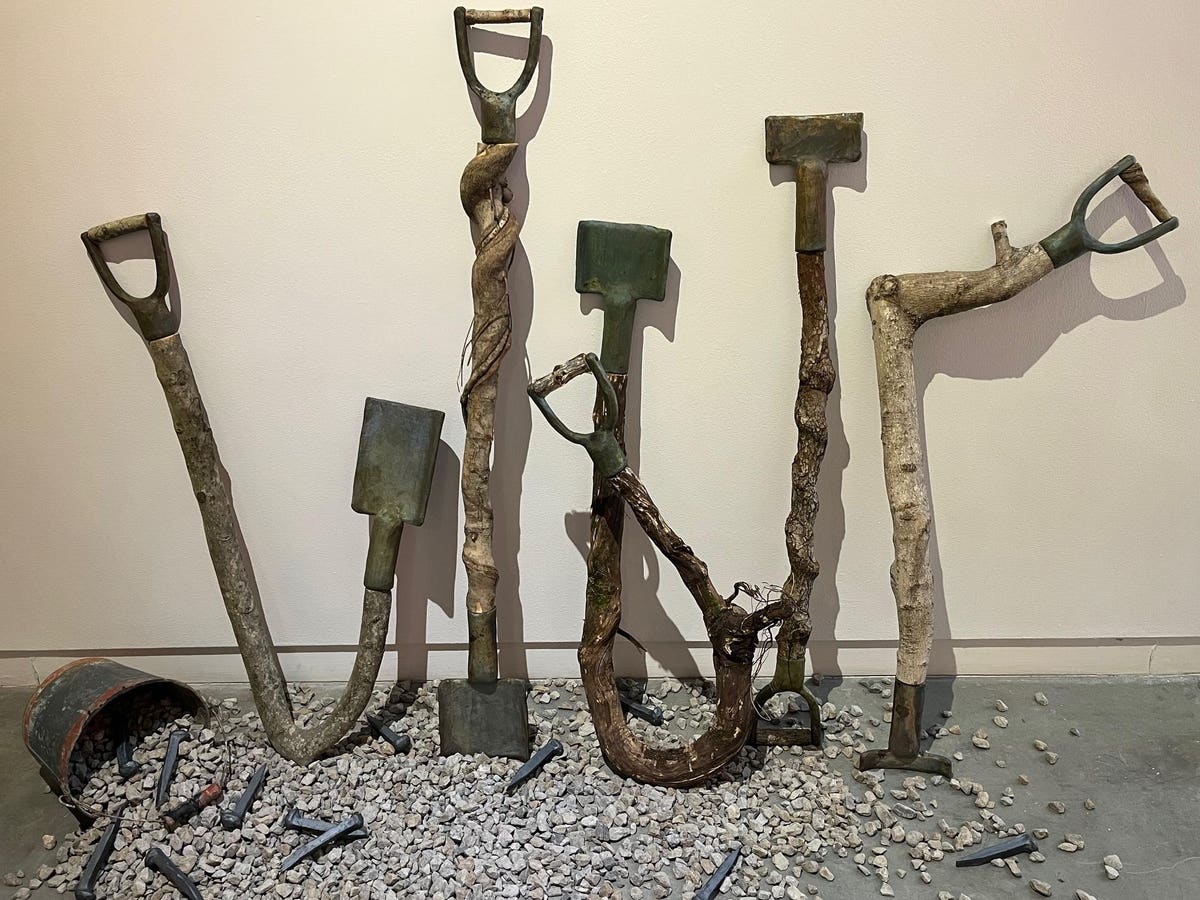
Katie Chin, ‘Short Pay, Short Shovels,’ 2026. Installation view at ‘Seventh AIM Biennial’ at The Bronx Museum of the Arts.
Chadd Scott
Bent and twisted shovels propped against a gallery wall rest on gravel strewn with railroad spikes.
Sabotage.
Look close.
At the shovel scoops.
Notice how short they are. How little work could be performed with a shovel manipulated in that fashion.
Subtle.
Clever.
Sabotage.
Ceramicist Katie Chin (b. 1990) came across an article from Brooklyn Institute for Social Research Professor R.H. Lossin recalling a story–maybe true, maybe not–of how early railroad workers would shorten their shovel scoops two inches when their pay was reduced.
“(The article) opened my mind to what sabotage could be as labor resistance,” Chin told me at the opening of the 2026 AIM Biennial at the Bronx Museum of the Arts. “Now I’m working on a comprehensive body of work all about sabotage throughout time, from early labor movements to modern day sabotage where digital workers will do quiet quitting.”
Chin’s installation can be seen in “The Seventh AIM Biennial: Forms of Connection,” an exhibition rising against division offering a powerful framework of connection. She represents one of 28 included artists all of whom completed the Bronx Museum’s AIM Fellowship in 2024 and 2025.
“I don’t believe in individual artistic genius,” Chin said. “There’s a collective, shared knowledge pool that you can pull information from, and it comes through in my work. Research and reading is really important to my practice.”
Collectivity is key to the Biennial and the Fellowship. The exhibition illuminates the essential yet often overlooked role of mutual support among artists in sustaining and amplifying their practices and underscores the Museum’s commitment to fostering creative communities.
Now in its 45th consecutive year, The Bronx Museum’s AIM program has benefited hundreds of New York City artists through professional development and community building. As a career accelerator fellowship coupled with a dedicated exhibition, AIM stands out for the depth and longevity of its investment in participants’ growth. Artists complete a nine-month curriculum designed to impart the knowledge and skills needed to succeed in the art world today.
Sabotage
Katie Chin, ‘Short Pay, Short Shovels’ (detail), 2026. Installation view at ‘Seventh AIM Biennial’ at The Bronx Museum of the Arts.
Chadd Scott
In researching her installation, Chin learned the word “sabotage” came from the French sabot, meaning “wooden shoe,” early in the 20th century.
“These workers threw their (wooden) clogs into the factory equipment, or so the story goes,” Chin explained. “It started as a labor tactic–the word itself–and now it’s been used for all sorts of other things.”
Like warfare. Perhaps history’s most famous example of sabotage.
Factory workers forced into labor by the Nazi’s sabotaging their production. That was obviously a labor effort as well. During World War II, America’s Office of Strategic Services, a precursor of the Central Intelligence Agency, distributed manuals encouraging and instructing would-be factory saboteurs on best practices.
“I’m interested in (sabotage) most as these subtle gestures that individual agents can (undertake) rather than really big spectacular spectacle. Usually, sabotage is a form of resistance that’s hard to track to the individual. It’s subtle,” Chin said. “How do I have agency in my own life, my own job, how can I push back?”
Now more difficult than ever considering the extraordinary surveillance dragnet existing across America–especially New York; see Bryan Fernandez’ Beso a La Cámara (2025) in the AIM Biennial.
Bryan Fernandez, ‘Beso a La Cámara,’ 2025. Installation view at ‘Seventh AIM Biennial’ at The Bronx Museum of the Arts.
Chadd Scott
Cameras on every street corner, smart phone, and doorbell. License plate readers at every intersection. Devices listening to and recording our conversations at home. In the office. Everywhere. Artificial intelligence able to piece that information together, millions of terabytes from around the world, in seconds. Law enforcement and private industry working together to strengthen the dragnet. To watch people. To track them.
Businesses tracking the computer keystrokes of their employees. Companies timing the work rate of employees to make sure they aren’t resting, let alone resisting.
Because an action is difficult doesn’t mean it isn’t worth pursuing.
“We live in a time where it’s hard to feel like you can do anything with the oppressive systems that we live in,” Chin said. “With all of the social media you see every day, everyone gets locked up and apathetic. I like this idea of sabotage, of finding agency again. How do we use it as a tactic to move into collective imagination and have it impact social systems.”
A question worthy of deep consideration.
“Small gestures that change large structures,” as Chin says.
“Forms of Connection” remains on view, free to visit, through June 29, 2026.
Björk Cafe & Bistro
Smörgåsbord Plate at Björk Cafe & Bistro inside Scandinavia House: The Nordic Center in America.
Björk Cafe & Bistro
Tastes unavailable in most of America are found on every corner in New York City. Björk Cafe & Bistro specializes in beloved Scandinavian classics alongside American favorites with a Nordic twist.
Raggmunks våffla, Swedish dairy-free waffles made from potatoes, with a topping of gravlax, seaweed roe, or bacon, and lingonberry jam. Björk’s Smörgåsbord Plate includes gravlax, mustard sauce, pickled herring, herb herring, red beet salad, meatballs, lingonberries, pickled cucumber, and boiled potatoes. Icelandic cod. Arctic Char. Braised short ribs.
The drinks menu is equally tantalizing.
Beers from Iceland. Chilled or warm glögg–a Scandinavian sangria. Cocktails combining elderflower and cucumber slices. Aquavit, a clear liquor infused with botanical combinations like caraway, dill, and fennel. Sing after taking a shot with herring.
Expect a crowd and make reservations if you’re able.
This slice of the European north on Park Avenue in Midtown can be found at Scandinavia House: The Nordic Center in America. The organization presents art exhibitions and an almost daily schedule of events from music performances to films, artmaking, and talks centered on the cultures of Denmark, Finland, Iceland, Norway, and Sweden, and increasingly expanding to include Greenland and Estonia.
Moxy East Village
Little Sister Bar at Moxy East Village.
Moxy East Village
The East Village is a common response when asking New Yorkers to name their favorite among the city’s neighborhoods. Union Square Park. Thompkins Square Park. NYU. The Strand. Unregular Pizza. Vintage retail.
Opened in 2019 as a new build, the property leans into the neighborhood’s roots, hoping to be worthy of its location.
The lobby Alphabet Bar references Alphabet City, a local neighborhood within a neighborhood. The public hang-out space frequented by travelers and NYU students–the hotel is bracketed by dorms–features regular social events, live DJs, and a terrace space for when the weather cooperates. Gen Xers were the target audience for interior decorators with a Debbie Harry amusement park claw game and VHS and cassette tapes replacing books in a library.
Moxy East Village’s subterranean Little Sister lounge takes inspiration from the East Village of the 1920s. Think speakeasy. In the nomenclature of night life, it’s one of the “toughest doors” in the city (hard to get into). The public is welcome, but it’s cozy, and there’s almost always a wait, so book a reservation ahead of time. No cover charge.
Cathédrale Bar recreates the old Fillmore East concert venue that operated just down the street from 1968 to 1971, welcoming the biggest musical acts of the era. Oysters are only $2 during happy hour. Another happy hour deal can be found on the rooftop The Ready Cantina with $1 tacos.
Who says New York has to be expensive to be enjoyed?
More From ForbesForbesMuseum Of Modern Art Continues Long Relationship With Wifredo LamBy Chadd ScottForbesContemporary Native American Artwork On View Across New York This WinterBy Chadd Scott