
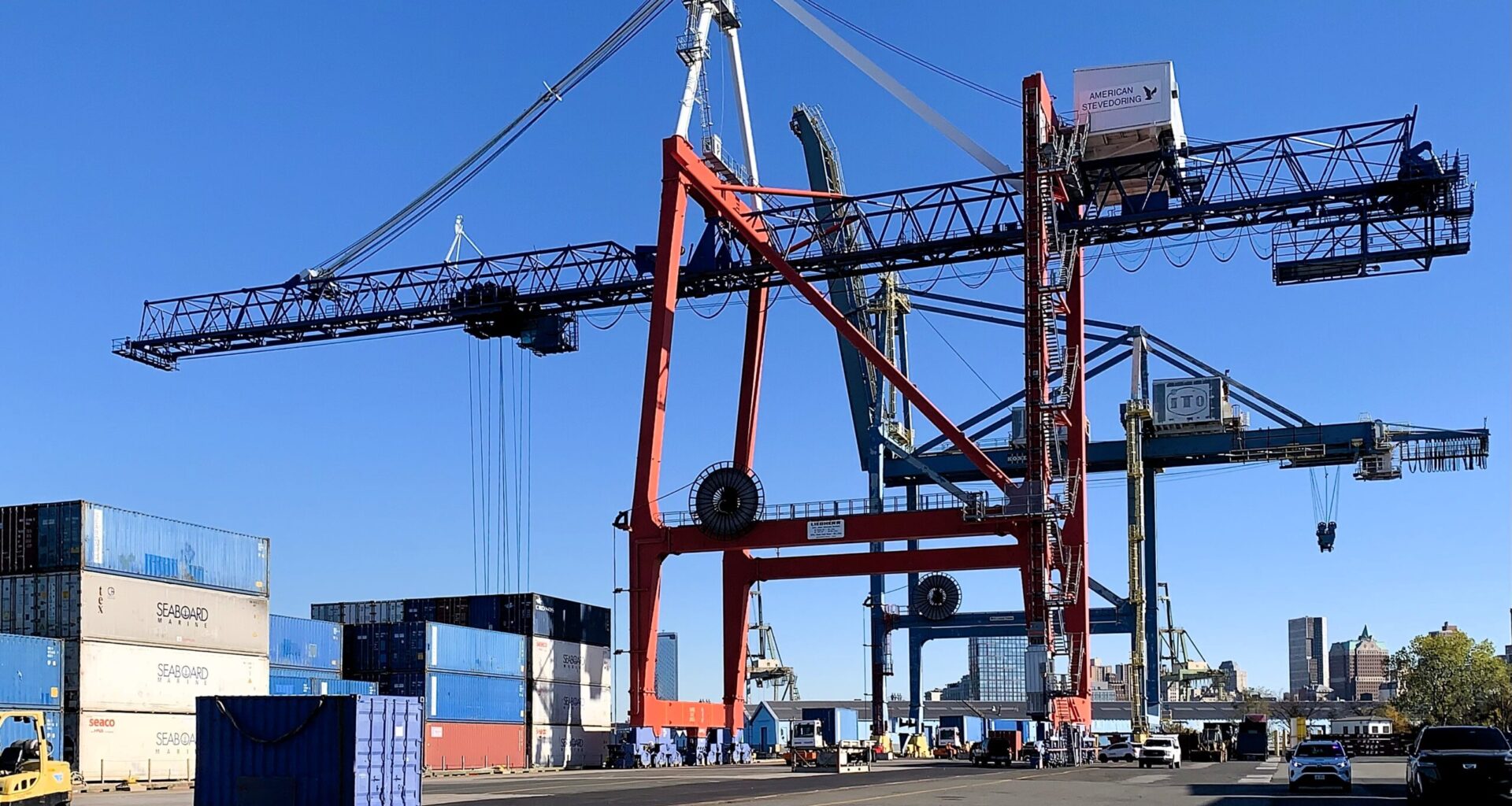
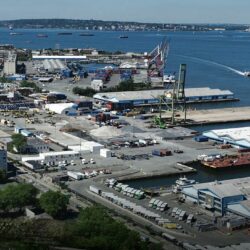
Cargo-handling cranes at the Container Terminal within the Brooklyn Marine Terminal site. Photo: Mary Frost, Brooklyn Eagle
COLUMBIA STREET WATERFRONT DISTRICT — The City Club of New York trustee Tom Fox introduced on Tuesday a new “all-maritime” proposal to redevelop the 122-acre Brooklyn Marine Terminal situated on an industrial waterfront site stretching from Atlantic Avenue to Red Hook on the East River.
Fox, co-founder of New York Water Taxi, the precursor to NYC Ferry Service, has numerous civic credits to his name, including spearheading the creation of the Brooklyn-Queens Greenway and co-founding the original Brooklyn Bridge Park Coalition.
More than 75 people attended the online presentation and conversation sponsored by Resilient Red Hook and The City Club of New York. The meeting was chaired by Victoria Alexander, chair of Resilient Red Hook.
Coming in at roughly $1 billion in public investment, the all-maritime plan would create a modern, resilient Blue Highway Hub with no housing, at one third the price of the controversial $3.5 billion BMT Vision Plan approved in September by the New York City Economic Development Corporation under former Mayor Eric Adams.
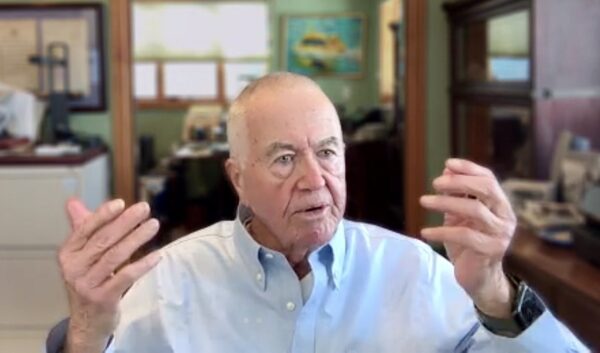 The City Club of New York trustee Tom Fox presents a new, all-maritime Brooklyn Marine Terminal proposal on Tuesday, Jan. 27, 2026. Photo: Screen grab from presentation
The EDC plan supported by Adams would convert about half of the current industrial acreage to 6,000 new units of housing, 60% of it luxury, bringing 15,000-18,000 new residents to an area prone to flooding and lacking transportation and sewage and electric infrastructure.
The all-maritime proposal, conversely, focuses on using the existing maritime infrastructure to support freight movement as a Blue Highway Hub, shifting freight from trucks to vessels that move food, packages and building materials by water instead of trucks.
The plan maintains that one of the city’s last publicly owned industrial ports, with its strategic location in the harbor, should be preserved as essential marine infrastructure and restored as a “fully functioning, all electric, climate-ready working port,” Fox said.
He told the crowd that the organization hopes the plan will serve “as a catalyst for a viable port of the future, to expand the Blue Highway initiative that’s just begun, although it’s been discussed for about 20 years. And our approach is quicker, cheaper and more easy to implement than the plan that’s been put forward by EDC.”
“It’s a critical piece of maritime infrastructure, strategically located,” he added. “This is the hub of the harbor.”
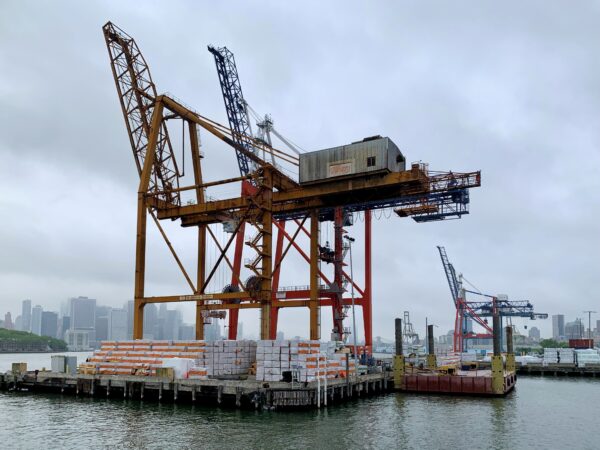 Cranes at Atlantic Basin within the Brooklyn Marine Terminal site. Photo: Mary Frost, Brooklyn Eagle
Bring in a marina supply store and build a dry-stack marine
Fox ran through the maritime advantages the site possesses, such as 1,400 linear feet of wharfage on the south face, which he said is “hard to find in New York City.” He suggested building a marine supply store, “which you can’t find in the city anymore,” and an inexpensive dry-stack marina “so that boats could be taken out of the water and put on racks, which is done all over the world, except for here in New York. It gets them out of the water, they don’t pollute the water, you don’t get a ‘beard’ on the bottom of your boat, and it’s inside in the winter.”
He added, “You can literally call a food and beverage place and say, ‘I’d like my boat refueled. I want my favorite sandwiches, and soda and hot chocolates for the kids, and I’ll pick up the boat at noon.” That facility could be a buffer between the commercial maritime to the south and recreational maritime to the north, he said.
Fox shared numerous design ideas retaining the current “finger piers.” He suggested Pier 10 remain the major input for containers, and the right-hand side piers 9A, 9B, and 8 “become distribution, over time,” though Pier 9A is in too bad shape to repair currently. “We don’t have the money now to begin to make major capital investments, so we have to make investments with the money we have judiciously, and then grow over time.” Depending on future water-levels, Pier 9A might eventually be replaced with a floating pier, for example.
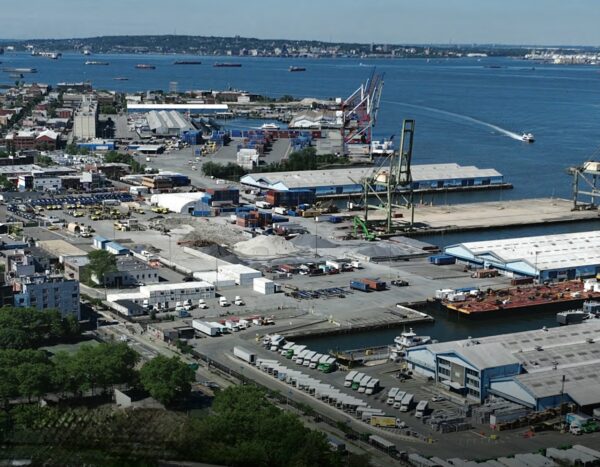 The 122-acre Brooklyn Marine Terminal. Photo: NYCEDC
Pier 8, in good shape, can be redeveloped as a distribution facility for the small “roll-on, roll-off” vessels that have begun to come into New York Harbor, he said, “anticipating the Blue Highway that both EDC and [the Department of Transportation] have been championing the last two years.”
Since the neighborhood suffers from frequent brownouts and the passenger-ship terminal is electrified, the site needs to have its own independent power, Fox said. “We suggest building a micro-grid for this entire facility, and having a tri-generation facility with wind, solar on the top of all of these buildings, and high-efficiency natural gas generators to create the energy needed to run this site, and to run it in an emergency.”
He also suggested a cold storage facility at the site. “The majority of the produce that comes in right now at Pier 10 is from South America. The EDC plan says that we should barge it up to the Bronx, put it in cold storage in the Bronx, and then distribute it from the Bronx to the city. We think that’s a waste of time and money, and that we should build a cold-storage facility here. … This actually gives us greater food security.”
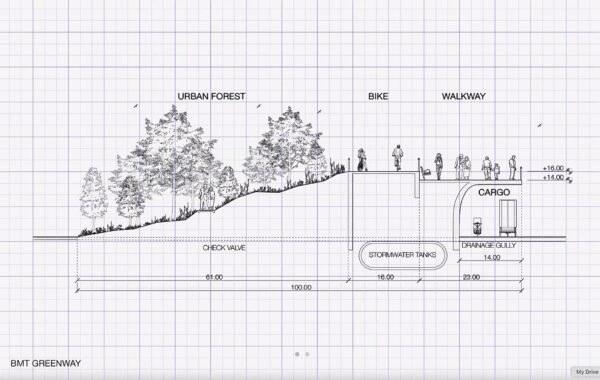 A Greenway plays a crucial role in the resiliency of the all-maritime Brooklyn Marine Terminal plan. Graphic: Chris Hauser
It’s a working port, not surplus land
Resilient Red Hook sees the plan as treating the Brooklyn Marine Terminal “as working port infrastructure, not surplus land,” Alexander said.
“For over a year now, the community, along with the Brooklyn Marine Terminal Task Force, has consistently asked the NYC Economic Development Corporation throughout this process to present alternative plans for the future of the Brooklyn Marine Terminal, specifically an all-maritime plan that preserves and revitalizes the critical industrial asset and public infrastructure that the city needs,” Alexander said.
“Despite repeated requests, the EDC has only put forward a housing-heavy redevelopment vision, and given the task force an ultimatum between a do-nothing plan and a housing plan. No alternative options, and certainly no maritime forward strategy were ever presented to us,” she said.
The numerous participants included local Councilmember Alexa Aviles, Jim Tampakis, owner of Marine Spares international; Columbia Street Waterfront District’s John Leyva; and PortSide NewYork’s Caralina Salguero, among others.
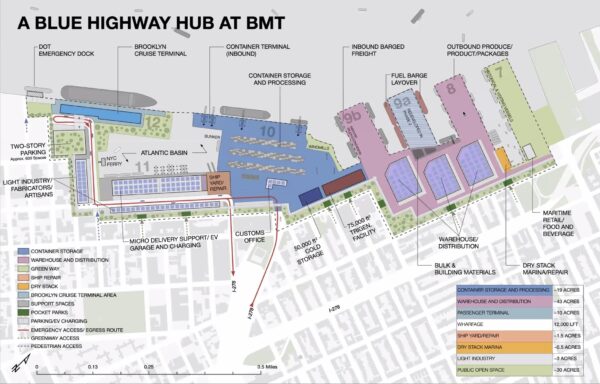 Elements of the all-maritime Brooklyn Marine Terminal plan. Graphic: Chris Hauser
Key elements of the all-maritime plan include:
Modernization of the port to support a citywide Blue Highway system
Cost conscious redevelopment of BMT largely “as is,” requiring approximately $1 billion in public investment
Avoiding landfill or platforming in the Buttermilk Channel and creating opportunities for private maritime, engineering and logistics investment
Preservation of Red Hook’s industrial identity without large-scale residential upzoning in a high-risk area
Nearly 30 acres of public open space, including waterfront parks on Pier 7 and Pier 12
Expanded green infrastructure and emergency preparedness systems designed for continuous operation
More than two miles of active wharfage supporting regional freight movement and emergency operations
Maritime, engineering, and technical job pathways, including port and vessel operations and maintenance, electrical and mechanical systems, logistics and transport, and management, supported by training and apprenticeships

Deadline for Brooklyn Marine Terminal environmental testimony extended to March 31
December 1 |
Mary Frost
Brooklyn residents prep for Brooklyn Marine Terminal environmental scoping hearing
November 21 |
Mary Frost
Video sheds harsh light on Brooklyn Marine Terminal redevelopment process
October 16 |
Mary Frost